Updated 2026/11/02 · Edited by Huanghe Cable Technical Team · Reading time: 10–13 minutes
YSLCY cable is a European VDE-standard flexible PVC control cable (often cross-listed as CY), manufactured in accordance with VDE 0245 / VDE 0281-13 / EN 50525-2-51), defined by a Class 5 fine-stranded copper conductor, 300/500 V rated voltage, and a tinned copper wire braid screen. Y stands for PVC insulation, SL for control cable, C for copper braid screen, and the final Y for the PVC outer sheath. The designation matters commercially because it fixes three things that are routinely swapped in a quotation: the conductor must be Class 5 flexible copper, the rated voltage is 300/500 V, and the screen must be braided copper rather than steel.
Most sourcing problems with YSLCY do not start with price. They start with a supplier quoting a cable that looks similar in a photo, costs less per metre, and arrives as SY—a galvanised steel braid construction that offers mechanical protection but no useful electromagnetic screening. This guide sets out the construction layer by layer, the model suffixes that change what you receive, the numbers to put in an RFQ, and the four points to check before you release a purchase order.
Key Takeaways
Contents
YSLCY is a European-style designation for a flexible, PVC-insulated and PVC-sheathed control cable with a tinned copper wire braid screen over the assembled cores. It is used to connect measurement, control and monitoring circuits inside industrial machinery, production lines, control panels, heating and refrigeration equipment and office equipment, where the surrounding electrical environment calls for screening.
The letters are not arbitrary. Each one removes a degree of freedom from the specification, which is exactly why the designation is useful in a purchase order and why a partial match is a risk.
| Letter | Meaning | What It Fixes in Your Order |
|---|---|---|
| Y | PVC insulation | Insulation compound and temperature class. Not XLPE, not PE. |
| SL | Control cable (Steuerleitung) | The product family. It is not a power cable and not a drive cable. |
| C | Copper braid screen | Screen material and form. Copper braid, not steel braid, not foil alone. |
| Y (final) | PVC outer sheath | Sheath compound and colour. Grey RAL 7001 is the common default. |
| Implied | Class 5 flexible conductor, 300/500 V | The two items most often quietly downgraded in a cheaper quotation. |
Once the letters are read, the construction is fully determined. A genuine YSLCY has six layers, and every one of them is a place where a supplier can save cost without changing the model name on the invoice.
| Layer | Material | Reference | What to Verify |
|---|---|---|---|
| 1. Conductor | Class 5 fine-stranded bare copper | IEC 60228 / EN 60228 / VDE 0295 | Strand count and class. Class 2 stranded is not Class 5. |
| 2. Insulation | PVC compound | EN 50363-3 / VDE 0207-363-3 | Nominal thickness: 0.4 mm up to 1.5 mm², 0.5 mm at 2.5 mm². |
| 3. Laying-up | Cores twisted in layers | Manufacturer specification | Lay length and core numbering clarity. |
| 4. Separator | Polyester tape or plastic foil | Manufacturer specification | Presence of the tape. It keeps the screen off the insulation and reduces overall diameter. |
| 5. Screen | Tinned copper wire braid | Manufacturer specification | Coverage percentage and braid wire diameter. Tinned copper, not galvanised steel. |
| 6. Sheath | PVC compound | EN 50363-4-1 / VDE 0207-363-4-1 | Thickness 0.8–1.4 mm depending on core count, and colour. |
This is the section to read before you compare two quotations, because five designations that look alike in a product photo are sold at five different price levels and do five different jobs.
| Designation | Screen | Insulation | Rated Voltage | What It Is Actually For |
|---|---|---|---|---|
| YSLCY | Tinned copper braid | PVC | 300/500 V | EMC-screened control and instrumentation circuits. |
| CY | Tinned copper braid | PVC | 300/500 V | The same cable under its market name. Eland, for example, lists its CY product as “CY PVC (YSLCY)”. |
| SY | Galvanised steel braid | PVC | 300/500 V | Mechanical protection. Galvanised steel braid does NOT provide EMC shielding; unsuitable as a direct functional substitute for YSLCY in electronic control circuits. |
| YSLY | None | PVC | 300/500 V | Unscreened flexible control cable. YSLCY is YSLY plus the C. |
| 2YSLCY-J | Aluminium foil + tinned copper braid (double) | PE | 0.6/1 kV | VFD-to-motor connections. A different product, not an upgraded YSLCY. |
| KVVP | Copper braid | PVC | 450/750 V or 0.6/1 kV | Chinese designation. Usually Class 1 or Class 2 conductor, so not equivalent for flexing duty. |
The most expensive mistake in this product family
A galvanised steel braid and a tinned copper braid look almost identical in a sample photo and feel similar in the hand. Both are described as “braided screened control cable” by suppliers. But steel braid is there to resist mechanical damage; it does not provide the low-resistance, continuous conductive path that an EMC screen depends on. If a quotation for YSLCY comes in noticeably below the others, ask for the braid material in writing before you ask for anything else.
The four-letter core of the designation does not tell you how the cores are identified or whether a protective conductor is included. That is carried by the suffix, and it is the second most common source of a wrong delivery after the screen material.
| Suffix | Core Identification | Green/Yellow Conductor | Typical Use |
|---|---|---|---|
| YSLCY-JZ | Black cores, white numbers | Yes | The most commonly ordered version in European projects. |
| YSLCY-OZ | Black cores, white numbers | No | Where all conductors are used for signals and no earth core is needed. |
| YSLCY-JB | Coloured cores | Yes | Small core counts where colour identification is preferred over numbering. |
| YSLCY-OB | Coloured cores | No | Same as -JB without the earth core. |
J comes from the German convention for a cable with a protective conductor; O means without. This is worth stating explicitly in the RFQ, because “7 × 1.5 mm² YSLCY” alone does not settle whether the seventh core is a green/yellow earth conductor or a numbered signal conductor — and the difference shows up at the terminal block, not on the packing list.
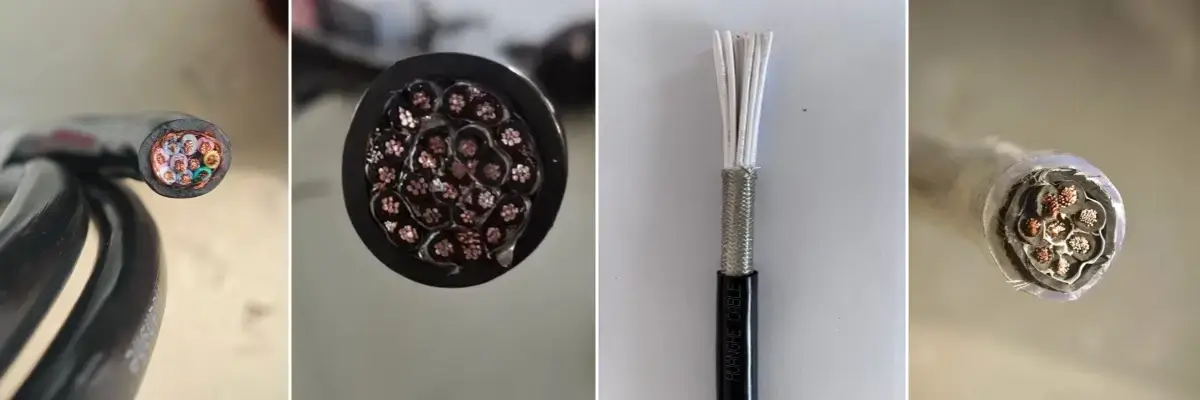
Overall diameter and copper weight per kilometre are the two figures that let a buyer check a quotation without waiting for a sample. Diameter governs drum capacity, gland size and panel space; copper weight governs both the price and the shipping weight.
| Cores × mm² | Approx. Overall Diameter (mm) | Copper Weight (kg/km) | Cable Weight (kg/km) | Max. DCR at 20 °C (Ω/km) |
|---|---|---|---|---|
| 6 × 0.5 | 7.7 | 44.0 | 63 | 39.0 |
| 4 × 2.5 | 10.1 | 106.8 | 114 | 7.98 |
| 6 × 1 | 9.0 | 73.3 | 91 | 19.5 |
| 7 × 1.5 | 9.9 | 110.5 | 123 | 13.3 |
| 12 × 1 | 11.6 | 130.7 | 140 | 19.5 |
| 36 × 1 | 19.0 | 373.4 | 387 | 19.5 |
| 60 × 1 | 23.8 | 592.1 | 586 | 19.5 |
These are representative values published in European YSLCY datasheets and are given here as a reference for checking quotations, not as a guaranteed table for any particular order. Manufacturing tolerances move overall diameter by a few tenths of a millimetre, and copper weight varies with braid coverage. Ask your supplier for the figures for the exact construction you are buying.
Note the last two rows. A 60-core cable weighs roughly nine times a 6-core cable of the same conductor size, while its copper content is about eight times higher. On a container load of control cable, the difference between 586 kg/km and a quoted figure that looks too good is usually either a thinner braid or a smaller nominal section than the drawing says.
Current ratings for control cable are quoted for a stated set of conditions and are not interchangeable between datasheets. The figures below are continuous-load values at 30 °C ambient, single cable in free air — the most common basis in European YSLCY catalogues.
| Cross-Section (mm²) | Current at 30 °C (A) | Max. DCR at 20 °C (Ω/km) |
|---|---|---|
| 0.5 | 9 | 39.0 |
| 0.75 | 12 | 26.0 |
| 1.0 | 15 | 19.5 |
| 1.5 | 18 | 13.3 |
| 2.5 | 26 | 7.98 |
| 4 | 34 | 4.95 |
| 6 | 44 | 3.30 |
| 10 | 61 | 1.91 |
| 16 | 82 | 1.21 |
| 25 | 108 | 0.780 |
| 35 | 135 | 0.554 |
Two things matter more than the table itself. First, ambient temperature: a rating quoted at 30 °C does not apply inside a closed cabinet that sits at 50 °C. Second, grouping: values quoted for a single cable in free air drop when cables are bunched in a duct or laid side by side in a tray. If your installation is a panel interior or a dense tray, tell the supplier and ask for the derating basis rather than taking the catalogue figure at face value.
The resistance column is the one to use for voltage-drop checks on long signal runs. At 1.5 mm², 13.3 Ω/km means a 200 m run adds roughly 2.7 Ω of loop resistance — enough to matter for a 4–20 mA loop or a 24 V relay circuit with a long cable route.
| Parameter | Typical YSLCY Value | Where It Comes From |
|---|---|---|
| Rated voltage | 300/500 V (U0/U) | IEC 60227 / EN 50525-2-51 |
| Test voltage | 4,000 V AC (Core-to-Core & Core-to-Screen; some specific lighter-duty constructions test at 2,000 V to 3,000 V — verify on datasheet) | Product specification |
| Conductor class | Class 5 flexible | IEC 60228 / EN 60228 |
| Insulation thickness | Nominal 0.6 mm (for 0.5–1.0 mm²); 0.8 mm (for 1.5–2.5 mm²) per EN 50363-3 | EN 50363-3 compound |
| Sheath thickness | 0.8–1.4 mm, increasing with core count | EN 50363-4-1 compound |
| Temperature, fixed | −40 °C to +80 °C | Varies by compound — confirm |
| Temperature, flexed | −5 °C to +70 °C | Varies by compound — confirm |
| Min. bending radius, fixed | Not less than 4D to 6D |
Huanghe’s product page states a minimum bending radius of not less than 6D for fixed installation, while dynamic (flexed) applications typically require 15D to 20D depending on operating conditions. |
| Min. bending radius, flexed | 15D to 20D (depending on exact construction) | |
| Flame retardance | IEC 60332-1-2 / EN 60332-1-2 | Vertical single-wire flame test |
Bending radius is where buyers most often get caught. A 60-core YSLCY at 23.8 mm diameter needs at least 143 mm of clear bending space for fixed installation (approx. 6D), and significantly more for dynamic or flexed applications (typically 15D to 20D). Always verify that the designated routing space accommodates the larger radius if the cable is subject to repetitive movement.
Most YSLCY datasheets state a nominal braid coverage of around 80%. That number is a description of the braid, not a measurement of screening effectiveness, and the two should not be treated as the same thing.
A practical check you can do on arrival
Take a 300 mm sample, strip the sheath, and count the braid wires around the circumference. Measure one wire with a micrometer. Multiply the count by the cross-sectional area of one wire to get the approximate copper cross-section of the screen, and compare it with the figure in the datasheet. This takes five minutes and catches the substitution that visual inspection misses. A screen that has been changed from tinned copper to galvanised steel will also show a different colour and a different solderability when you touch it with a soldering iron.
Sometimes yes, often no, and the answer depends on a narrower set of items than a model-code comparison suggests. When a European project specification calls for YSLCY and a Chinese supplier offers KVVRP as “the same thing”, the conductor and screen arguments no longer separate the two products. What remains is the voltage rating and the governing standard.
| Requirement | YSLCY | KVVRP (typical) | Verdict |
|---|---|---|---|
| Conductor class | Class 5 flexible, IEC 60228 | Class 5 flexible, GB/T 3956 (equivalent to IEC 60228) | Aligned. Both use fine-stranded Class 5 copper. |
| Screen material | Tinned copper braid | Copper braid; can be specified as tinned copper | Directionally aligned. Confirm the braid material is tinned copper, not bare copper, if the application requires corrosion resistance. |
| Rated voltage | 300/500 V | 450/750 V to GB/T 9330 (0.6/1 kV variants may be available from some manufacturers — confirm) | The key difference. The higher voltage rating (450/750 V) requires thicker PVC insulation and sheath layers per national standards, resulting in a noticeably larger outer diameter that directly impacts cable gland sizing and panel entry space. |
| Governing standard | EN 50525-2-51 / IEC 60227 | GB/T 9330 | Different test regimes. A project specifying the EN standard may not accept GB/T certification alone. |
| Core identification | Numbered or coloured per suffix | Numbered, or coloured depending on manufacturer | Acceptable if the numbering scheme matches the wiring diagram. |
The practical conclusion changes when the comparison is made against KVVRP rather than KVVP. KVVRP uses a Class 5 soft conductor to GB/T 3956 (equivalent to IEC 60228) and can be supplied with a tinned copper braid screen, so the conductor and screen arguments no longer separate the two products. What remains is the voltage rating: KVVRP is 450/750 V against YSLCY’s 300/500 V. The higher rating typically means thicker insulation and a larger overall diameter, which affects gland size, panel space and minimum bending radius. A KVVRP with a confirmed tinned copper screen can serve a fixed or lightly flexed control circuit electrically, but it is not a drop-in replacement where the route and termination were sized for 300/500 V. Confirm the outer diameter against the installation drawing before substitution.
Control cable is priced on copper content plus conversion cost. Any quotation that cannot be broken down into those two parts is hard to compare with another quotation, and that is the single biggest reason buyers end up choosing the wrong offer.
| Cost Driver | Effect on Price | What to Ask For |
|---|---|---|
| Copper content | The largest single item. A 60 × 1 mm² construction carries about 592 kg of copper per kilometre. | Copper weight in kg/km, and the copper base price used. |
| Core count | Raises copper content, overall diameter, sheath weight and lay-up time together. | Whether the earth core is counted in the core number. |
| Cross-section | Scales copper content directly, and insulation and sheath thickness in steps. | Nominal section and conductor class. |
| Braid coverage | Moving from 70% to 85% adds copper and braiding machine time. | Coverage percentage and braid wire diameter. |
| Sheath compound | Standard PVC is the base case. Oil-resistant, UV-stable or LSZH compounds carry a premium. | The compound designation, not just “PVC”. |
| Drum length | 500 m and 1,000 m drums differ in drum cost, freight weight and handling. | Length per drum and maximum drum diameter acceptable on site. |
| Order quantity | Small runs carry set-up cost per construction. | Total metres per construction, and whether constructions can be combined. |
| Testing and documentation | Routine factory tests are normally included; third-party inspection and full FAT documentation are not. | Which test reports and inspection records are required, and by whom. |
Because copper dominates, a quotation is only stable for as long as the copper price assumption holds. Ask each supplier to state the copper base price and the validity period of the offer. Two quotations that differ by a few percent almost always reflect differences in copper content rather than profit margin.
These four items decide whether a technically correct quotation is actually deliverable on your schedule. They are also the four items most often left out of a first RFQ, which is why quotations come back non-comparable.
| Item | Common Practice | What to Confirm in Writing |
|---|---|---|
| Minimum order | Set per construction, often expressed as a minimum total length or minimum copper weight. | Whether the minimum applies per size or per order. |
| Drum length | 500 m and 1,000 m are the usual options for YSLCY. | Length per drum, tolerance on length, and the drum type. |
| Packing | Wooden drum, steel-wooden drum or coil, depending on size and destination. | Fumigation or heat-treated timber where the destination requires it. |
| Lead time | Depends on core count, braid coverage and whether the construction is standard. | Lead time from order confirmation, and from receipt of the down payment. |
| Shipping terms | FOB, CIF or CFR to the destination port. | The named port, and who arranges insurance. |
| Documents | Packing list, invoice, certificate of origin, test report. | Whether third-party inspection is required, and which reports must travel with the shipment. |
A factory audit for control cable does not need to be long. It needs to hit the eight points where a cost reduction can hide without changing the label on the drum.
| # | Check | Pass Condition |
|---|---|---|
| 1 | Conductor class | Class 5 fine-stranded, strand count matching IEC 60228 for the nominal section. |
| 2 | Braid material | Tinned copper, confirmed by colour, solderability and a written material declaration. |
| 3 | Braid coverage | Measured on a stripped sample and consistent with the declared figure. |
| 4 | Insulation and sheath thickness | Measured values meet or exceed the nominal values in the standard. |
| 5 | Separator tape | Present between insulation and screen, keeping the braid off the insulation. |
| 6 | In-line spark test | 100% in-line spark testing on the insulation, with records available. |
| 7 | Routine electrical tests | Conductor resistance, insulation resistance and 2,000 V AC voltage test per drum. |
| 8 | Traceability | Batch number on the drum traceable to test records and the material batch. |
Is your current YSLCY quotation missing one of these points?
If you have a supplier quotation or datasheet in hand, send it to our technical team. We will check the conductor class, braid material, voltage rating and standard scope against your original specification, and reply with a written clause-by-clause comparison — no obligation to order.
Send these sixteen items and you will get comparable quotations instead of four different interpretations of the same sentence.
| # | Item | What to Write |
|---|---|---|
| 1 | Model | YSLCY-JZ, YSLCY-OZ, YSLCY-JB or YSLCY-OB — include the suffix. |
| 2 | Cores and section | For example 12 × 1.0 mm², and whether the earth core is counted. |
| 3 | Conductor class | Class 5 to IEC 60228, stated explicitly. |
| 4 | Rated voltage | 300/500 V, or the project rating if different. |
| 5 | Screen | Tinned copper braid, with required coverage percentage. |
| 6 | Insulation and sheath | PVC compound designations, or any special requirement such as oil or UV resistance. |
| 7 | Sheath colour | Grey RAL 7001 or another specified colour. |
| 8 | Core identification | Numbered or coloured, matching the wiring diagram. |
| 9 | Standard | EN 50525-2-51, IEC 60227, or the project specification. |
| 10 | Installation | Fixed or flexed, ambient temperature, and whether the route is in a panel or a tray. |
| 11 | Quantity | Total metres per construction, and number of constructions. |
| 12 | Drum length | Preferred length per drum and any site handling limit. |
| 13 | Destination | Country, delivery site or destination port. |
| 14 | Incoterm | FOB, CIF or CFR, with the named port. |
| 15 | Documents | Test reports, inspection records, certificate of origin, third-party inspection. |
| 16 | Copper basis | The copper price used in the offer and how long the quotation is valid. |

Huanghe Cable has manufactured industrial power and control cables since 1980. For YSLCY-type constructions, the review before quotation covers the conductor class, the screen material and coverage, the core identification scheme, the sheath compound and the governing standard — because those are the five items that decide whether the delivered cable matches the specification.
| Item | Reported Detail |
|---|---|
| Manufacturing history | Cable manufacturing since 1980 |
| Production capacity | 60+ production lines, annual capacity approximately ¥3.5 billion RMB |
| R&D and testing | 30+ engineers, 45 sets of testing equipment |
| Control cable range | 0.5–10 mm², 2–61 cores, subject to the selected construction |
| Standards and certification | Can manufacture to applicable IEC, BS/EN and GB/T requirements; holds IEC and CB test certificates |
One point to be clear about. The stated control cable range is 0.5–10 mm² and 2–61 cores. Core counts up to 100 and sections up to 35 mm² appear in some European YSLCY catalogues, and those fall outside the stated range here. If your schedule needs them, say so at the RFQ stage so the construction can be reviewed and confirmed — or declined — before you build a project timeline around it.
Certificate scope works the same way. Holding an IEC or CB certificate does not mean every construction is covered. Check the applicable standard and certificate scope against the specific product, conductor class, and construction you are ordering.
Our international project experience includes supplying infrastructure and industrial sites. At the Erdenet Copper Mine in Mongolia, Huanghe supplied cables for a site where ambient temperatures and mechanical duty were more demanding than a standard European installation — the same conditions that make conductor class, screen material and sheath compound the first three items to check on a control cable order. Other references include the Botswana Power Project, the Bangladesh Power Development Board, mining projects in Vietnam, and solar installations in Madagascar.
These references illustrate general company experience and do not imply that every site used YSLCY-type control cable.
Send Your YSLCY SpecificationChat on WhatsApp
Yes. They describe the same construction: flexible Class 5 copper conductors, PVC insulation, tinned copper braid screen, PVC sheath, rated 300/500 V. CY is the market name and YSLCY is the fuller designation. European catalogues often print both on the same datasheet.
The screen material. YSLCY uses a tinned copper braid, which provides a conductive path for interference currents. SY uses a galvanised steel braid, which is there for mechanical protection and does not function as an EMC screen. They are not interchangeable in a screened application.
-JZ means the cores are black with white numbers and one green/yellow protective conductor is included. -OZ uses the same numbering without the protective conductor. -JB and -OB use coloured cores, with and without the protective conductor respectively.
It is rated for 300/500 V (U_0_/U). The routine factory test voltage is typically 4,000 V AC (core-to-core and core-to-screen) according to standard European manufacturing practices, though certain regional or light-duty specs may state 2,000 V to 3,000 V. It is strictly a control and instrumentation cable, not a 0.6/1 kV power cable. If your circuit requires a higher working voltage, a power or drive cable (such as 0.6/1 kV types) must be used instead.
Around 80% is the common nominal figure in European YSLCY datasheets. Below 70% deserves a question about why. Coverage is a description of the braid construction, not a measurement of screening effectiveness, so confirm the figure and the braid wire diameter together.
Not as the standard construction. Drive-to-motor circuits normally call for 2YSLCY-J, which combines aluminium foil with a copper braid and uses PE insulation at 0.6/1 kV. A single-braid YSLCY is a control cable, and substituting it changes both the screening performance and the voltage rating.
Only after four items match: Class 5 conductor, confirmed tinned copper braid, an agreed voltage rating, and acceptance of the governing standard. A Class 2 KVVP is not a functional substitute where the cable will be flexed, and a project that specifies EN 50525-2-51 may not accept GB/T certification alone.
The stated control cable range is 0.5–10 mm² and 2–61 cores, subject to the selected construction. Core counts above 61 and sections above 10 mm² appear in some European catalogues and sit outside this stated range, so confirm them separately at the RFQ stage.
Ask both suppliers for copper weight in kg/km, braid material and coverage, conductor class, and the copper base price used with the validity period. Two rates that differ by a few per cent almost always reflect differences in copper content rather than margin.
Looking for YSLCY Cable for an Industrial Project?
Send your cable schedule or specify the model and suffix, cores and section, conductor class, braid coverage, sheath colour, standard and quantity. Huanghe Cable’
Content prepared by Huanghe Cable Technical Team. Cable construction, material options, standards, certificate scope and available configurations should be confirmed against the relevant product documentation, project specification and final quotation.

Please contact us for a free quotation by the below form. We promise the quickest response within 12 hours.