A power cable RFQ should give every supplier enough technical information to quote the same product against the same design basis. If an inquiry only says “11kV XLPE cable,” “6.35/11(12)kV cable,” or “LV power cable,” suppliers may make different assumptions about voltage rating, conductor material, screen, armour, sheath, installation conditions, testing and delivery configuration.
That creates a procurement problem: the quotations may look comparable because they use the same product name, while the actual cable constructions are different.
A well-written RFQ solves this before the quotation stage. It converts the project requirement into a structured technical specification that manufacturers can price, review and confirm.
Direct Answer
A complete power cable RFQ should define the electrical system, cable voltage rating, conductor, cross-section, insulation, screen, armour, sheath, installation conditions, electrical performance, applicable standard, testing, quantity, delivery configuration and destination. The purpose is not to specify every manufacturing detail yourself; it is to give suppliers enough information to quote the same technical basis and identify any remaining engineering decisions before production.
Table of Contents
The purpose of a cable RFQ is to make every supplier quote against the same technical and commercial basis.
A procurement RFQ is not simply a request for a price. It is the document that establishes what the supplier is expected to manufacture, test, package and deliver.
For engineering procurement, the RFQ should answer four questions:
If these questions cannot be answered from the RFQ, suppliers may need to make assumptions. Those assumptions can later appear as differences between quotations.
The RFQ must state the actual system voltage and required cable voltage designation because “11kV cable” or “1kV cable” is not by itself a complete electrical specification.
For medium-voltage projects, specify the system voltage together with the required standard U₀/U(Uₘ) rating according to IEC 60502-2 (for example, 6.35/11 (12) kV). The cable voltage designation should be confirmed against the project electrical design and applicable standard.
For example, an 11kV project should not automatically be treated as one universal cable specification. The project earthing arrangement, fault-clearing requirements and utility specification can affect the required voltage designation.
| RFQ Field | Example | Why It Matters |
|---|---|---|
| System voltage | 11kV | Defines the electrical system |
| Cable voltage designation | 6.35/11 (12) kV | Must follow IEC 60502-2 U₀/U(Uₘ) designation |
| Frequency | 50Hz / 60Hz | Used in electrical design data |
| Earthing system | Project-specific | Relevant to system fault conditions and cable design |
The RFQ should identify conductor material and nominal cross-sectional area together, because copper and aluminium of the same nominal size do not provide identical electrical performance.
IEC 60228:2023 specifies nominal conductor cross-sectional areas from 0.5mm² to 1000mm² and includes requirements for conductor wire numbers, sizes and resistance values. It covers copper, aluminium and aluminium-alloy conductors among the conductor types within its scope.
The RFQ should therefore identify:
Do not write only “240mm² cable” when requesting competing quotations. Write the conductor material and complete cable configuration.
For projects where conductor material has not yet been finalized, see Copper vs Aluminum Power Cables: 9 Engineering Checks Before You Order.
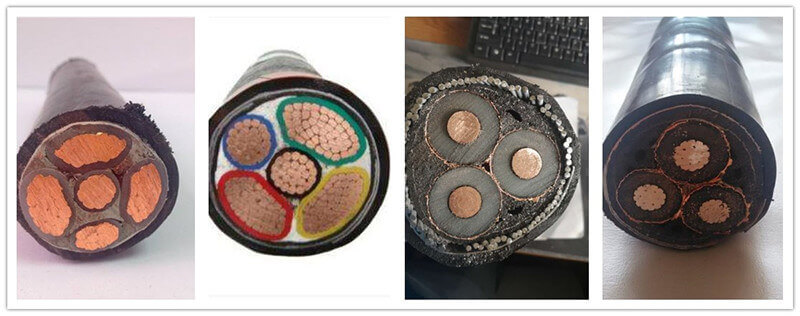
The RFQ should identify the insulation system and major cable layers because a conductor size alone does not define the finished power cable.
For applicable LV cables, IEC 60502-1:2021 specifies construction, dimensions and test requirements for extruded-insulation power cables rated 1kV and 3kV for fixed installations.
For applicable MV cables, applicable standard: IEC 60502-2 (latest edition) or equivalent national standard (e.g., BS 6622 / BS 7835). It covers extruded-insulation power cables from 6kV to 30kV for fixed installations.
A practical RFQ should identify the construction sufficiently for suppliers to quote consistently:
For MV cable, the metallic screen must be specified as an electrical design component, not treated as a generic layer in the cable description.
The RFQ should identify the required screen construction where the project design specifies it, such as copper tape, copper wires or another defined arrangement.
The procurement team should confirm:
For single-core MV cables, screen bonding can also affect circulating currents and losses. Where parallel single-core circuits are involved, the current-sharing and circulating-loss calculation should be addressed during design rather than left as an unspecified supplier assumption.
Huanghe’s existing guide on 11kV single-core XLPE cable sheath bonding covers this subject in more detail.
The RFQ should state whether armour is required and identify the intended armour construction because “armoured cable” is not a sufficiently precise procurement description.
Depending on cable type, installation and project requirements, the specified construction may include SWA, STA, AWA or another armour arrangement. Single-core AC cable applications require particular attention to armour material because magnetic armour can introduce additional losses.
State:
For underground applications, connect the RFQ to the installation specification. Huanghe’s guide on specifying underground armoured power cables covers the information that should be fixed before ordering.
Note for Single-Core AC Cables: The RFQ must explicitly specify non-magnetic armour (such as Aluminum Wire Armour – AWA) for single-core AC cables to prevent electromagnetic eddy current heating. Steel Wire Armour (SWA) or Steel Tape Armour (STA) should only be specified for multi-core cables.
The sheath specification must reflect the cable’s actual environmental exposure rather than being selected only by habit or catalogue availability.
The RFQ should identify the required sheath material and any environmental requirements that are part of the project specification.
| Requirement | Information to Put in RFQ |
|---|---|
| Sheath material | PVC, PE, LSZH or project-specified material |
| Installation environment | Indoor, outdoor, underground, duct, tray, etc. |
| Water exposure | State project requirement where relevant |
| Chemical exposure | Identify known chemicals or site conditions |
| Fire/smoke requirements | State the actual project standard or required test |
Do not combine insulation, sheath and fire-performance requirements into one generic phrase such as “fire-resistant XLPE cable.” Each requirement should be linked to the applicable product construction and standard.
Need a Cable RFQ Reviewed Before Sending It to Suppliers?
Send your current specification, BOQ or cable schedule to Huanghe. We can identify the main technical fields that should be clarified before quotation.

An ampacity value without its installation basis is incomplete engineering data and should not be used as the sole basis for comparing cable quotations.
IEC 60287-1-1:2023 provides calculation equations for steady-state current rating and losses, including cable installations buried directly in ground, in ducts, troughs or steel pipes, and cables in air. The standard leaves certain surrounding-condition parameters open because those conditions depend on the actual installation environment.
Your RFQ should therefore state, where applicable:
Rule of Thumb
If the supplier cannot tell from the RFQ how the cable will be installed, do not expect its quoted ampacity to be directly comparable with another supplier’s value.
Long cable circuits should be specified with sufficient load and route information for voltage-drop and electrical-performance checks rather than conductor size alone.
Where the conductor size is already fixed by the engineering design, state it directly. If the supplier is expected to recommend a size, provide the design load and installation conditions.
For a balanced three-phase system, apparent-power current can be estimated from:
For example, a 5MVA load at 11kV corresponds to approximately 262A of three-phase line current before other design considerations are applied.
The RFQ should also provide, where relevant:
For long MV cable routes, additional electrical effects may need to be assessed by the responsible engineer rather than handled as a simple ampacity calculation.
A cable RFQ should state the project short-circuit duty because conductor size selected for normal load current does not automatically satisfy the fault-current requirement.
Provide:
A commonly used adiabatic conductor verification form is:
The applicable value of k depends on the conductor material, temperature limits and calculation basis. It should not be copied between cable designs without checking the applicable method.
For a more detailed explanation, link the RFQ reader to Power Cable Short-Circuit Rating: 9 Checks Before Ordering.
An RFQ should identify the exact applicable cable standard because “IEC compliant” does not define the complete technical basis.
Examples relevant to power-cable procurement include:
| Standard | Procurement Relevance |
|---|---|
| IEC 60228:2023 | Conductor nominal areas, construction and resistance requirements within its scope |
| IEC 60502-1:2021 | Applicable LV extruded-insulation power cables for fixed installations |
| IEC 60502-2:2014+AMD1:2024 | Applicable MV extruded-insulation power cables from 6kV to 30kV |
| IEC 60287-1-1:2023 | Steady-state current-rating and loss calculations |
The project may also require national standards, utility specifications, EPC technical specifications or customer-specific requirements. The RFQ should list these explicitly rather than expecting the supplier to infer them from the destination country.
The RFQ should distinguish design evidence, production testing and third-party inspection because these documents prove different aspects of cable compliance.
Specify which documents are required rather than writing only “all certificates required.”
| Document / Test | RFQ Question |
|---|---|
| Technical datasheet | Required for technical evaluation? |
| Construction drawing | Required for cable approval? |
| Routine test | What production-test documentation is required? |
| Type/design test | Is existing design-test evidence required for approval? |
| Third-party inspection | Who performs the inspection and what is its scope? |
| Pre-shipment inspection | Is purchaser or independent inspection required? |
Huanghe’s guide How to Verify a Power Cable Test Certificate can be used as the next step after the RFQ and quotation stage.
Cable quantity should be accompanied by delivery-length and drum information when those details affect installation, joints, logistics or project planning.
A quantity of “20,000 metres” does not tell the manufacturer how the cable should be divided between drums unless the project has no specific length requirement.
Where applicable, specify:
For large cable projects, drum planning should be coordinated with route lengths and joint locations rather than decided only after the quotation is accepted.
Commercial requirements should be stated clearly enough that suppliers are quoting the same scope of supply, delivery basis and contractual assumptions.
Include, where applicable:
Do not mix technical requirements and commercial assumptions into one short sentence. Keeping the two sections separate makes supplier evaluation much easier.
The most reliable quotation comparison begins with identical technical information being issued to every supplier.
If Supplier A receives a complete construction specification while Supplier B receives only a cable model and quantity, the resulting prices are not technically comparable.
For procurement teams, use one controlled RFQ document and maintain a revision number. If the specification changes, issue the same revision to every invited supplier.
Quick Answer
If three suppliers receive three different interpretations of the cable specification, you do not have three comparable quotations. You have three different technical offers.
The strongest RFQs use a small number of verifiable engineering data points to define the design basis rather than relying on generic product names.
| Data Point | Source | Applicable Scenario |
|---|---|---|
| 0.5–1000mm² conductor nominal area range | IEC 60228:2023 | Specifying applicable power-cable conductors |
| 1kV and 3kV rated cable classes | IEC 60502-1:2021 | Applicable LV fixed-installation power cables |
| 6–30kV cable voltage range | IEC 60502-2:2014+AMD1:2024 | Applicable MV extruded-insulation cables |
| 100% load factor | IEC 60287-1-1:2023 | Steady-state current-rating calculations |
| ≤5kV DC | IEC 60287-1-1:2023 | Scope of the standard’s steady-state rating method for DC applications |
| 11kV / 5MVA ≈ 262A | Three-phase apparent-power relationship | Illustrative load-current calculation before cable selection |
| 90°C commonly used conductor operating temperature for relevant thermoset cable designs | Applicable product standard / cable design | Only where the actual cable standard and construction specify this limit |
| 250°C commonly used short-circuit conductor temperature for relevant XLPE designs | Applicable product standard / calculation basis | Short-circuit thermal verification for specified cable construction |
| √3 in three-phase current relationship | Three-phase electrical calculation | Converting apparent power and line voltage into approximate line current |
| 50 / 60Hz | Project electrical system | Electrical design and impedance calculations |
Note: Numerical values must always be interpreted within the applicable standard, cable construction, calculation method and project conditions. They should not be copied into an RFQ as universal cable-design limits.
A practical RFQ should give suppliers a structured specification they can quote against without having to reconstruct the project requirements. Use this standardized template and checklist to ensure your RFQ includes all technical and commercial requirements before requesting quotes from cable manufacturers.
Need an editable Excel spreadsheet with pre-formatted formulas for voltage drop, ampacity derating, and core specifications? Download our complete engineering template package for free.
Download Editable Excel RFQ Template →Content Upgrade: Get Your Cable RFQ Technically Checked
Already have a BOQ, cable schedule, datasheet or tender specification? Send it to Huanghe Cable instead of rewriting the entire document. We can review the main cable construction, electrical requirements and documentation fields that should be confirmed before requesting quotations.
| Term | Engineering Definition |
|---|---|
| RFQ | Request for Quotation: a procurement document defining the goods, technical requirements and commercial basis on which suppliers are asked to quote. |
| Cable construction | The defined arrangement of conductor, insulation, screens, metallic layers, armour, sheath and other specified cable components. |
| Ampacity | The allowable continuous current under specified cable construction and installation conditions. |
| Short-circuit withstand | The ability of the cable component under consideration to withstand specified fault-current effects for the required duration. |
| Technical equivalence | A condition in which competing supplier offers satisfy the same relevant technical requirements and performance basis. |
| Routine test | A production-related test performed according to the applicable product standard and specified procurement requirements. |
| Type test | Testing used to demonstrate performance of a cable design against specified requirements; it is distinct from production routine testing. |
Editorial Notice & Technical Assurance:
This article has been authored by the Huanghe Cable Technical Writing Team and Reviewed by Chief Cable Engineer (20+ Years Experience in IEC Power Cable Manufacturing) to ensure strict alignment with international cable design standards, manufacturing tolerances, and field installation practices.

A manufacturer can quote more accurately when the RFQ defines the cable’s electrical, structural and installation requirements before commercial pricing begins.
Huanghe Cable has manufactured power cables since 1980 and supports LV and MV cable requirements for international projects. Its product scope includes XLPE power cables, armoured power cables and other power and electrical cable products.
For an engineering procurement team, the useful starting point is the project specification rather than a generic product name. Huanghe can discuss conductor material, cable construction, screen, armour, sheath, applicable standards and specified testing or inspection requirements according to the project.
Huanghe’s cable manufacturing capability can therefore be incorporated into the procurement process at the specification stage, before the quotation is finalized.
The final cable design should remain consistent with the project engineer’s calculations, purchaser requirements and applicable standards.
A power cable RFQ should include the electrical system, voltage rating, conductor, size, construction, installation conditions, standards, testing, quantity and delivery requirements. The exact fields depend on whether the cable is LV, MV or a project-specific design.
No. The supplier normally needs the required voltage designation, conductor material and size, number of cores, screen, armour, sheath, applicable standard and relevant installation or testing requirements.
Yes, when the project design has already selected the conductor material. If it has not been selected, provide the electrical design requirements and ask suppliers to identify the proposed conductor size and basis.
Because cable ampacity depends on installation conditions. Burial, duct, tray or air installation, grouping, spacing, ambient conditions and soil thermal resistivity can influence current-rating calculations.
Yes, when the project fault level is available. Short-circuit current and clearing time are needed to verify the thermal duty of the conductor and relevant cable components.
The RFQ should state the standard that applies to the actual cable type and voltage range. Examples include IEC 60228:2023, IEC 60502-1:2021 and IEC 60502-2:2014+AMD1:2024, subject to the project specification.
Yes for applications where the metallic screen is part of the required cable design. State the material, construction and electrical requirements where the project specification defines them.
Yes when drum length affects installation, joints, transportation or site handling. The RFQ can state preferred lengths, maximum drum weight or other project logistics requirements.
A technical datasheet and cable construction information should normally be requested for technical evaluation. Depending on the project, the purchaser may also require test reports, certificates, inspection plans and other technical documents.
A manufacturer can identify missing information and propose a technical option, but the final cable selection should remain consistent with the project’s engineering design and responsible engineer’s calculations.
A technically complete RFQ is the foundation for receiving technically comparable power cable quotations.
The most important information is not the product name. It is the combination of electrical system, cable voltage rating, conductor, cable construction, installation conditions, electrical performance, standards, testing and delivery requirements.
Once those requirements are fixed, the procurement team can compare supplier quotations on the same basis and identify genuine differences in price, construction, testing and commercial scope.
For LV and MV projects, this approach also creates a stronger document trail from project requirement → RFQ → supplier quotation → technical approval → testing → purchase order.
Need a Power Cable Quotation?
Send your cable specification, BOQ, cable schedule or tender requirement. Huanghe can review the required cable construction and prepare a quotation based on the specified technical and commercial scope.

Please contact us for a free quotation by the below form. We promise the quickest response within 12 hours.