Power cable codes identify the basic conductor, insulation, armour and sheath construction, but they do not by themselves define the complete cable specification.
Codes such as YJV, YJV22, YJV32, YJLV and N2XY are commonly used to describe different cable constructions and naming systems. Before ordering, the buyer should decode the model and then verify the voltage rating, conductor size, conductor material, number of cores, screen or armour, sheath, applicable standard and installation conditions.
For example, YJV is commonly used for a copper-conductor XLPE-insulated PVC-sheathed power cable in Chinese cable designation practice, while YJV22 adds steel tape armour and YJV32 uses steel wire armour. YJLV uses an aluminium conductor instead of copper. N2XY is a VDE-style designation for a copper-conductor XLPE-insulated PVC-sheathed power cable.
The important procurement rule is simple: never place an order from the model code alone. Use the code as a construction shortcut, then confirm the complete technical specification and applicable standard.
Need a Cross-Reference or Instant RFQ for Your Cable Schedule?
Upload your BOQ or cable model. Our senior electrical engineers will cross-verify IEC compliance, conductor sizing, and armour selection within 12 hours.
A cable model is a construction identifier, not a complete purchase specification.
Procurement documents frequently use short cable codes because they are convenient for drawings, BOQs and quotations. The problem occurs when the code is copied between countries, manufacturers or standards without confirming what the designation actually means.
A model such as YJV22 can communicate the basic construction, but it does not automatically tell the supplier whether the required cable is 0.6/1 kV, 3.6/6 kV, 6/10 kV, 8.7/15 kV or another voltage rating. It also does not specify whether the required conductor is 1-core, 3-core or another configuration.
The same procurement risk appears when a buyer treats YJV22 and N2XY as interchangeable simply because both can describe XLPE-insulated PVC-sheathed power cable constructions. The designation system, applicable standard, rated voltage and construction details still need to be checked.
Scroll horizontally to view full table →
| Procurement item | What the model may indicate | What still needs confirmation |
|---|---|---|
| Conductor | Copper or aluminium depending on designation | Material, class, size and resistance |
| Insulation | For example, XLPE | Voltage grade and applicable standard |
| Armour | Steel tape or steel wire in relevant codes | Armour material, dimensions and installation requirements |
| Sheath | Often PVC in the codes discussed here | Sheath material, colour, thickness and environmental requirements |
YJV commonly identifies a copper-conductor XLPE insulated PVC sheathed power cable in Chinese cable designation practice.
The designation is commonly interpreted as a combination of conductor, insulation and sheath information. In procurement documents, YJV is widely used for XLPE power cable constructions where an armoured layer is not included in the basic model.
Scroll horizontally to view full table →
| Code element | Common meaning | Engineering Note |
|---|---|---|
| (Omitted Prefix) | Copper Conductor (Cu) | In Chinese GB coding, copper is default and omitted. ‘L’ is added for Aluminium (YJLV). |
| YJ | XLPE insulation | Cross-linked Polyethylene insulation |
| V | PVC sheath | Polyvinyl Chloride outer sheath |
In a complete purchase specification, YJV should normally be accompanied by the rated voltage, number of cores, conductor cross-sectional area, conductor class, applicable standard and installation requirements.
For example, a specification such as 0.6/1 kV 4×95 mm² Cu XLPE/PVC communicates significantly more procurement information than simply writing YJV.
YJV22 commonly identifies a copper-conductor XLPE insulated steel tape armoured PVC sheathed power cable.
The key difference between YJV and YJV22 is the addition of steel tape armour. The armour changes the cable construction and provides mechanical protection appropriate to the installation conditions for which that construction is specified.
Scroll horizontally to view full table →
| Designation | Conductor | Insulation | Armour | Sheath |
|---|---|---|---|---|
| YJV | Copper | XLPE | None in the basic construction | PVC |
| YJV22 | Copper | XLPE | Steel tape | PVC |
Important: YJV22 should not be selected simply because it is armoured. The required armour type must match the mechanical, installation and electrical requirements of the project.
Procurement & Safety Alert: YJV22 (steel tape armour) applies to multi-core cables only. Never specify or supply YJV22 for single-core AC installations, as the magnetic steel tape will generate dangerous eddy current heat. Single-core steel-tape equivalents for AC applications require non-magnetic armour (such as YJV28 / aluminium tape).
Not sure whether your project requires YJV, YJV22 or another construction?
Send the cable schedule or BOQ for technical review.
YJV32 commonly identifies a copper-conductor XLPE insulated steel wire armoured PVC sheathed power cable.
Important Engineering Note: YJV32 utilizes magnetic steel wire armour and is specified exclusively for multi-core (e.g., 3-core) AC systems. For single-core AC cables, magnetic steel armour causes severe electromagnetic induction and eddy current heating. Therefore, single-core armoured AC cables must use non-magnetic armour (such as aluminium wire armour, designated as YJV62).
The principal construction difference between YJV22 and YJV32 is the armour system. YJV22 uses steel tape armour, while YJV32 uses steel wire armour.
Steel wire armour and steel tape armour should not be treated as equivalent simply because both are metallic armour. Their mechanical characteristics and construction are different, so the choice should be based on the project installation conditions and applicable cable standard.
Scroll horizontally to view full table →
| Feature | YJV22 | YJV32 |
|---|---|---|
| Basic insulation | XLPE | XLPE |
| Conductor in common designation | Copper | Copper |
| Armour | Steel tape | Steel wire |
| Sheath | PVC | PVC |
If a project drawing specifies YJV32, do not replace it with YJV22 without confirming the engineering requirement and obtaining approval for the change.
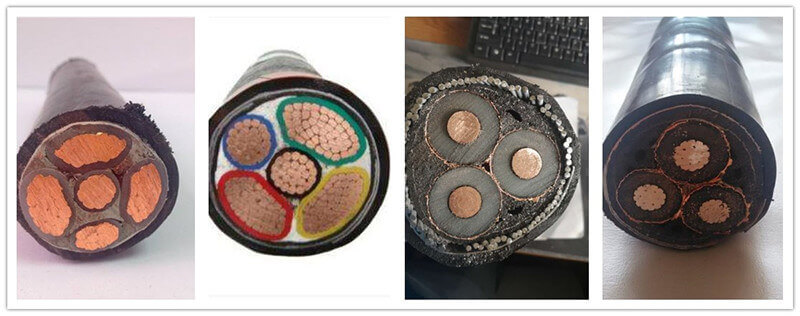
YJLV commonly identifies an aluminium-conductor XLPE-insulated PVC-sheathed power cable.
The important distinction between YJV and YJLV is the conductor material. YJV commonly denotes copper conductor, while YJLV denotes aluminium conductor within the corresponding designation practice.
Conductor material affects electrical resistance, conductor dimensions, cable mass, termination requirements and ampacity calculations. Therefore, replacing a copper cable with an aluminium cable is not simply a model-code substitution.
When comparing YJV and YJLV quotations, the buyer should compare the complete conductor specification and electrical performance rather than comparing only the nominal cross-sectional area.
N2XY is a VDE-style designation commonly used for a copper-conductor XLPE-insulated PVC-sheathed power cable.
N2XY is frequently encountered in European-oriented specifications and international procurement documents. However, the presence of a familiar construction description does not mean that N2XY and YJV can be treated as identical in every project.
The correct comparison should consider the applicable standard, rated voltage, conductor class, insulation requirements, sheath requirements, test requirements and dimensional requirements.
Scroll horizontally to view full table →
| Designation | Typical construction description | Procurement point |
|---|---|---|
| YJV | Cu / XLPE / PVC | Confirm Chinese designation and applicable GB/IEC specification. |
| N2XY | Cu / XLPE / PVC | Confirm the required VDE/IEC standard and rated voltage. |
Beyond standard compliance, two critical physical differences between N2XY (DIN VDE 0276-603) and YJV (GB/T 12706) are core color coding and conductor stranding flexibility (IEC 60228 Class 1 vs. Class 2). European projects specifying N2XY often strictly mandate HD 308 S2 color identification, which may differ from standard Chinese domestic color schemes.
The construction description may look similar, but the purchasing specification must still state the governing standard and complete technical requirements.
The fastest way to compare these cable codes is to separate conductor material, insulation, armour and sheath before checking the standard.
Scroll horizontally to view full table →
| Cable code | Conductor | Insulation | Armour | Sheath | Main procurement check |
|---|---|---|---|---|---|
| YJV | Copper | XLPE | None in basic construction | PVC | Voltage, size and installation |
| YJV22 | Copper | XLPE | Steel tape | PVC | Armour and installation |
| YJV32 | Copper | XLPE | Steel wire | PVC | Armour and installation |
| YJLV | Aluminium | XLPE | None in basic construction | PVC | Conductor material and sizing |
| N2XY | Copper | XLPE | None in basic construction | PVC | VDE/IEC standard and voltage |
This table is a construction-level comparison. It is not a statement that the five designations are fully interchangeable. The governing standard and complete specification remain decisive.
The table below provides approximate overall diameters and continuous current-carrying capacities (ampacity) for standard 0.6/1kV copper-conductor XLPE power cables based on IEC 60502-1 and GB/T 12706.
Swipe horizontally to view complete dimensions & current ratings →
| Conductor Size (mm²) | YJV Approx. OD (mm) | YJV22 Approx. OD (mm) | Current Rating in Air (A) | Current Rating Underground (A) |
|---|---|---|---|---|
| 3 × 16 + 1 × 10 | 20.5 | 23.5 | 85 | 98 |
| 3 × 25 + 1 × 16 | 24.0 | 27.0 | 115 | 128 |
| 3 × 35 + 1 × 16 | 26.5 | 29.5 | 140 | 155 |
| 3 × 50 + 1 × 25 | 30.0 | 33.5 | 175 | 188 |
| 3 × 70 + 1 × 35 | 34.5 | 38.0 | 220 | 230 |
| 3 × 95 + 1 × 50 | 39.0 | 43.0 | 270 | 275 |
| 3 × 120 + 1 × 70 | 43.0 | 47.0 | 310 | 310 |
| 3 × 150 + 1 × 70 | 47.5 | 51.5 | 355 | 345 |
| 3 × 185 + 1 × 95 | 53.0 | 57.0 | 410 | 390 |
| 3 × 240 + 1 × 120 | 60.0 | 64.5 | 485 | 450 |
* Note: Ratings based on 30°C ambient air temperature and 25°C ground temperature. De-rating factors must be applied for ambient variation, duct grouping, and thermal resistivity.
Download the complete Huanghe Cable Product Catalog (including 6/10kV, 8.7/15kV, and 26/35kV YJV/YJV22/YJV32 datasheets with voltage drop and short-circuit rating calculations).
Request Full Specification Book (PDF)
Decode the model in layers: conductor → insulation → screen or armour → sheath → voltage → core configuration → size → standard.
A procurement engineer should be able to turn a short cable code into a complete line-item specification. The process below reduces ambiguity when comparing quotations from different suppliers.
Scroll horizontally to view full table →
| Step | Question | Example |
|---|---|---|
| 1 | What is the conductor material? | Cu or Al |
| 2 | What is the insulation? | XLPE |
| 3 | Is there armour? | Steel tape or steel wire |
| 4 | What is the sheath? | PVC |
| 5 | What voltage is required? | 0.6/1 kV, 6/10 kV, etc. |
| 6 | How many cores? | 1C, 2C, 3C, 4C, etc. |
| 7 | What conductor size? | 95 mm², 240 mm², etc. |
| 8 | Which standard governs? | Project-specified GB/IEC/VDE standard |
This approach is especially useful when the same project receives quotations using different cable naming systems. Compare the construction and standard first; compare the model name second.
If your BOQ uses a cable code but does not show the complete construction, send the BOQ or drawing to our team.
Select the cable construction from the installation requirement, not from the shortest or most familiar model code.
For a project engineer, the correct cable code is the result of the electrical and mechanical requirements. The model should follow the design rather than replace it.
Scroll horizontally to view full table →
| Project requirement | Technical decision | What to verify |
|---|---|---|
| Copper conductor required | YJV-family construction may be relevant | Voltage, size, cores and standard |
| Aluminium conductor required | YJLV-family construction may be relevant | Conductor class, resistance and ampacity |
| Steel tape armour specified | YJV22 may be relevant | Armour specification and installation |
| Steel wire armour specified | YJV32 may be relevant | Armour dimensions and standard |
| VDE-style specification | N2XY may be relevant | Exact VDE/IEC requirement and voltage |
For underground applications, also confirm whether the project requires armour, screen, special sheath properties, water-resistance measures, chemical resistance or other environmental requirements.
Huanghe’s related guide on specifying underground armoured power cables covers the additional details that should be confirmed before ordering.

The cable code identifies construction, while the standard defines the technical requirements that the cable must satisfy.
This distinction is critical in international procurement. A quotation can use a familiar model name while the actual construction, dimensions, testing requirements or voltage rating follow a different standard.
For example, IEC 60502-1:2021 covers extruded solid insulation power cables for rated voltages of 1 kV and 3 kV for fixed installations. The model name alone does not replace the standard reference.
For medium-voltage applications, IEC 60502-2:2014+Amd1:2024 covers extruded solid insulation power cables for rated voltages from 6 kV to 30 kV for fixed installations.
For conductor construction and resistance requirements, IEC 60228:2023 is the relevant conductor standard. For steady-state current rating calculations, IEC 60287-1-1:2023 provides the calculation framework.
Scroll horizontally to view full table →
| Reference | What it addresses | Procurement use |
|---|---|---|
| IEC 60228:2023 | Conductors | Verify conductor construction and resistance requirements |
| IEC 60502-1:2021 | LV/low-voltage power cables within its scope | Confirm cable design, tests and rated voltage |
| IEC 60502-2:2014+Amd1:2024 | MV power cables within its scope | Confirm MV cable construction and testing |
| IEC 60287-1-1:2023 | Steady-state current rating calculations | Check ampacity under defined installation conditions |
Before accepting an international cable quotation, write the model + complete construction + voltage + size + standard together. This makes supplier comparison much more reliable.
Before issuing a purchase order, verify eight items beyond the cable model itself.
These checks become especially important when a project receives offers from suppliers using different naming systems. A model-number comparison without these eight checks can create false equivalence between technically different products.
Good cable procurement decisions depend on traceable technical data rather than model names alone.
The following data points are useful when preparing a specification, comparing quotations or reviewing supplier documentation.
Scroll horizontally to view full table →
| Data point | Source / standard | Applicable scenario |
|---|---|---|
| 0.5–3500 mm² conductor cross-sectional area scope | IEC 60228:2023 | Conductor specification and resistance verification |
| 1 kV and 3 kV rated cable scope | IEC 60502-1:2021 | Applicable LV cable designs within the standard scope |
| 6–30 kV rated cable scope | IEC 60502-2:2014+Amd1:2024 | Applicable MV cable designs within the standard scope |
| Steady-state current rating | IEC 60287-1-1:2023 | Buried, duct, trough, steel pipe and air installation calculations |
| Conductor material and resistance | IEC 60228:2023 | Copper, aluminium and conductor construction verification |
| Cable test requirements | Applicable cable product standard | Supplier qualification and shipment documentation |
| Short-circuit performance | Applicable calculation/test framework | Fault-current verification |
| Installation-dependent ampacity | IEC 60287-1-1:2023 | Cable selection under actual thermal conditions |
| Rated voltage | Project specification / applicable product standard | LV and MV cable selection |
| Core configuration | Project cable schedule | Single-core and multicore applications |
These data points are more useful for procurement than simply collecting model names because they allow suppliers to be compared against the same technical baseline.
The following definitions provide a practical procurement vocabulary for the cable designations discussed in this guide.
Scroll horizontally to view full table →
| Term | Practical definition |
|---|---|
| Power cable code | A designation used to identify a cable’s basic construction or material combination. |
| YJV cable | Common Chinese designation for a copper-conductor XLPE insulated PVC sheathed power cable construction. |
| YJV22 cable | Common designation for a copper-conductor XLPE insulated steel tape armoured PVC sheathed construction. |
| YJV32 cable | Common designation for a copper-conductor XLPE insulated steel wire armoured PVC sheathed construction. |
| YJLV cable | Common designation for an aluminium-conductor XLPE insulated PVC sheathed power cable construction. |
| N2XY cable | VDE-style designation commonly associated with copper conductor XLPE insulated PVC sheathed power cable. |
| XLPE power cable | Power cable using cross-linked polyethylene as the insulation material. |
| Armoured power cable | Power cable incorporating metallic armour as part of its construction. |

Huanghe supports cable procurement by translating project cable models into complete manufacturing specifications.
Huanghe is a cable manufacturer founded in 1980, with production covering LV and MV power cables, XLPE cables, armoured power cables, control cables, rubber cables, photovoltaic wire, overhead cables and building wires.
For model-based inquiries, the engineering and sales teams can work from a cable schedule, BOQ, technical specification, drawing or existing model number and clarify the required construction before quotation.
This is particularly useful when an international project uses a designation such as YJV, YJV22, YJV32, YJLV or N2XY and the buyer needs to compare offers against a defined technical baseline.
Huanghe’s manufacturing scope and quality documentation can be aligned with the applicable project requirements, including relevant IEC-based production and requested inspection or certification documentation.
For additional technical verification, see Huanghe’s guides on power cable test certificates, IEC 60287 ampacity, and power cable short-circuit rating.
Send your cable model, technical specification, drawing or BOQ. Huanghe can review the required construction and prepare a quotation based on your project requirements.
Email: sales@huanghecables.com
YJV commonly identifies a copper-conductor XLPE-insulated PVC-sheathed power cable in Chinese cable designation practice. The complete specification still needs the rated voltage, core configuration, conductor size and applicable standard.
YJV22 adds steel tape armour to the basic YJV construction. The armour changes the cable construction and should be selected according to the installation and mechanical requirements.
YJV22 commonly uses steel tape armour, while YJV32 commonly uses steel wire armour. They should not be treated as automatically interchangeable.
YJLV commonly identifies an aluminium-conductor XLPE-insulated PVC-sheathed power cable. Conductor material and electrical performance should be confirmed in the complete specification.
N2XY is a VDE-style designation commonly used for a copper-conductor XLPE-insulated PVC-sheathed power cable. The applicable VDE/IEC requirements and rated voltage must still be confirmed.
YJV and N2XY can describe similar basic Cu/XLPE/PVC constructions, but they should not be assumed to be fully equivalent. The governing designation system, standard, voltage and detailed construction must be compared.
No, the YJV model code alone does not specify the complete rated voltage. The procurement specification should state the required voltage rating separately.
No, YJV22 indicates a steel-tape-armoured construction but does not by itself approve every installation method. The cable design, applicable standard and project installation requirements must be checked.
Compare the complete conductor specification, electrical performance, insulation, sheath, voltage, core configuration, applicable standard and installation conditions rather than comparing only the model names.
Send the cable model, rated voltage, conductor material and size, number of cores, armour or screen requirements, sheath requirements, applicable standard, quantity and installation conditions whenever available.
Use the cable code to identify the basic construction, but use the complete technical specification to make the purchasing decision.
YJV, YJV22, YJV32, YJLV and N2XY are useful cable designations, but the model number is only one part of the specification. For reliable procurement, confirm the conductor material and class, insulation, armour, sheath, rated voltage, core configuration, conductor size, installation conditions and governing standard.
This approach makes quotations easier to compare and reduces the risk of approving a cable that matches the model name but does not match the project’s actual technical requirements.
Established in 1980, Huanghe Cable is a direct B2B manufacturer specializing in low- and medium-voltage power cables built strictly to IEC 60502 and international standards.
Send your cable schedule, BOQ, drawing or technical specification to Huanghe for a project-based quotation.
sales@huanghecables.com
|
+86 151 3625 6310

Please contact us for a free quotation by the below form. We promise the quickest response within 12 hours.