Shielded control cables are used in industrial automation systems where control, monitoring and instrumentation signals may be affected by electromagnetic interference (EMI). Typical applications include PLC input/output circuits, sensor connections, control cabinets, industrial machinery and process-control equipment.
For project procurement, the cable name alone is not enough. Buyers should confirm conductor size, core or pair count, shielding arrangement, insulation, outer sheath, rated voltage, applicable standard and installation conditions. These details help ensure that the supplied construction matches the project specification.
Huanghe Cable manufactures control cables in a stated conductor-size range of 0.5–10 mm² and core configurations of 2–61 cores, subject to the selected construction. Cables can be specified with different shielding arrangements and insulation or sheath materials, depending on the required design. Visit our shielded control cable product page for product information.
Looking for Shielded Control Cable for an Industrial Project?
Send your cable schedule or specify the conductor size, core count, shield type, rated voltage and applicable standard. Huanghe Cable can review your requested construction for quotation.
A shielded control cable is a cable incorporating a conductive screening layer around individual conductors, pairs or the assembled group of insulated cores. The screen helps control electromagnetic coupling and provides a conductive path for interference currents when correctly terminated as part of the system design.
These cables are commonly used to connect control and monitoring equipment where signal reliability matters. Applications include PLC input/output circuits, sensors, actuators, control cabinets, industrial machinery and process automation systems.
Shielding does not eliminate every source of electrical noise. Its effectiveness depends on the screen construction, interference characteristics, cable routing, termination, grounding arrangement and connected equipment. The cable and installation design should therefore be considered together.
| Cable Feature | Purpose | What to Specify |
|---|---|---|
| Conductors | Carry control or monitoring signals | Material, cross-section and conductor class |
| Insulation | Provides electrical separation between conductors | Material, rated voltage and temperature requirements |
| Shield | Helps reduce electromagnetic interference | Foil, copper tape, braid or combined construction |
| Outer sheath | Protects the cable in its installation environment | PVC, PE, LSZH or another specified material |
| Optional armour | Provides additional mechanical protection | Whether armoured construction is required |
Programmable logic controllers receive signals from field devices and send control commands to equipment. Shielded control cables may be specified for input/output circuits where electrical noise is a concern. The required conductor size and core count depend on the circuit schedule, terminal arrangement and equipment requirements.
Pressure, temperature, position and other field instruments may transmit measurement-related signals. Depending on the instrument and signal type, the cable design may require individual pair shielding, an overall shield or a combination of both. Buyers should identify any twisted-pair, pair-identification or screening requirements in the technical specification.
Variable-frequency drives, switching devices and motors can create electrically noisy environments. Shielded control cable may be suitable for relevant control or feedback circuits, depending on the equipment requirements. It should not automatically be treated as a motor power cable or as a substitute for a purpose-designed encoder or communication cable.
Manufacturing lines, packaging machinery, material-handling systems and process-control equipment use control circuits to connect panels, sensors, relays and actuators. The cable’s shielding, conductor flexibility and sheath material should reflect the installation environment, including any specified exposure to oil, abrasion, moisture or repeated movement.
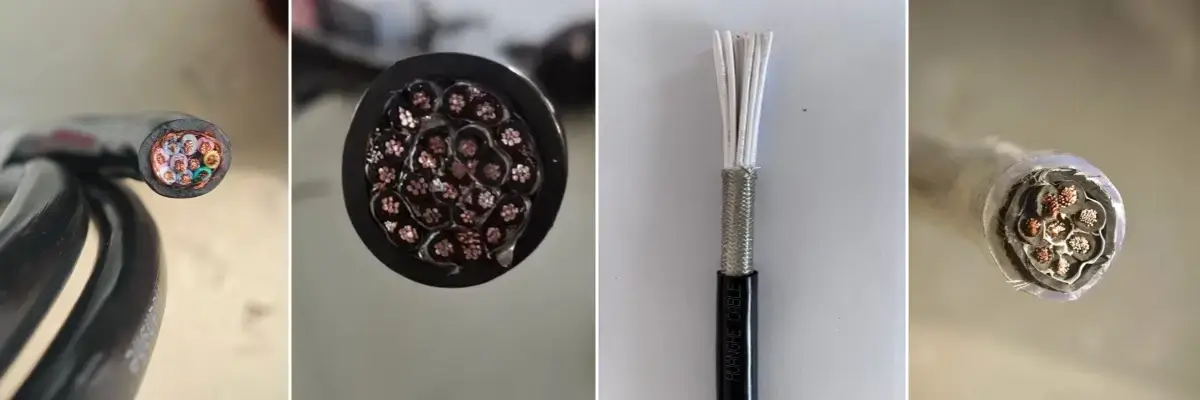
The appropriate screen depends on the interference environment, cable construction and installation requirements. A shield type should not be selected on the assumption that one design is best for every application.
| Shield Type | Typical Characteristics | Selection Considerations |
|---|---|---|
| Aluminum Foil | A lightweight screening layer that can provide broad coverage, depending on the foil and overlap design. | Confirm foil construction, overlap, any drain wire and the required termination arrangement. |
| Copper Tape | A conductive screening layer applied as a tape-wrapped construction. | Confirm tape design, continuity, mechanical requirements and suitability for the intended installation. |
| Copper Braid | A woven conductive screen that can offer useful flexibility, depending on braid construction and coverage. | Specify braid material and required coverage where relevant; confirm flexibility and termination requirements. |
| Foil + Braid | Combines two screening layers to meet specified screening requirements. | Confirm whether combined shielding is required and whether the added diameter, stiffness and cost suit the application. |
Some constructions use a drain wire to support electrical connection to a foil screen; others use different screen and termination designs. A drain wire, its material and its size should be confirmed from the requested construction rather than assumed from the phrase “shielded control cable.” Likewise, screening coverage depends on the actual design and should be confirmed where it is a project requirement.
Shield placement is another important design decision. The correct arrangement depends on the signal type, circuit layout and whether interference between circuits must be controlled.
An overall shield surrounds the assembled group of insulated cores. It may be suitable when several control circuits share one cable and the project calls for screening around the complete core group.
Individual shielding places a screen around each specified pair or group of conductors. It can be used where the design requires separation between sensitive circuits. The number of pairs, pair identification and screening arrangement should be stated clearly in the RFQ.
A combined construction includes screens around individual pairs or groups and an additional screen around the complete assembly. It may be specified for more demanding signal-separation requirements, but it adds materials and construction complexity. Confirm the requirement from the system design instead of selecting double shielding solely because it appears more protective.
International buyers may specify control cables using designations such as YY, CY, SY or YSLY, while projects based on Chinese cable specifications may use models such as KVVP, KVVP2 or KVVRP. These designations are not automatically interchangeable: the construction, conductor class, insulation, screening, rated voltage and applicable product specification must be checked before a substitute is approved.
The following table explains commonly encountered designations to help procurement teams identify the intended construction. It is a general market reference, not a declaration that every model is manufactured to the same standard or available in every configuration.
| Model | Common Construction | Typical Selection Consideration |
|---|---|---|
| YY | Flexible control cable, commonly PVC-insulated and PVC-sheathed, without a screening braid. | Consider for control wiring where screening is not specified and the installation conditions suit the cable design. |
| CY | Flexible control cable commonly using a copper-wire braid screen, often tinned copper. | Consider where electromagnetic screening is required. Confirm braid construction, termination and EMC installation requirements. |
| SY | Flexible control cable commonly using a galvanised steel-wire braid for additional mechanical protection. | Do not treat the steel braid as equivalent to a copper EMC screen. Confirm the actual construction and suitability for the installation. |
| YSLY | A designation encountered in European flexible control-cable catalogues; exact construction depends on the manufacturer’s specification. | Check conductor class, insulation, sheath, voltage rating, flexibility and any screening or special requirements. |
| KVVP | Chinese control-cable designation commonly associated with PVC insulation, PVC sheath and copper-wire-braid shielding. | Confirm the screen type, conductor construction, rated voltage and applicable product standard. |
| KVVP2 | Chinese designation commonly associated with a copper-tape-screened PVC control cable. | Verify the exact tape-screen construction in the manufacturer’s datasheet. |
| KVVRP | Flexible PVC control-cable designation commonly associated with screening. | Confirm conductor class and whether the design is suitable for the required movement conditions. |
| KVVP22 / KVVP32 | Designations used for certain armoured shielded PVC control-cable constructions. | Confirm the armour construction, installation conditions and full model definition. |
| KYJVP / KYJVRP | Designations commonly associated with XLPE-insulated shielded control cables; the precise construction depends on the model. | Check insulation, conductor class, screening, sheath, rated voltage and the governing standard. |
| Instrument / paired cable | Purpose-designed constructions may use twisted pairs, individual screens, an overall screen or combined shielding. | Pair count, individual and overall screen requirements, electrical characteristics and instrumentation specification. |
Important for international procurement: YY, CY and SY are widely used market designations, but the letters alone do not establish a complete technical specification or prove compliance with a particular standard. Product requirements and standards can differ by manufacturer and market. Before ordering, confirm the cable’s construction and applicable standard in the datasheet. In particular, do not assume that every YY, CY or SY design conforms to BS EN 50525 or is suitable for every fixed-wiring application.
If your project specification uses a European designation such as CY or SY but your supplier quotes a Chinese model, ask for a construction-by-construction comparison rather than accepting a model-code substitution alone.
For more product details, see the Huanghe shielded control cable range.
Request a Control Cable Quotation
Send your model or datasheet, conductor size, core or pair count, shielding arrangement, insulation and sheath requirements, applicable standard and project quantity.
A useful project specification identifies electrical, structural and installation requirements together. The options below are specification items to confirm with the manufacturer; they do not mean every possible combination is a standard product.
| Parameter | Possible Options / Range | RFQ Notes |
|---|---|---|
| Conductor material | Copper for the specified design | State the material and applicable conductor requirements. |
| Conductor construction | Solid, stranded or flexible stranded | Select according to fixed installation, termination and movement needs. |
| Cross-section | 0.5–10 mm² within Huanghe Cable’s stated control cable range | Specify the size and conductor class. Confirm availability for the requested core count and shielding arrangement. |
| Core / pair count | 2–61 cores within Huanghe Cable’s stated control cable range; paired designs should specify pair count separately | Match the circuit schedule and confirm the exact combination with the supplier. |
| Shield construction | Aluminum foil, copper tape, copper braid or a specified combination | Identify overall, individual-pair, group or combined shielding as required. |
| Insulation | PVC, XLPE or another specified compound | Confirm rated voltage, temperature requirements and applicable standard. |
| Rated voltage | Common control and power ratings include 300/500 V, 450/750 V and 0.6/1 kV, depending on the product design, insulation compound and governing standard. | Do not treat these voltage grades as interchangeable. 300/500V or 450/750V are typical for control/instrumentation circuits, whereas 0.6/1 kV applies to heavier power/control duties. Confirm the rating against the specific project datasheet. |
| Operating temperature | Depends on the insulation compound and cable design; PVC and XLPE constructions may have different ratings | Confirm the permitted conductor temperature and service conditions for the specific cable. |
| Outer sheath | PVC, PE, LSZH or another specified compound | Identify environmental, fire-performance and installation requirements. |
| Mechanical protection | Unarmoured or specified armoured construction | Describe the installation route and mechanical exposure. |
| Identification | Numbered or colour-identified cores; pair identification where required | Match the project wiring diagrams and termination requirements. |
Important: The stated cross-section and core-count ranges do not mean that every size can be manufactured with every shield, insulation, sheath and armour combination. Confirm the complete cable construction, availability and rated performance before placing an order.
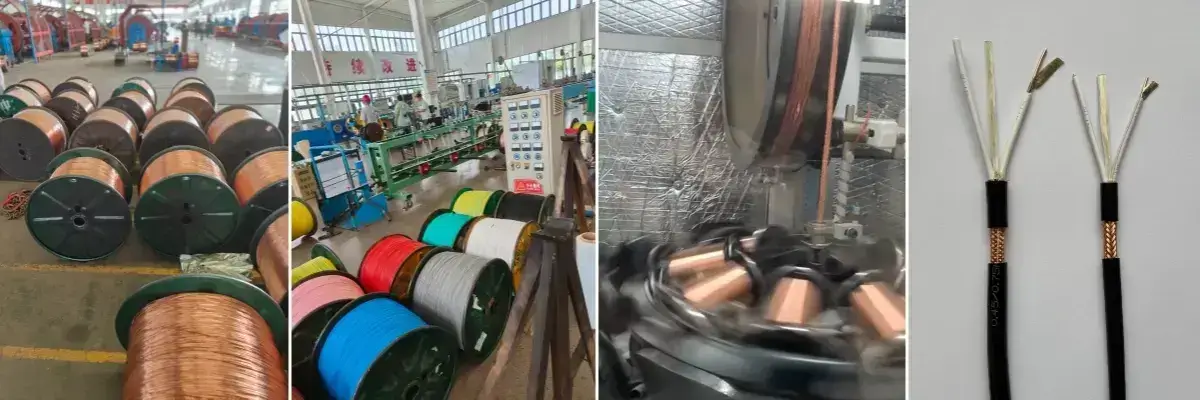
Core count should follow the actual circuit schedule, not simply the number of connected devices. A project may need separate conductors for commands, status feedback, interlocks, common connections and spare circuits. Where paired signals are involved, specify the number of pairs separately from the total conductor count.
Conductor cross-section should be selected according to circuit current, permissible voltage drop, routing length, connected equipment and terminal compatibility. Smaller cross-sections may be used in some signal circuits, while control supplies or relay circuits may require larger conductors. The correct size must be established from the circuit design rather than a general rule of thumb.
Also distinguish between fixed-installation control cable and cable intended for repeated flexing. A stranded conductor alone does not establish that a cable is suitable for continuous movement. For moving machinery, specify the movement pattern, bending conditions and duty, then confirm the proposed cable design with the manufacturer.
Choosing a shielded cable is only part of the solution. Installation and termination can affect the performance of the complete control circuit.
A shield can help reduce interference, but it cannot compensate for every grounding, routing or equipment-design problem. For systems with strict signal-integrity requirements, review the cable specification and installation method together.
For industrial automation projects, required control cables are defined by more than just model names. Conductor cross-sections (stated range from 0.5 mm² to 10 mm²), core configurations (2 to 61 cores), shielding arrangements, insulation, outer sheath, rated voltage, and applicable standards all determine the final construction.
Huanghe Cable has manufactured industrial power and control cables since 1980. We support OEM and project-specific customization, with constructions reviewed and confirmed against your technical specifications, cable schedules, or bills of quantities before quotation.
| Company & Production Profile | Reported Details & Capabilities |
|---|---|
| Manufacturing history | Cable manufacturing since 1980 |
| Production capacity | 60+ production lines, 20,000 km annual output |
| R&D and testing | 30+ engineers, 45 sets of testing equipment |
| Standards & Certification | Can manufacture to applicable IEC/BS/EN and GB/T requirements; holds IEC/CB test certificates (certificate scope and product applicability must be verified prior to order) |
Our past international project experience includes supplies for major infrastructure and industrial sites such as the Erdenet Copper Mine in Mongolia, the Botswana Power Project, the Bangladesh Power Development Board, mining projects in Vietnam, and solar installations in Madagascar. (Project references illustrate general company experience and do not imply that every site used shielded control cables).

To help a manufacturer review your requirement and prepare a comparable quotation, include as many of the following details as are available:
| RFQ Item | Information to Provide |
|---|---|
| Cable model or type | For example, KVVP, KVVP2, KVVRP, or a construction description |
| Rated voltage | The rating required by the project specification |
| Core count and size | For example, 7 × 1.5 mm², subject to the required design |
| Shielding | Foil, copper tape, braid, individual-pair, overall or combined shielding |
| Insulation and sheath | PVC, XLPE, PE, LSZH or the specified materials |
| Armour | Required armour type, if any |
| Applicable standard | The relevant IEC, BS/EN, GB/T or project-specific requirement |
| Quantity and length | Total quantity and length per cable specification |
| Destination | Country, delivery location or destination port |
| Required documents | Datasheets, test reports, inspection documents or other project-required records |
If some details are not yet available, send the existing cable schedule, bill of quantities or reference datasheet. The supplier can then identify which technical items need clarification before the quotation is finalized.
Request a Shielded Control Cable Quotation
Send Huanghe Cable your required cross-section, core count, shield type, insulation and sheath materials, rated voltage, applicable standard and project quantity. Include your datasheet or cable schedule if available.
Shielded control cable is used to connect control, monitoring and instrumentation circuits where electromagnetic interference may affect signal reliability. Common applications include PLC systems, sensors, control cabinets, industrial machinery and process automation equipment.
Foil shielding can provide broad screening coverage with relatively little added bulk, depending on the design. Copper braid provides a woven conductive screen and may offer useful mechanical flexibility. The appropriate option depends on the interference environment, cable construction, movement and termination requirements.
It may be suitable for some applications, but not all. Where individual signal pairs need additional separation, a cable with individually shielded pairs or groups may be specified. The decision should follow the signal type, equipment requirements and installation conditions.
Huanghe Cable’s stated control cable range covers 0.5–10 mm² and 2–61 cores. Availability depends on the complete cable design, including conductor class, shielding, insulation, sheath and other requirements. Confirm the exact combination with the supplier.
Control cable insulation and rated voltage depend on the product design and applicable standard. PVC-insulated designs are widely used for standard control circuits (e.g., 300/500 V or 450/750 V), while XLPE insulation or 0.6/1 kV ratings may be specified for higher thermal withstand or heavier power-distribution control requirements. These voltage grades and insulation types are not interchangeable. Always confirm the exact system voltage rating, insulation compound, and permitted operating temperature from the selected product datasheet before final procurement.
Not always. Armour may be considered when additional mechanical protection is required. An unarmoured cable may be suitable for protected routes. The decision depends on the installation method, mechanical exposure and project requirements.
Huanghe Cable can manufacture to applicable IEC/BS/EN and GB/T requirements and holds IEC/CB test certificates. The applicable standard and the scope of any certificate must be checked against the requested product, construction and project requirements. Do not assume a certificate covers every model or construction.
Content prepared by Huanghe Cable Technical Team. Cable construction, material options, standards, certificate scope and available configurations should be confirmed against the relevant product documentation, project specification and final quotation.

Please contact us for a free quotation by the below form. We promise the quickest response within 12 hours.