Updated 2026/11/06 · Edited by Huanghe Cable Technical Team · Reading time: 10–13 minutes
You already know what you need. The drawing says 4C×95 mm², or the BOQ lists 4 core armoured cable sizes, and the specification names a standard. Now you are looking for a factory that can build it, quote it correctly, and ship it on time.
That is a different question from “what is armoured cable”, and it deserves a different kind of page. This one is written for buyers and traders who have moved past product selection and are now comparing suppliers.
It covers four things: whether your size list falls inside what we actually manufacture, how the same nominal cable can differ by 30% between quotations, how to tell a factory from a trading company before you place a deposit, and what Huanghe can and cannot do.
Contents
The first thing to check against any supplier is whether your size list falls inside their range. Above that, the cable becomes heavy enough that drum size, crane capacity and container loading start to constrain the project as much as the cable itself.
Huanghe manufactures four core armoured cable from 1.5 mm² to 400 mm² per conductor, in copper and aluminium, with both armour types. The table below shows the complete standard series with indicative dimensions, so you can confirm at a glance whether your BOQ sizes are covered.
Table 1. Full 4 core armoured cable series, 1.5 to 400 mm².
On mobile devices, swipe horizontally to view the complete table.
| Size (mm²) | SWA overall dia. | SWA mass | STA overall dia. | STA mass | Clipped direct, 30 °C air | Buried, 20 °C soil |
|---|---|---|---|---|---|---|
| 1.5 | 15 mm | 0.40 kg/m | 14 mm | 0.35 kg/m | 18 A | 22 A |
| 2.5 | 17 mm | 0.55 kg/m | 16 mm | 0.48 kg/m | 25 A | 29 A |
| 4 | 19 mm | 0.75 kg/m | 18 mm | 0.65 kg/m | 33 A | 38 A |
| 6 | 21 mm | 0.95 kg/m | 20 mm | 0.83 kg/m | 42 A | 47 A |
| 10 | 24 mm | 1.35 kg/m | 23 mm | 1.18 kg/m | 57 A | 63 A |
| 16 | 28 mm | 1.90 kg/m | 26 mm | 1.65 kg/m | 76 A | 81 A |
| 25 | 32 mm | 2.60 kg/m | 30 mm | 2.25 kg/m | 99 A | 104 A |
| 35 | 36 mm | 3.40 kg/m | 34 mm | 2.95 kg/m | 121 A | 126 A |
| 50 | 41 mm | 4.40 kg/m | 39 mm | 3.80 kg/m | 145 A | 149 A |
| 70 | 47 mm | 5.80 kg/m | 44 mm | 5.00 kg/m | 183 A | 186 A |
| 95 | 52 mm | 7.40 kg/m | 49 mm | 6.40 kg/m | 220 A | 223 A |
| 120 | 57 mm | 9.00 kg/m | 54 mm | 7.80 kg/m | 253 A | 255 A |
| 150 | 63 mm | 11.0 kg/m | 59 mm | 9.50 kg/m | 290 A | 287 A |
| 185 | 69 mm | 13.3 kg/m | 65 mm | 11.5 kg/m | 329 A | 321 A |
| 240 | 78 mm | 17.0 kg/m | 73 mm | 14.7 kg/m | 386 A | 370 A |
| 300 | 86 mm | 21.0 kg/m | 81 mm | 18.1 kg/m | 442 A | 419 A |
| 400 | 97 mm | 27.5 kg/m | 91 mm | 23.7 kg/m | 505 A | 474 A |
Source note: diameters and masses are indicative for 4 core XLPE insulated cable series (SWA or STA, PVC sheathed 0.6/1 kV cable with copper conductors) and vary with conductor class, armour wire or tape size and sheath thickness. Current ratings are indicative for three loaded conductors at 90 °C conductor temperature and follow the order of magnitude of BS 7671 Appendix 4 and IEC 60364-5-52. Apply correction factors for grouping, ambient temperature and soil conditions. Confirm final values against the manufacturer datasheet for the specific construction.
Technical Note on Aluminium Conductor Current Ratings
While Table 1 lists copper conductors, Huanghe Cable also manufactures a complete series of 4-core aluminium armoured cables (Al/XLPE/SWA/STA). As a general engineering rule of thumb, an aluminium conductor requires approximately 1.5 to 1.6 times the cross-sectional area of copper for the equivalent current-carrying capacity, resulting in a current rating roughly 78% to 82% of the corresponding copper size under identical installation conditions.
Action for Buyers: Do not use fixed conversion ratios for final BOQ submittals. Send your exact circuit current, route length, and installation method to our engineering team, and we will provide a verified dual-metal (Cu/Al) quotation alongside individual technical datasheets.
Two notes on the top of the range.
At 500 and 630 mm², four core is a special-order item in most factories, including ours. The cable is heavy (43 kg/m at 630 mm²), the drum is large, and a 500 m length may exceed what a standard drum can carry. Expect a longer production slot and a drum plan agreed in advance.
Above 400 mm², check whether four core is the right answer at all. Many designs at that current level use single-core cables in trefoil, because three smaller drums are easier to move than one 122 mm diameter four core drum. If your drawing specifies four core at 630 mm², we can build it, but confirm the route and the pulling equipment first.
Need to verify your project BOQ or drum plan against this size list? Send your requirements to our engineering team:
| Request a Quote | WhatsApp Us | Email Sales Team |
Two decisions are already fixed on your drawing, and both of them change the price. When sourcing any heavy-duty armoured cable, understanding the mechanical protection differences is essential. This section is not an explanation of what the options are. It is a summary of what each choice costs and when it is worth arguing about.
Table 2. Conductor arrangements and the commercial difference between them.
On mobile devices, swipe horizontally to view the complete table.
| Arrangement | Example | Relative cost | When it is the right choice |
|---|---|---|---|
| 4 equal cores | 4×95 mm² | Reference | Neutral carries close to phase current, or the fourth core is a full-size protective earth. Also the default where the specification is written without a harmonic study. |
| 3.5 core | 3×95 + 1×50 mm² | Roughly 10 to 15% lower | Balanced three-phase loads with low harmonic content: motors, pumps, distribution to balanced panels. Not for office or data-centre circuits with high third-harmonic content. |
| 3 core + separate earth | 3×95 mm², earth via armour | Roughly 20 to 25% lower | Where the installation standard accepts the armour as the protective conductor and the earth fault loop impedance works out. Requires an adiabatic check, so it is usually the engineer’s decision, not the buyer’s. |
Source note: cost indications are indicative ranges for the same conductor size and construction, and move with copper price and order quantity. They are not a quotation basis.
The practical point: if a supplier quotes you 3×95+1×50 against a 4×95 requirement and does not flag the difference, that is worth noticing. It happens constantly in this category, and it is the single most common reason a shipment gets rejected at site.
Harmonic Current Warning for 3.5 Core: While 3.5 core cables (e.g., 3×95 + 1×50 mm²) save 10% to 15% in cost, verify the total harmonic distortion (THD) of the load. In modern commercial buildings with heavy non-linear loads, triple-n harmonics circulate in the neutral conductor, which may require a full-size neutral (4 equal cores) rather than a reduced 0.5 neutral to avoid overheating.
The second decision is the armour. Both types are available from us, and both are built to the same conductor and insulation standard. The difference is mechanical, and it shows up in price, diameter and lead time.
Table 3. SWA and STA compared on the points that affect a purchase order.
On mobile devices, swipe horizontally to view the complete table.
| Point | SWA, steel wire armour | STA, steel tape armour | What to check on the order |
|---|---|---|---|
| Chinese code | 32 (Steel wire armour, PVC sheath), 33 (Steel wire armour, PE sheath) | 22 (Steel tape armour, PVC sheath), 23 (Steel tape armour, PE sheath) | The digit is the quickest way to confirm the armour in a model string. |
| Relative price | Reference | Typically 5 to 10% lower at the same conductor size | On a multi-size BOQ, this is visible in the total, not just the unit rate. |
| Overall diameter | Reference | 3 to 5 mm smaller | Matters where the duct is already at its fill limit or the tray is at capacity. |
| Mass | Reference | 10 to 15% lighter | Changes how many metres fit on a drum and in a container. |
| Lead time | Longer. Wire drawing and stranding add process steps. | Shorter at the same size | On a tight project schedule, the faster armour can matter more than the price. |
| Tensile capability | Carries the cable’s own weight in a vertical run | No meaningful tensile strength | If the route has a vertical shaft, STA is the wrong product regardless of price. |
| Impact and rodent | Good, with narrow gaps between wires | Better. Continuous coverage around the circumference. | Where gnawing is a known issue, STA is the safer default even on a tray. |
| Bending | More forgiving | Stiffer | Ducts with several bends pull more easily with SWA. |
Source note: price and lead time differences are indicative for the same conductor size and standard, and vary with order quantity and production schedule. Diameter and mass differences are approximate.
Engineering Note on Armour as Protective Conductor (CPC)
When specifying a 3-core cable to rely on the steel wire armour (SWA) as the sole protective earth conductor (CPC) instead of a dedicated fourth core, BS 7671 and IEC installation standards require a rigorous adiabatic equation check. The cross-sectional area and thermal capacity of the steel wire must be capable of withstanding prospective fault currents without exceeding the maximum permitted temperature limit before the protective device clears the fault.
Design Warning: For long cable runs or systems with high prospective short-circuit current (PSCC), relying solely on armour impedance can lead to earth fault loop impedance (Zs) non-compliance. Always verify with your electrical consultant whether a dedicated earth core or supplementary earthing is mandatory.
One rule covers most purchase orders. If the cable hangs or gets dug into, it is SWA. If it lies on a tray or in a duct, STA is enough and cheaper.
A note for anyone buying single-core cable at the same time: steel armour of either type is not used on single-core cable, because the steel forms a magnetic circuit and eddy currents heat it. Single-core armoured cable uses aluminium wire armour. Four core does not have this problem, since the phase currents sum to zero inside the same cable.
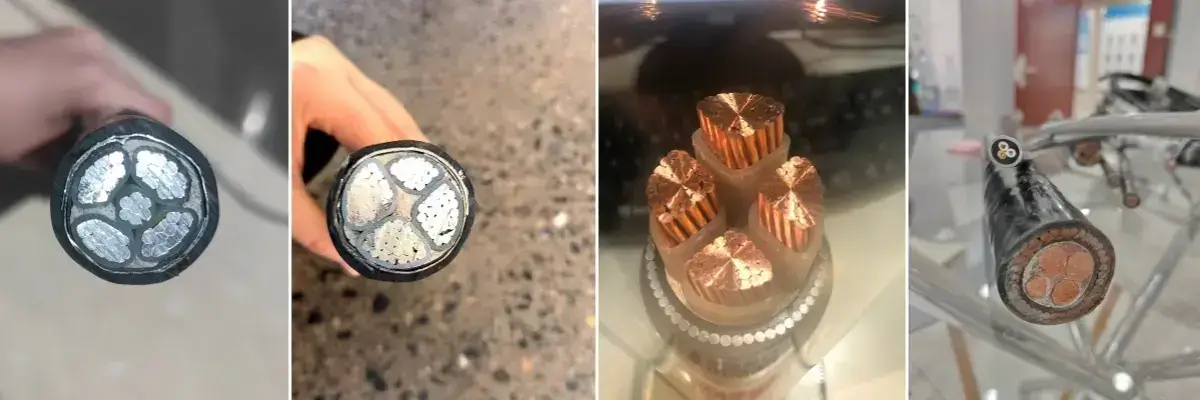
Aluminium is the most over-promised saving in this category. The conductor metal costs less, but the cable is bigger for the same current, the terminations are different, and the installation crew needs to know what it is doing. The saving is real on some projects and gone on others.
The numbers behind the conversion: copper resistivity is about 0.0172 Ω·mm²/m at 20 °C, aluminium about 0.0283 Ω·mm²/m, a ratio of 1.64. In practice, an aluminium cable needs roughly 1.5 to 1.6 times the copper cross-section for the same current, because the larger conductor also sheds heat better.
Table 4. Copper to aluminium conversion, and where the money goes.
On mobile devices, swipe horizontally to view the complete table.
| Copper section (mm²) | Aluminium section normally used (mm²) | Commercial note |
|---|---|---|
| 16 | 25 | Smallest aluminium size we normally build. Saving is small at this level. |
| 25 | 35 | Common in LV distribution. Terminal cost starts to matter. |
| 35 | 50 | Check duct size, since the aluminium cable is larger overall. |
| 50 | 70 | Weight advantage becomes visible from here upwards. |
| 70 | 95 | Typical feeder size in both metals. |
| 95 | 150 | A 120 mm² aluminium is usually too close to the copper 95 rating. Specify 150. |
| 120 | 185 | Outer diameter grows enough to affect tray loading and duct fill. |
| 150 | 240 | Handling equipment starts to matter on site. |
| 185 | 300 | Confirm drum size and site access before ordering. |
| 240 | 400 | Strong saving case on long runs. Weigh the termination cost against it. |
| 300 | 500 | Weight saving is substantial at this level. |
| 400 | 630 | Largest combination we build. Confirm the pulling plan before ordering. |
Source note: conversion based on the resistivity ratio and typical current ratings. The final section comes from the cable calculation for the actual installation conditions. Resistivity values per IEC 60028.
Three things decide whether the saving survives.
Run length. Aluminium wins on long runs. On a 40 m run at 50 mm², the metal saving rarely covers the extra care at the terminations. On a 400 m buried feeder at 185 mm², it usually does, and the drum is also lighter to handle.
Terminations. Every aluminium connection needs a bimetallic transition or a copper-aluminium lug, an oxide-inhibiting compound, and correct torque. If the contractor prices those as an extra, add it back into the comparison before deciding.
Additional Field Note on Aluminium Terminations: When aluminum conductors are terminated in standard copper-busbar panel boards without bimetallic connectors (Cu-Al lugs), galvanic corrosion occurs rapidly in humid environments. Ensure your project specifications explicitly require friction-welded copper-aluminium transition lugs and an approved joint compound to prevent high-resistance joints over time.
Crew experience. Aluminium oxide is an insulator. A crew that treats it like copper will produce hot joints within two years. If the site has not installed aluminium before, budget for supervision.
We build four core armoured cable in both metals, from 16 mm² in aluminium and from 1.5 mm² in copper. If you are comparing the two for a specific project, send the route length and the load and we will quote both.
Most quotation errors in this category come from a model string, not from a technical disagreement. The same cable carries a different name in each market, and a supplier reading a familiar-looking code can build a different armour.
Chinese designations pack the construction into letters and digits. YJ is XLPE insulation, L is aluminium conductor (no L means copper), V is PVC sheath. The digits then give the armour: 22 is steel tape with PVC sheath, 23 is steel tape with PE sheath, 32 is steel wire with PVC sheath, 33 is steel wire with PE sheath.
So YJV22 is Cu/xlpe/pvc/sta/pvc. YJLV32 is Al/xlpe/pvc/swa/pvc. Add a WDZ prefix and the sheath becomes low smoke halogen free (lszh).
Table 5. The same cable in four naming systems.
On mobile devices, swipe horizontally to view the complete table.
| Construction | Chinese designation | British / IEC description | Product standard |
|---|---|---|---|
| Cu, XLPE, steel tape, PVC | YJV22 | Cu/XLPE/STA/PVC 4C×S | IEC 60502-1; BS 5467 permits tape armour |
| Cu, XLPE, steel wire, PVC | YJV32 | Cu/XLPE/SWA/PVC 4C×S | IEC 60502-1; BS 5467 |
| Al, XLPE, steel tape, PVC | YJLV22 | Al/XLPE/STA/PVC 4C×S | IEC 60502-1 |
| Al, XLPE, steel wire, PVC | YJLV32 | Al/XLPE/SWA/PVC 4C×S | IEC 60502-1 |
| Cu, XLPE, steel wire, PE | YJV33 | Cu/XLPE/SWA/PE 4C×S | IEC 60502-1 |
| Cu, XLPE, steel wire, LSZH | WDZ-YJY23 / WDZ-YJY32 | Cu/XLPE/SWA/LSZH 4C×S | BS 6724 |
| Cu, PVC insulation, steel wire, PVC | VV32 | Cu/PVC/SWA/PVC 4C×S | BS 6346; IEC 60502-1 |
| North American style | Not used | 4C 4/0 AWG XLPE SWA PVC | ICEA S-95-658; UL 1072 where required |
Source note: Chinese designations follow GB/T 12706.1, which adopts IEC 60502-1. British descriptions follow BS 5467, BS 6724 and BS 6346 usage. A designation is not a specification on its own; the standard has to be stated alongside it.
Two checks are worth making on every quotation you receive.
22 against 32. These are not interchangeable. They differ in armour type, and therefore in tensile capability, diameter, weight, lead time and price. A supplier offering 22 against a schedule asking for 32 is offering a different cable, even with the same conductor.
Model number without a standard. YJV32 built to GB/T 12706.1 and YJV32 built to BS 5467 are close relatives, but the test regime, the sheath compound and the marking differ. If your specification says BS 5467, the quotation should say BS 5467, not only YJV32.
Armour Thickness Tolerance Note: Be aware that standard IEC 60502-1 allows a slightly broader tolerance range for galvanized steel wire diameter compared to the strict minimum requirements under BS 5467. If the installation is subject to heavy mechanical stress or potential rock impact during backfilling, specifying BS 5467 construction guarantees a heavier, more resilient armour layer.
Send the same 4C×95 mm² SWA specification to six factories and you will get six prices spanning a range that looks impossible for a commodity. It is not fraud in most cases. It is ten different decisions about what goes inside the cable, and the buyer rarely sees any of them.
This section exists so that you can ask the right question on each line.
Table 6. The ten variables that move a 4 core armoured cable price.
On mobile devices, swipe horizontally to view the complete table.
| Variable | The cheaper version | The compliant version | What it changes on site |
|---|---|---|---|
| Copper price basis | A price quoted on a favourable day, with no basis date and no validity period. | A stated reference date (LME cash, Shanghai Futures or a fixed basis) and a stated validity. | Copper can move several percent in a month. A price without a basis is not a price, it is an invitation to renegotiate. |
| Conductor class and compaction | Non-compacted Class 2 stranding, or a lighter stranding pattern. | Compacted Class 2, with the strand count and nominal diameter stated. | Affects overall diameter, terminal fit and the actual copper content. Compacted conductors use less metal for the same nominal section. |
| Nominal section tolerance | Resistance measured to the lower limit of the standard, giving slightly less metal. | Resistance comfortably inside the limit, with the measured value on the routine test sheet. | Both can pass, but the margin matters on a feeder running near its rating. Ask for the measured resistance, not just a pass mark. |
| Armour wire or tape size | The minimum wire diameter the standard permits. | A wire or tape size stated on the datasheet, with the earth fault capability checked. | Thinner armour means less mechanical protection and, where the armour is the earth path, less fault current capability. |
| Insulation thickness | Nominal thickness at the lower tolerance across the whole length. | Nominal thickness with the minimum point checked, as the standard requires. | Thin insulation at a bend or a gland is where failures start. It is invisible in a photograph. |
| Bedding | Taped bedding, thinner and faster to apply. | Extruded bedding where the standard or the application calls for it. | Taped bedding can shift during bending, letting the armour press on the insulation. |
| Sheath compound | A general-purpose PVC, or a PE grade with lower UV or oil resistance. | The compound named in the standard, with UV stabilisation for exposed routes. | Sheath cracking after two summers outdoors is a compound problem, not an installation problem. |
| Standard and edition | Built to a generic IEC equivalent and described loosely. | Built and tested to the named standard and edition, with that standard on the drum and the certificate. | BS 5467 and BS 6724 impose compound and test requirements that a generic build does not automatically meet. |
| Drum length | Short drums, which reduce factory handling and freight weight per metre. | The drum length stated in the order, with jointing minimised. | The cheapest offer is often the one with the shortest drum. Jointing cost and joint failure risk move to site. |
| Testing and documentation | Routine tests only, with a generic certificate. | Routine tests per drum plus type test reports for the construction, and third-party witness testing if required. | Type test reports are what a consultant asks for at technical review. A routine test sheet does not answer that question. |
Source note: these variables reflect common differences between offers in the low-voltage armoured cable market. Which of them matter depends on the project specification. They are a questioning aid, not an accusation against any supplier.
The single question that surfaces most of this: ask each supplier to state, in the quotation, the standard, the conductor class, the armour wire or tape size, the sheath compound and the drum length. A quotation that answers all five can be compared. One that answers none of them cannot, no matter how the total looks.
There is one more variable that is not in the table, because it does not belong to the cable: who is actually making it. A trading company quoting a factory price adds a margin and controls neither the schedule nor the test documents. That is the subject of the next section.
Tired of ambiguous quotations and hidden compromises? Get a transparent, compliance-backed quotation from Huanghe Cable:
| Request a Quote | WhatsApp Us | Email Sales Team |
Most buyers in this category are talking to a mix of factories, trading companies and factories that also trade. None of that is automatically bad, but you should know which one you are dealing with before you pay a deposit, because the three behave differently when a test fails or a schedule slips.
These checks can be done before the first order, mostly by email.
Table 7. Six checks that separate a factory from a trader.
On mobile devices, swipe horizontally to view the complete table.
| Check | What a factory can answer | What a trader usually cannot |
|---|---|---|
| Ask for a type test report | A report for the specific construction, with the laboratory named, the standard and edition, and the tested sizes listed. | A generic certificate, a routine test sheet, or a report for a different construction that is described as “similar”. |
| Ask about BS 5467 and BS 6724 | A specific answer about which parts of the standard the construction meets and which test evidence exists. | A confident yes with no detail, or a pivot to “we can do IEC equivalent”. |
| Ask about the top size | A clear answer on whether 500 and 630 mm² four core is available, and what the drum and schedule constraints are. | An immediate yes for every size, because the answer costs nothing when you are not the one making it. |
| Ask about aluminium | Whether both metals are made in-house, and from what minimum size. | A yes that turns into a longer lead time, because the cable is being sourced from another plant. |
| Ask for third-party inspection | Acceptance of SGS, BV, TÜV, Intertek or a nominated inspector, with a defined scope and access to the test bay. | Resistance, or a condition that inspection happens only at a warehouse after the cable has been moved. |
| Ask for a live video walk-through | Stranding, insulation extrusion, armouring and sheathing shown in sequence, on a call you schedule. | A pre-recorded video, or a tour that stays in the warehouse and the office. |
Source note: these are general procurement checks, not a certification scheme. A trading company can be a legitimate and useful supplier; the point is to know which model you are buying through, because the risk profile differs.
The equipment question is the one that settles it fastest. A factory that can make 4 core armoured cable to 630 mm² has, by necessity, a stranding line, an insulation extrusion or cross-linking line, an armouring machine that handles large diameters, and a sheathing line to match. That is a capital investment that trading companies do not make. Ask what the largest four core drum they have shipped is, and ask for the drum diameter.
One more thing worth asking, and it is not about capability. Ask what happens when a routine test fails. A factory will describe a re-test, a hold on the drum and a root cause. A trader will describe a phone call to someone else.
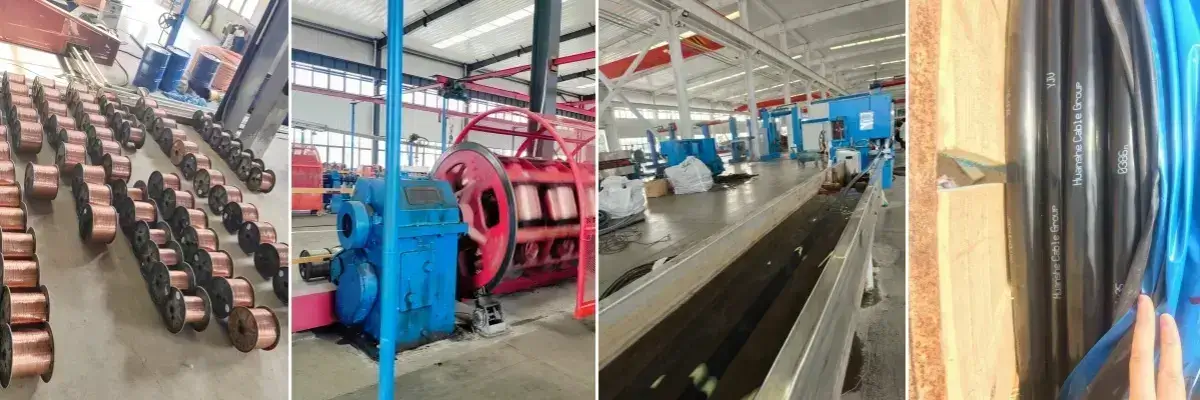
Huanghe Cable is a Chinese manufacturer of low-voltage power cable, exporting to Southeast Asia, Central Asia and Africa. Four core armoured cable is one of our standard product families, not an occasional build.
The reason this matters to a buyer is simple. Huanghe’s armoured cable manufacturing involves conductor preparation, insulation extrusion, armouring and outer sheathing. Buyers can request production-line information and a factory walkthrough to verify the processes relevant to their specified cable. When a supplier outsources any of those, the schedule and the quality both become someone else’s problem.
What we build.
Size range: 1.5 mm² to 400 mm² per conductor, copper and aluminium, full series.
Armour: both types in production. Steel wire (SWA, code 32/33) and steel tape (STA, code 22/23).
Insulation: XLPE rated 90 °C, or PVC rated 70 °C.
Sheath: PVC, PE, or LSZH for tunnels, metro and enclosed public buildings.
Voltage: 0.6/1 kV.
Arrangements: 4 equal cores, 3.5 core, and 3 core with the earth taken from the armour.
Standards we build and test to. Constructions are built to IEC 60502-1 and GB/T 12706.1, which adopts the IEC standard. We also build to BS 5467 and BS 6724 constructions, which is what most enquiries from British Standard markets actually need.
Those two statements are different and it is worth being precise about it. Built to BS 5467 means the construction, the compounds and the test regime follow that standard. It does not mean the cable carries a BASEC or LPCB product certificate, because it does not.
Certifications: Huanghe Cable holds CB certification for applicable product scopes and manufactures cables in accordance with relevant IEC standards and agreed project specifications.
Routine Electrical Tests: Including conductor resistance, insulation resistance and voltage withstand tests, are carried out according to the applicable product standards and agreed inspection requirements.
Third-Party Inspection: For project orders, we can provide available product and quality documentation for review. Third-party inspection by SGS or other appointed inspection agencies can also be coordinated at our factory, subject to the inspection scope and project requirements.
The inspection plan, applicable standards, required tests and documentation should be confirmed before order placement. This helps ensure that the supplied cable construction and inspection records match the technical requirements of the project.
What we do not hold. BASEC or LPCB product certification for the British Standard families, and a CPR reaction-to-fire classification under EN 50575. Europe is not a market we serve, and we do not issue declarations we cannot support.
If your specification requires one of those certificates, tell us at enquiry stage. We will say plainly that we cannot provide it, rather than bid and let the gap surface after award.
How we handle a specification we cannot meet. We decline it. A cable that is 90% right is a rejected shipment, and both sides lose more from that than from an enquiry that ends early.
A note on certification claims in this market. Plenty of suppliers describe themselves as “BS certified” when they mean the cable is built to a BS construction. Ask for the certificate number and the issuing body. If the answer is a construction description rather than a certificate, you now know what you are buying.

Armoured cable is heavy, and weight decides most of the logistics. A 40-foot high cube will run out of payload long before it runs out of space on anything above 50 mm².
MOQ. Minimum order quantity applies per size, not per order, because each size is a separate production run with its own set-up. A schedule with six sizes is six runs. If you need a small quantity of a large size, say so early, because that is the combination that decides whether an order is workable.
Lead time. It depends on three things and it is worth asking about each separately. SWA takes longer than STA at the same conductor size, because wire drawing and stranding add process steps. Aluminium takes longer than copper at the same nominal size, because the conductor is larger and the stranding run is longer. LSZH takes longer than PVC, because the compound is more sensitive to process temperature and the run speed is lower.
Ask for lead time in writing, separately for standard season and peak season. A single number quoted in the quiet part of the year is not a commitment.
Table 8. Approximate container loading for 4 core SWA copper cable.
On mobile devices, swipe horizontally to view the complete table.
| Size (mm²) | Mass (kg/m) | Approx. metres, 20GP | Approx. metres, 40HQ | Limiting factor |
|---|---|---|---|---|
| 25 | 2.60 | About 6,900 m | About 9,600 m | Payload, then drum count |
| 50 | 4.40 | About 4,000 m | About 5,600 m | Payload |
| 95 | 7.40 | About 2,400 m | About 3,300 m | Payload and drum diameter |
| 150 | 11.0 | About 1,600 m | About 2,250 m | Payload |
| 240 | 17.0 | About 1,050 m | About 1,450 m | Payload, drum size |
| 400 | 27.5 | About 650 m | About 900 m | Payload and drum diameter |
| 630 | 43.0 | About 400 m | About 580 m | Drum diameter first, then payload |
Source note: indicative only, based on a 20GP payload of about 18 t and a 40HQ payload of about 25 t, with typical drum sizes. Actual loading depends on drum diameter, drum count, port weight limits and road transport limits at destination. Confirm the drum plan before booking.
Two logistics points that cause problems after the order is placed.
Drum diameter. At 400 and 630 mm², the drum can be the constraint rather than the weight. A drum that does not fit a standard flatbed, or that exceeds a destination road limit, turns into a re-packing exercise at the port. Agree the drum diameter in writing.
Destination weight limits. Some markets limit axle load on the final road leg. A 40HQ at full payload may have to be split across two trucks, which changes the delivered cost. If your site is inland, tell us at quotation stage.
An enquiry that reads “4 core 95 armoured cable, 500 metres” produces quotations that cannot be compared, because every supplier fills in the gaps differently. The fix is to close the gaps in the enquiry.
Example enquiry, written so it can be answered
Construction: Cu/XLPE/SWA/PVC, 4 core equal, 0.6/1 kV
Standard: BS 5467
Sizes: 4×95 mm², 620 m; 4×50 mm², 480 m; 4×25 mm², 350 m
Conductor: copper, Class 2 compacted
Route: cable tray in a plant room, then buried direct for 180 m
Drum: 500 m preferred, split drums acceptable
Delivery: CIF Mombasa, copper basis LME cash settlement on order date, validity 7 days
Documents: routine test certificate per drum, type test reports for the construction, third-party inspection acceptable
Two quotations built from that enquiry can be compared line by line. Two quotations built from “4 core 95, 500 m” cannot, because the armour, the sheath, the standard and the drum length are all still open, and each of them moves the price.
Send Your Cable Schedule for a Quotation
Huanghe builds 4 core armoured cable from 1.5 to 400 mm², in copper and aluminium, SWA and STA, to IEC 60502-1 and BS 5467 or BS 6724 constructions. Send the BOQ or the specification and we will confirm which sizes we can build, what standard we can test to, and what the drum plan looks like.
| Request a Quote | WhatsApp Us | Email Sales Team |
From 1.5 mm² to 400 mm² per conductor, in the standard series, with no gaps in the usual steps. Copper starts at 1.5 mm² and aluminium at 16 mm². Above 400 mm² the cable is a special-order item and the drum plan needs to be agreed in advance.
Yes, both are in production. SWA is steel wire armour, Chinese code 32 with PVC sheath and 33 with PE sheath. STA is steel tape armour, code 22 with PVC and 23 with PE. The two differ in tensile capability, diameter, weight, lead time and price, so it is worth confirming which one your drawing actually specifies.
Yes, from 16 mm² upwards, with both armour types. Aluminium needs roughly 1.5 to 1.6 times the copper cross-section for the same current, so a copper 95 mm² enquiry becomes aluminium 150 mm², not 120 mm². Send the load and the route and we will confirm the size.
Yes. We build and test to those constructions. We do not hold BASEC or LPCB product certification, and we do not hold a CPR reaction-to-fire classification under EN 50575. If your specification requires a product certificate rather than a construction built to the standard, tell us at enquiry stage and we will say so before quoting.
It applies per size, not per order, because each size is a separate production run. The practical minimum depends on the construction and the size, and a large size at small quantity is the combination that decides whether an order is workable. Send the size list and we will confirm per line.
It depends on three things. SWA takes longer than STA at the same size, aluminium takes longer than copper, and LSZH takes longer than PVC. Ask for the figure in writing, separately for standard and peak season, because a number quoted in a quiet month is not a commitment.
Available test reports and product quality documents can be provided for review, subject to the cable type, construction and applicable certification scope. For projects requiring additional inspection or testing, third-party inspection by SGS or another appointed agency can be coordinated at our factory, subject to prior agreement on the inspection scope and requirements.
The required standards, test items and documentation should be confirmed during the technical review before order placement.
Yes. SGS, BV, TÜV, Intertek or a nominated inspector, with the scope agreed before the visit and access to the test bay. We prefer the scope to be fixed at order stage, because inspection requirements added later usually mean the drum has already been packed.
On the metal content at a stated basis date, plus the construction, the standard, the drum length and the freight term. Ask for the basis date and the validity period in the quotation. Copper can move several percent in a month, so a price without a basis is not a firm price.
Standard lengths and made-to-order lengths, subject to drum diameter and weight limits. At 400 and 630 mm² the drum is often the constraint rather than the cable weight, so the drum diameter should be agreed in writing before the order is confirmed.
For 4 core SWA copper cable, roughly 3,300 m of 95 mm² in a 40HQ, and about 2,250 m of 150 mm². These are weight and drum limited estimates. Actual loading depends on drum diameter, drum count and destination road limits.
Yes, in copper and aluminium, SWA and STA, built to BS 6724 constructions. LSZH takes longer to produce than PVC because the compound is more sensitive to process temperature. If the project specifies LSZH and the quotation says PVC, that is a different cable, not a cheaper one.
Sources and scope: Construction and test references follow IEC 60502-1, GB/T 12706.1, BS 5467, BS 6724 and BS 6346. Current ratings are indicative and follow the order of magnitude of BS 7671 Appendix 4 and IEC 60364-5-52; the edition in force for the project governs. Diameters, masses and container figures are indicative and vary with construction, drum size and carrier. Published November 2026.
Technical note: Cable selection, protective device coordination and earthing design remain the responsibility of the project engineer. The information on this page supports procurement decisions and does not replace the installation design.

Please contact us for a free quotation by the below form. We promise the quickest response within 12 hours.