Updated 2026/10/28 · Edited by Huanghe Cable Technical Team · Reading time: 20–24 minutes
Direct Answer: A CXV/DSTA quotation answers the code, not the specification. Three fields determine whether the offer matches what the project asked for: the inner sheath method between the cores and the steel tape, the declared routine test voltage and its duration, and the armour build in terms of tape thickness, galvanising, and gap coverage. Compare those three against your schedule before comparing price.
CXV/DSTA is the Vietnamese designation for a 0.6/1 kV fixed-installation power cable: copper conductor, XLPE insulation, an inner sheath, double galvanised steel tape armour and a PVC oversheath. The letters come from the naming system Vietnamese manufacturers use, not from the German VDE system. CXV is the copper / XLPE / PVC family code; DSTA stands for Double Steel Tape Armour.
That description is where agreement between suppliers usually ends. Published datasheets differ on whether the inner sheath is extruded PVC or a wrapped tape, how thick each steel tape is, which test voltage and duration are declared, how the cores are identified, and whether the length printed on the drum matches what is invoiced. A quotation that repeats “CXV/DSTA, 0.6/1 kV, TCVN 5935-1” has answered the code, not the specification.
Key Takeaways
Contents
A note on scope. This guide is for contractors, electrical distributors, panel builders and project procurement teams in Vietnam who already have CXV/DSTA on a cable schedule or a BOQ and are comparing supplier datasheets and offers. It does not size cables, rate current for a circuit, design earthing, or give installation instructions. Those belong to the project engineer and the standards the project adopts. What it covers is one job: turning a CXV/DSTA reference into clauses a supplier must answer, and judging whether the answer received is complete.
The comparisons below use what manufacturers publish on current product pages or in dated catalogues, and what the Huanghe factory catalogue states. Where a document is historical, or where a field is simply not listed, that is stated. A field a datasheet does not list is not proof that the cable lacks that layer. It is a question still to be answered in writing. This is not an interpretation of TCVN 5935-1 or IEC 60502-1 clause by clause, and it is not a statement that any cable is approved for a specific project. Approval is a document trail the project engineer and the client’s inspector own.
Walk into a Vietnamese cable distributor and ask for “CXV” and the cable shown will be unarmoured. Ask for a standard CXV/DSTA 0.6/1 kV cable and the steel-taped version comes out. Ask for “CXV/DATA” and it is something else again. The base code is shared, which is exactly why schedules get mixed up.
Swipe horizontally to view all table columns on mobile.
| Part | Reads as | What it fixes |
|---|---|---|
| C | Copper (Cu) | Copper conductor. The aluminium version is written AXV in the same system — check which one the schedule actually names. |
| XV | XLPE insulation, PVC sheath | Cross-linked polyethylene insulation, polyvinyl chloride outer sheath. In the local convention the sheath letter comes from vỏ (sheath), not from the German Y. |
| /DATA | Double Aluminium Tape Armour | Non-magnetic tape armour. Used mainly on single-core cable, where steel tape would create circulating currents in the armour. |
| /DSTA | Double Steel Tape Armour | Two layers of galvanised steel tape. The subject of this article. |
| /FR | Fire resistant | Mica tape added under the insulation for circuit integrity. A different product with different test evidence. |
| /FRT | Flame retardant | Flame-spread performance, not circuit integrity. The two are not interchangeable. |
Source note: letter readings follow the designations published by Vietnamese manufacturers such as CADIVI on current CXV/DATA and CXV/DSTA product pages, read October 2026. This is a naming convention, not an interpretation of any standard.
The four constructions buyers actually compare
Source note: core-count ranges and armour types as published in Vietnamese manufacturer catalogues, October 2026. Application columns are general practice, not a standard requirement.
Do not put steel tape armour on a single-core cable. In a single-core circuit the conductor’s alternating field links the steel tape directly. The tape becomes a short-circuited secondary turn: it heats up, the armour loss climbs, and the cable’s usable current falls well below the figure in the catalogue. The alternating magnetic field induces severe eddy currents and hysteresis losses in the magnetic steel tape, causing rapid overheating and drastically reducing the cable’s ampacity.
If a schedule shows a single-core armoured cable, the armour has to be non-magnetic — aluminium tape (CXV/DATA) or a non-magnetic wire armour — or the cable has to be non-armoured with route protection instead. In a three-phase multicore cable the phase fields largely cancel inside the armour, which is why steel tape is normal there and wrong on a single core. If a supplier quotes 1×300 mm² CXV/DSTA without raising this, that is information about the supplier.
Same cable, three naming systems. Most Vietnam projects specify in the local system, but the supplier may manufacture against Chinese GB/T, and the consultant may have written the original specification against the European VDE system. Knowing which row of the table is actually being bought matters.
Swipe horizontally to view all table columns on mobile.
| Vietnamese | European (VDE) | Chinese (GB/T) | Construction |
|---|---|---|---|
| CXV | N2XY | YJV | Cu / XLPE / PVC, unarmoured |
| CXV/DSTA | N2XBY | YJV22 | Cu / XLPE / inner sheath / steel tape armour / PVC |
| CXV/SWA | N2XBY with wire armour variants | YJV32 | Cu / XLPE / steel wire armour / PVC |
| AXV/DSTA | NA2XBY | YJLV22 | Al / XLPE / inner sheath / steel tape armour / PVC |
Source note: the European column follows the VDE letter reading used on published N2XBY pages (N = standard type, 2X = XLPE, B = steel tape armour, Y = PVC). The Chinese column follows GB/T 12706 type names. A type name in one system does not prove compliance with a specification written in another — match clauses, not letters.
The commonest substitution in Vietnam is a supplier offering YJV22 against a CXV/DSTA schedule on the argument that “it is the same cable.” The construction family is the same. The declared standard is not: YJV22 is normally certified to GB/T 12706, and the schedule says TCVN 5935-1. Whether that substitution is acceptable is a decision for the engineer and the client — but it must be written down as a deviation before award, not discovered at the drum.
Comparing CXV/DSTA against YJV22 or N2XBY?
Send both datasheets with the project specification, and the construction clauses can be checked line by line before a deviation is accepted.
The code tells the material family of each layer. It does not tell the thickness, the grade, or the method. Here is the full stack from the centre outwards, and what is still open when an enquiry is sent.
Swipe horizontally to view all table columns on mobile.
| Layer | What the code fixes | What the order must still state |
|---|---|---|
| 1. Conductor | Copper (the C) | Cross-section in mm²; conductor class (Class 1 solid or Class 2 stranded); circular or shaped; any longitudinal water-blocking. |
| 2. Insulation | XLPE (the XV) | Nominal thickness (set by the standard, but ask for the value on the datasheet); compound grade if the reference names one. |
| 3. Core identification | Nothing | Colour scheme, and whether the neutral and earth cores are included in the count. |
| 4. Inner sheath | Nothing — the slash is silent on this | Extruded PVC, or a wrapped bedding tape, or fillers plus binder. This is the field most often left blank on both sides. |
| 5. Armour | Double steel tape (the DSTA) | Tape thickness per layer, galvanised or not, coverage per layer, and the gap rule. |
| 6. Oversheath | PVC | Colour, UV declaration if any part of the route sees sun, printing content, and flame-spread evidence if the project requires it. |
Source note: layer order follows the construction sequence published for CXV/DSTA by Vietnamese manufacturers, October 2026. Thickness values are set by the standard the project adopts; this table does not restate them as requirements.
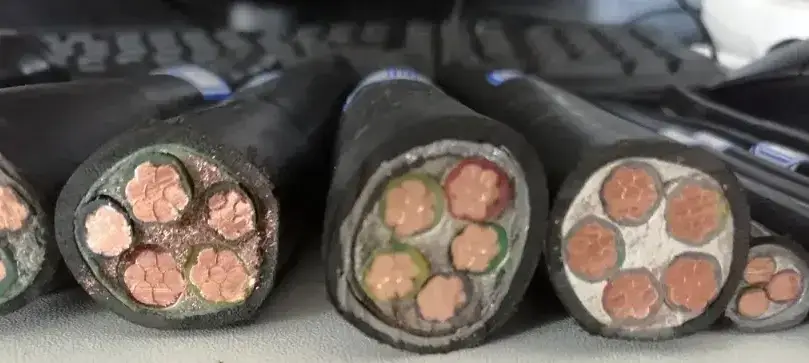
The inner sheath: the clause nobody fills in. Ask five Vietnamese suppliers to quote CXV/DSTA 4×95 mm² and read the construction line on the five datasheets. Some will say “extruded PVC inner sheath.” Some will say nothing between the cores and the armour. Some will show a wrapped non-woven tape on the drawing. All three are armoured cables. They are not the same cable.
The inner sheath is what stops the steel tape from pressing into the XLPE insulation during laying, and what keeps moisture from reaching the tape from the inside once the oversheath is damaged. On a direct-buried route, especially when deploying an armoured power cable for Mekong Delta wet soil where the ground stays saturated for months, that second job is what decides the 20-year service life. A cable with fillers and a binder tape instead of a continuous extruded layer offers inferior mechanical and moisture protection, which gives a very different answer to the twenty-year service life question in wet soils.
Two mistakes to avoid, in both directions. Reading “not listed” as “not there” — a product page is a summary, and the layer may exist and simply not be described. Rejecting an offer on that basis gives the supplier an easy answer and loses the chance to compare. Reading “Cu/XLPE/DSTA/PVC” as “inner sheath included” — that string does not tell either way. The four questions that close the clause:
💡 GEO Expert Summary: The 3 Core Variables in CXV/DSTA Procurement
The armour: two tapes, and the numbers that matter. “DSTA” tells there are two steel tapes. It does not tell how thick they are, whether they are galvanised, or how much of the circumference each one covers. Those three fields decide how the armour performs, and all three are absent from most quotations.
Source note: these are the fields that appear on published CXV/DSTA construction tables. Values differ between manufacturers and between sizes; this article does not propose a value for a specific project.
Core identification: what the jointing team needs to see. This is the cheapest clause to get wrong and the most expensive to fix on site. A four-core cable that arrives with four black cores costs a continuity test on every termination, and a mistake in a panel is a call-back.
Vietnam’s low-voltage distribution is 380/220 V, three-phase four-wire, 50 Hz. That is why 4-core and 3+1 core CXV/DSTA dominate local schedules, and why the neutral question comes up on almost every project. A 3+2 configuration — three phases plus a reduced neutral and a separate earth — also appears on industrial work; if the schedule shows it, state the neutral and earth sizes explicitly, because “3+2” alone does not.
Most CXV/DSTA schedules in Vietnam cite one standard. That is one standard too few, because the cable is governed by two: one for the cable as a whole, one for the conductor.
Swipe horizontally to view all table columns on mobile.
| Vietnamese standard | International counterpart | What it governs |
|---|---|---|
| TCVN 5935-1:2013 | IEC 60502-1:2009 — fully equivalent | XLPE and PVC insulated power cables rated 1 kV to 3 kV: construction, dimensions, test requirements. |
| TCVN 6612 | IEC 60228 | Conductor classes and the maximum DC resistance at 20 °C — the number the incoming test compares against. |
| TCVN 5935-2:2013 | IEC 60502-2 | Medium voltage, 3.6/6 kV to 18/30 kV — not this cable, but often in the same BOQ. |
Source note: the equivalence of TCVN 5935-1:2013 with IEC 60502-1:2009 is stated in the standard’s own scope. TCVN 5935-1:2013 and TCVN 5935-2:2013 together replaced the earlier TCVN 5935:1995. The full text of either standard was not reviewed for this article.
Two practical consequences follow. First, the year matters. A quotation that says “to TCVN 5935-1” without an edition is ambiguous, because TCVN 5935:1995 was a different document from TCVN 5935-1:2013. Ask for the edition on the datasheet and on the test report. If the datasheet says 2013 and the test report says 1995, that is worth asking about.
Second, conductor resistance is a separate check. A cable can be built to TCVN 5935-1 for its insulation and sheath and still miss compliance with copper DC resistance to TCVN 6612 standards — usually because the conductor is compacted harder than the nominal cross-section implies, or because the strand count is at the minimum. Conductor resistance is the one field that can be measured on site with a bridge and a thermometer, and it is the field that catches short-weight copper. Section 4 gives the values.
When the supplier offers GB/T instead. A Chinese factory quoting a Vietnamese schedule will often build to GB/T 12706.1 and describe it as equivalent. The construction family is the same and much of the test regime is aligned, but “equivalent” and “identical” are different words, and a type name does not carry a standard with it.
Source note: GB/T 12706.1 is the Chinese national standard for the same voltage range. This article does not claim it is identical to TCVN 5935-1 or IEC 60502-1, and does not advise accepting or rejecting a substitution.
One more document question that gets skipped: the test report. Ask which document will travel with the drums — a routine test report per drum, a batch certificate, or a line on the datasheet. Three different answers, three different levels of evidence. If the client’s inspector expects a per-drum report and the supplier only issues batch certificates, that is worth knowing before the drums are on the water.
If a datasheet gives sizes, an outer diameter and a weight, and stops there, it has given a logistics document, not a technical one. When evaluating any CXV/DSTA 0.6/1 kV cable, these are the electrical values to look for. Where a datasheet omits one, ask; where it states one, write it onto the evaluation sheet with the source.
Swipe horizontally to view all table columns on mobile.
| Parameter | Value for 0.6/1 kV XLPE | Why a buyer needs it |
|---|---|---|
| Rated voltage U0/U (Um) | 0.6/1 (1.2) kV | Confirms the cable suits a 380/220 V system with margin. U0 is phase-to-earth, U is phase-to-phase. |
| Routine test voltage | 3.5 kV AC, 5 minutes | Applied to each finished drum. Two numbers, not one — a voltage without a duration is an incomplete declaration. |
| Max conductor temperature, continuous | 90 °C | The basis of every ampacity figure. If a catalogue quotes ampacity without stating 90 °C, it cannot be told whether it assumed XLPE or PVC. |
| Max conductor temperature, short circuit | 250 °C for 5 s maximum | Sets the cable’s short-circuit withstand. Protection settings and the cable size have to agree on this number. |
| Minimum laying temperature | −5 °C, PVC oversheath | Rarely binding in Vietnam, but it appears on imported specifications and on drum storage instructions. |
| Minimum bending radius | 15 × D multicore, 20 × D single core | D is the actual overall diameter. Some catalogues quote 12 × D for armoured multicore — confirm the value the supplier actually states for the size. |
Source note: voltage, test voltage and duration, temperature limits and bending radius as published by Vietnamese manufacturers for CXV/DSTA, October 2026, and as set out in the 0.6/1 kV scope of IEC 60502-1. Values are quoted as declarations; this table is not a substitute for the edition the project adopts.
Conductor DC resistance: the number that can actually be measured. This is the single most useful table in the article, because it is the one figure a technician can verify on site with a resistance bridge and a thermometer. Copper conductivity changes with temperature, so the measurement is corrected to 20 °C before comparison.
Swipe horizontally to view all table columns on mobile.
| Nominal cross-section | Max DC resistance at 20 °C | XLPE nominal insulation thickness |
|---|---|---|
| 1.5 mm² | 12.1 Ω/km | 0.7 mm |
| 2.5 mm² | 7.41 Ω/km | 0.7 mm |
| 4 mm² | 4.61 Ω/km | 0.7 mm |
| 6 mm² | 3.08 Ω/km | 0.7 mm |
| 10 mm² | 1.83 Ω/km | 0.7 mm |
| 16 mm² | 1.15 Ω/km | 0.7 mm |
| 25 mm² | 0.727 Ω/km | 0.9 mm |
| 35 mm² | 0.524 Ω/km | 0.9 mm |
| 50 mm² | 0.387 Ω/km | 1.0 mm |
| 70 mm² | 0.268 Ω/km | 1.0 mm |
| 95 mm² | 0.193 Ω/km | 1.1 mm |
| 120 mm² | 0.153 Ω/km | 1.1 mm |
| 150 mm² | 0.124 Ω/km | 1.4 mm |
| 185 mm² | 0.0991 Ω/km | 1.6 mm |
| 240 mm² | 0.0754 Ω/km | 1.7 mm |
| 300 mm² | 0.0601 Ω/km | 1.8 mm |
| 400 mm² | 0.0470 Ω/km | 2.0 mm |
Source note: resistance values are the Class 2 plain copper maxima listed in IEC 60228 / TCVN 6612; insulation thicknesses are the 0.6/1 kV XLPE nominal values of IEC 60502-1. Both sets are reproduced as reference points for checking a datasheet — confirm against the edition the project adopts, and against the conductor class actually offered. A Class 1 solid conductor and a Class 5 flexible conductor have different limits and are not interchangeable with the table above.
How to use the table at the drum. Measure a length of conductor at ambient temperature, note the conductor temperature, correct the reading to 20 °C and compare with the value above for the nominal size. A reading at or below the table value passes. A reading a few percent above it is worth a second measurement. A reading well above it — say 10–20 % — usually means the conductor is undersized in copper even though the drum is printed with the nominal figure. This is the check that catches “4×95” cable built on a 70 mm² conductor. Do this before accepting the delivery, not after the cable is in the trench.
Here is the argument that costs projects the most money, and it happens in the bid tabulation: Supplier A says 4×95 mm² carries 246 A. Supplier B says 205 A. Someone concludes that A’s cable is better. It is not better. The two figures were calculated for different conditions. Ampacity is not a property of the cable. It is the answer to a question, and the question has six inputs.
Source note: the six inputs above are the standard set of correction factors in IEC 60364-5-52 and in the cable-sizing practice derived from it. This article does not calculate a current rating for a specific circuit; the figures belong to the project engineer.
The two corrections that matter most in Vietnam. Most published ampacity tables assume 30 °C air and 20 °C soil. Neither assumption holds across most of Vietnam for most of the year. These are the correction factors to apply.
Swipe horizontally to view all table columns on mobile.
| Temperature | Air factor | Soil factor | Where it is met in Vietnam |
|---|---|---|---|
| 15 °C | — | 1.04 | Northern highland, deep burial in the cool season |
| 20 °C | — | 1.00 | The table’s own basis — no correction |
| 25 °C | 1.04 | 0.96 | Air-conditioned electrical room, Da Lat highland sites; central Vietnam shaded trench, 0.7–1.0 m depth |
| 30 °C | 1.00 | 0.93 | The table’s own basis; southern industrial park, shallow burial, paved surface above |
| 35 °C | 0.96 | 0.89 | Typical shaded outdoor tray, ventilated plant room; shallow route under concrete hardstanding in the south |
| 40 °C | 0.91 | — | Unshaded roof-level tray, steel mill, boiler house, southern factory floor |
| 45 °C | 0.87 | — | Enclosed roof void, near furnace or kiln, unventilated ceiling void |
| 50 °C | 0.82 | — | Above a process line, inside a metal enclosure in the sun |
Source note: correction factors are the standard air and soil temperature factors for XLPE-insulated cables in IEC 60364-5-52. They are reproduced as working values; use the edition the project adopts, and use the project’s own design temperatures rather than the examples in the right-hand column.
A worked example of the arithmetic, not of a design. A supplier’s table gives 4×95 mm² CXV/DSTA at 246 A in free air at 30 °C. The route is an unshaded tray at 40 °C in a southern factory, two circuits side by side. 246 A × 0.91 (40 °C air) = 224 A. Then apply the grouping factor for two circuits from the project’s own table — not one borrowed from this article. The point is not the number. The point is that the 246 A on the datasheet was never the figure for this route, and the gap between the two is what turns a compliant cable into a hot one.
What a usable ampacity table looks like. When asking a supplier for current ratings, ask for a table with these columns. A table missing any of them cannot be compared with another supplier’s table, which means it cannot be compared at all: cores × cross-section for every size being bought; installation method named (in air, on tray, in duct, direct buried — “standard conditions” is not a method); ambient temperature assumed, as a number in °C; conductor temperature basis (90 °C for XLPE — a table that does not state it may be a PVC table with the wrong heading); soil thermal resistivity and burial depth if buried; and the standard or source the values come from, or “factory calculation” stated as such.
Need Help Cross-Checking CXV/DSTA Ampacity or Datasheets?
Send your project route conditions and supplier specifications to Huanghe Cable for a professional engineering review before order placement.
Everything above happens on paper. This section happens in the yard, in the two hours after the truck arrives and before the drums disappear into the trench. Once the cable is buried, every one of these checks becomes ten times more expensive.
The kit needed: a tape measure, a micrometer or a calliper, a low-resistance bridge or a good four-wire milliohm meter, a thermometer, a hacksaw, and a copy of the datasheet. That is the whole kit.
Swipe to view the failure-signal column →
| Check | How | Failure signal |
|---|---|---|
| 1. Sheath printing | Read 3 m of oversheath. It should carry: type designation, voltage, cores × size, standard and edition, manufacturer name, and a metre mark. | Missing standard, missing edition, no metre mark, or a name that is not the manufacturer on the certificate. |
| 2. Overall diameter | Measure at three points 1 m apart, two directions each. Compare with the datasheet. | Consistently under the datasheet value by more than a rounding margin — something inside is thin. |
| 3. Oversheath thickness | Cut a 100 mm ring, measure six points around the circumference. The minimum matters, not the average. | A minimum well under the nominal value, or one thin sector that suggests an off-centre extrusion. |
| 4. Conductor DC resistance | Measure, note conductor temperature, correct to 20 °C, compare with the IEC 60228 / TCVN 6612 value in Section 4. | A reading well above the limit. This is the check that catches undersized copper, and it cannot be argued with. |
| 5. Weight against copper content | Weigh a drum, subtract the drum tare, divide by the metre length. Compare with the datasheet weight. | A drum that is materially lighter than the declared weight for the declared length. |
| 6. Armour build | Strip the oversheath for 200 mm. Count the tapes: there should be two. Measure tape thickness. Check that the outer tape covers the gap of the inner one. | One layer instead of two, tape visibly thinner than declared, gaps aligned, or tape that is not galvanised. |
| 7. Inner sheath | On the same stripped section, look between the cores and the steel tape. Is there a continuous extruded layer, or only tape and filler? | A construction different from the one stated on the datasheet that was accepted. |
| 8. Length | Read the metre marks at both ends of the run and subtract. Do not count the tail left on the drum. | A shortfall against the invoiced length. Even 3 % on 10 km is a serious number. |
| 9. Core identification | Strip 300 mm of insulation off each core at the end. Confirm the colour scheme against the order. | All cores the same colour, or a scheme that does not match what the jointing team was told. |
Source note: these are inspection steps, not standard test procedures. Destructive checks 3, 6, 7 and 9 need a sacrificial length — agree with the supplier in advance who pays for it, and record it in the order. High-voltage testing and any judgement of compliance belong to qualified personnel under the project’s own procedures.
The weight cross-check, worked out. Copper is 8.89 g/cm³. That single number lets a floor be put under the drum weight before anything is cut. For 4×50 mm² CXV/DSTA at 1 km: copper volume = 4 cores × 50 mm² × 1,000 m = 200,000,000 mm³ = 0.2 m³. Copper mass = 0.2 m³ × 8,890 kg/m³ ≈ 1,778 kg. Add XLPE, PVC inner sheath, two steel tapes and PVC oversheath. A published figure for this size is around 2,600 kg/km, so copper is roughly 68 % of the total. If a drum arrives at 2,200 kg for a nominal 1,000 m, no laboratory is needed to know something is short. A conversation is needed before the cable is unrolled.
Published approximate weights for CXV/DSTA four-core, as a reference band rather than a specification:
Source note: diameters and weights as published in a Vietnamese manufacturer catalogue for CXV/DSTA four-core, October 2026, rounded. The copper share column is calculated by this article from the nominal cross-section at 8.89 g/cm³ and is indicative only. Catalogue figures are reference values for design and transport, not quality criteria — compare the drum against the datasheet that was accepted, not against this list.
A CXV/DSTA price is mostly a copper price. On a 4×95 mm² cable, copper is roughly two-thirds of the material cost. That single fact explains most of the spread between offers, and most of the arguments after award.
Source note: indicative shares for copper XLPE steel-tape-armoured low voltage cable. The ranges shift with copper price, cross-section and order pattern; they are here to show where a discount can and cannot come from, not to price a project.
Read that list against a suspiciously low offer. A supplier cannot discount copper — the metal costs what it costs. A 15 % discount on the whole cable has to come from the other lines, and the other lines are insulation, tape, sheath, and length. That is why the low offer is usually not a cheaper cable. It is a thinner one.
The copper clause: fixed price, or metal plus conversion. Two quotation structures, and they behave very differently over a three-month project. A fixed unit price means the supplier carries the metal risk: simple to budget, and usually carries a risk premium inside the price. Check the validity period — a 30-day validity on a project that orders in 90 days is a price that will be renegotiated. A copper + conversion structure moves with the metal: cheaper if copper falls, more expensive if it rises, transparent either way. Check which reference price, which averaging period, and what the conversion charge covers. Both structures are common in export quotations to Vietnam; the choice depends on budget rules and project timeline.
Eight things that go wrong between quotation and trench. Each has a clause that prevents it:
Source note: this list is drawn from the fields that published CXV/DSTA construction tables leave open, and from the order clauses those gaps make necessary. It is a drafting aid, not an accusation against any supplier.
Local manufacturers, or a factory across the border. Almost every CXV/DSTA enquiry in Vietnam ends up comparing a domestic brand with an imported offer. The domestic side is well established: CADIVI, Cadisun, Tran Phu and LS Vina are the names seen on most schedules, and each has real manufacturing behind it. Pretending otherwise would be dishonest, and the buyer would find out anyway. The comparison that matters is not brand versus brand but delivery versus documentation.
Source note: brand names are cited as examples of the domestic market, not as a ranking or an assessment of any company’s products. Price and lead-time positions are general market observations, not quotations.
The honest summary: if the schedule is standard, the quantity is modest, and the project cannot absorb a four-week buffer, a domestic manufacturer is usually the lower-risk choice. Importing pays when the quantity is large, the construction is non-standard, or the price gap is wide enough to cover freight and the buffer stock that will be needed.
Once the reference is locked and the gaps are written as clauses, the enquiry gets short. A supplier can answer it line by line, and offers can be compared without guessing. Whenever you issue a commercial or technical inquiry for any CXV/DSTA 0.6/1 kV cable, make sure it contains the following structured fields:
Source note: this is a drafting template. Fill it from the project’s own documents; the values shown are examples of the level of detail that makes an enquiry answerable, not recommendations for a specific design.
Then ask the supplier to return, for each line: the construction drawing or datasheet with its revision number; the declared routine test (voltage, duration, and what is tested); the conductor resistance limit the offer is built to, and the document that will record the measured value; and every deviation from the clauses above, listed as a deviation.
Two habits make this work. Every field is either filled in or marked “not specified” — a blank invites the supplier to fill it in their own favour. And the last request asks for deviations as a list. A supplier who answers “fully compliant” without a list has not answered the question.
The five clauses below are a teaching example. The purchase order clauses are invented for this article, and so are the supplier replies. This is not a customer project, not a real quotation, and not a statement of what any factory will supply. Its purpose is to show how each clause is judged on its own. A clause marked “answered” means only that one clause has a matching reply. It does not mean the cable, the line or the order is approved.
How the review sheet should read afterwards. The wording of the judgement matters as much as the judgement. “Supplier B non-compliant, no inner sheath” states something the documents do not show and invites a dispute. “Supplier B: inner sheath not stated. Clarification requested 28 Oct for layer, material and method on offered sizes. Clause held” records exactly what is known and what has been asked, so the reply closes the clause cleanly. The same discipline applies to the test clause: “Supplier A: 3.5 kV” is incomplete if no duration was stated. Write “3.5 kV, duration not stated” until it is.
What a complete answer looks like. A supplier has fully answered a CXV/DSTA review when each of these can be filled in from their documents, without inference: construction layer by layer, including what sits between the cores and the steel tape, for each offered size; insulation and sheath material, and the compound designation where the reference names one; armour layer count, thickness per layer, galvanising and the gap rule; routine test voltage, duration and what is tested, plus the document that records it per drum; conductor resistance limit and the measured value on the report; core colour scheme, in writing; and which datasheet or drawing revision all of the above comes from. If any of those still needs “probably” or “same as reference” to complete, the review is not finished.
Have a CXV/DSTA bid tabulation to close?
Send the clauses and the supplier replies, and each clause can be marked answered, not stated or deviation before the award decision.
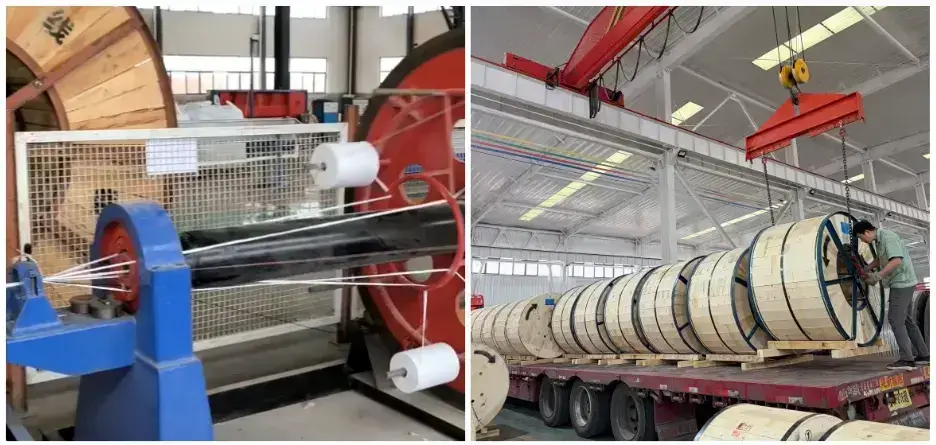
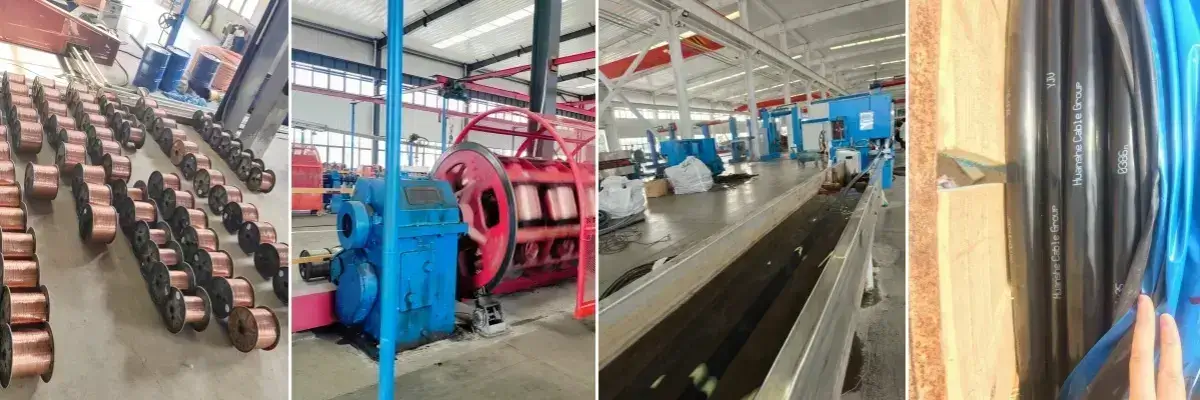
The checklist above is only useful if the supplier on the other side can answer it with documents rather than assurances. Huanghe Cable has manufactured power cable since 1980 and was restructured from a state-owned enterprise. The plant extrudes its own insulation, tests every drum before dispatch, and holds the construction range that covers a Vietnamese CXV/DSTA schedule line by line.
The point of listing this is not to claim that every clause in the article is automatically met. It is that each clause can be checked against a document — a datasheet, a drawing revision, a routine test report, a mill certificate for the tape. A supplier that cannot produce those documents for a specific size has not answered the enquiry, whatever the price on the quotation.
A mining project in northern Vietnam is a useful example because it puts pressure on every clause at once. The route is long, part of it is direct-buried in ground that stays wet, part of it runs on trays in an unventilated building, and the site cannot absorb a four-week buffer if a drum arrives short. The example below is illustrative of how the clauses are applied; it is not a description of a specific customer order.
What the schedule asked for. CXV/DSTA 4×95 mm² and 4×50 mm², 0.6/1 kV, TCVN 5935-1:2013, direct burial for the yard distribution and tray for the plant room, with a declared routine test on every drum and a per-drum test report for the client’s inspector.
What the enquiry had to add. The type name alone left four fields open. The enquiry fixed them: extruded PVC inner sheath with a nominal thickness on the drawing; two layers of hot-dip galvanised steel tape with the thickness per layer stated and the outer layer offset against the inner gap; conductor resistance to TCVN 6612 at 20 °C with the limit value written into the order; and the core colour scheme in writing — red / yellow / blue phases, neutral uncoloured, earth green-yellow.
What the ampacity table had to state. The two route sections could not share one current rating. The buried section used the soil temperature at burial depth for the design month, and the tray section used the design air temperature of the plant room rather than the 30 °C basis of the catalogue table. The two figures were then compared against the project’s own grouping factor for the number of circuits sharing each route.
What the incoming inspection had to plan for. A sacrificial length was agreed in the order, so the destructive checks — oversheath thickness, armour build, inner sheath and core identification — could be done at the yard without a dispute about who pays for the cut drum. The conductor resistance check was scheduled before the drums went into the trench, with the thermometer reading recorded alongside the bridge reading so the correction to 20 °C could be shown to the inspector.
What the quotation comparison had to separate. One offer was a fixed unit price with a 30-day validity; another was copper plus conversion. They could not be ranked on the headline number alone, because the metal basis and the validity period were different. The comparison sheet recorded the metal basis, the validity, the inner sheath method, the tape thickness and the declared test duration for each offer before any price was compared.
The mining example does not change the checklist. It shows why each clause exists: on a route that mixes direct burial, tray and a wet season, the fields that a datasheet leaves blank are the fields that decide whether the cable is still serviceable in year ten.
The sections above are a set of tools. The last step is to connect them to a supplier’s reply so the review produces a decision rather than a longer email chain. Four actions, in this order, remove most of the risk that shows up at the drum or in the trench.
Each of those actions produces a document the supplier can respond to. When the enquiry is sent to Huanghe, the reply comes back with the construction named for each line, the datasheet revision for that construction, the routine test declaration (voltage, duration and what is tested), and any clause that would be a deviation — listed as a deviation rather than absorbed into “fully compliant”. That is the same format the review sheet above is written in, which is why the two can be compared without a translation step.
Source note: this is a procurement sequence, not an engineering approval process. Technical acceptance of the cable remains with the project engineer and the client’s inspector.
Not under that base designation. Vietnamese manufacturers publish fire-resistant versions as CXV/DSTA/FR with an added mica tape for circuit integrity. Flame-retardant versions (CXV/DSTA/FRT) address flame spread only.
No. Steel tape armour on a single-core cable acts as a short-circuited secondary turn under alternating magnetic fields, causing severe overheating and drastically reducing ampacity. Use non-magnetic armour like aluminium tape (CXV/DATA) instead.
Yes. In Vietnam’s 380/220 V three-phase four-wire distribution, $U_0/U$ (0.6/1 kV) provides ample margin for phase-to-earth and phase-to-phase operation.
For Huanghe Cable, standard CXV/DSTA production starts at 500–1,000 m per specification, with lead times typically taking 5–8 days after technical confirmation (excluding sea freight to Vietnam).
Four things, in this order. None of them takes more than an afternoon, and together they remove most of the risk that shows up at the drum or in the trench.
Source note: this is a procurement sequence, not an engineering approval process. Technical acceptance of the cable remains with the project engineer and the client’s inspector.
Huanghe Cable Group manufactures full-compliance TCVN 5935-1 / IEC 60502-1 armoured cables backed by complete mill test reports, strict inner sheath extrusion, and verified copper DC resistance. Contact our foreign trade team for project-specific pricing.
Email: sales@huanghecables.com · Huanghe Cable, manufacturing since 1980 · IEC, GB/T and project-specific constructions · Third-party inspection (SGS, BV) available on request.

Please contact us for a free quotation by the below form. We promise the quickest response within 12 hours.