Updated 2026/11/10 · Edited by Huanghe Cable Technical Team · Reading time: 11–13 minutes
Direct Answer: Providing a comprehensive ZR-YJV Cable Specification, this guide explains that ZR-YJV cable is a widely specified Chinese industrial power cable featuring a copper conductor, cross-linked polyethylene (XLPE) insulation, and a flame-retardant PVC outer sheath. Standardly rated at 0.6/1 kV and manufactured in strict compliance with GB/T 12706.1 (adopting IEC 60502-1), it is the standard unarmoured low-voltage power distribution cable for building services, cable trays, and industrial plants. As a direct manufacturer, Huanghe Cable Group supplies full IEC 60332-3 test-verified ZR-YJV ranges from 1.5 mm² to 630 mm² for global EPC projects. The “ZR” prefix is informal shorthand; the formal flame classes under GB/T 19666 are ZA, ZB, ZC, or ZD, with ZC as the default.
ZR-YJV does not appear in the IEC 60502-1 catalogue itself, and you will not find it in a British or North American cable catalogue. If it turned up on a BOQ or a package from a Chinese contractor, that is why. Decoding the letters takes one line: ZR is flame retardant, YJ is XLPE, V is PVC sheath, and the conductor is copper unless an L appears.
What takes longer is everything those letters leave out: which flame class, which voltage, which core arrangement, and whether the sheath is actually suitable for the building it is going into. That last point is where a lot of ZR-YJV purchases go wrong, and section 6 deals with it directly.
Contents
1. What Does ZR-YJV Stand For? Decoding the Letters
3. Flame Rating A, B, C, D: What the Letter Costs
4. Cores, Cross-Sections and Current Ratings
5. Voltage Grades and Where ZR-YJV Stops
6. ZR Is Not LSZH, and the Difference Is a Rejected Shipment
7. ZR-YJV Cable Specification Equivalents: What It Is Called in IEC, BS and North American Markets
8. Huanghe: Range, Standards and What We Hold
9. MOQ, Lead Time and Container Loading
When reviewing any professional ZR-YJV Cable Specification for international B2B procurement, understanding how Chinese manufacturing designations map to IEC standards is the first step. Chinese cable designations are built from abbreviations rather than words, and each letter carries one property. Once you know the letters, any model in the family reads the same way.
ZR is the market shorthand for 阻燃 (flame retardant), but it is not a formal class under GB/T 19666. It describes a test performance, not a material. The compound is still PVC; what changes is the additive package and the oxygen index. The standard uses ZA, ZB, ZC and ZD to denote bunched flame-retardant classes. A bare “ZR” on a drawing usually means the supplier will default to Class C, because it is the easiest to pass.
One detail matters here. Since GB/T 19666 was revised, the formal notation carries a class letter: ZA, ZB, ZC or ZD. A drawing that says only “ZR-YJV” is using the older shorthand, and in practice it means Class C. If the project needs Class A or B, the drawing should say so, and section 3 explains why the difference is not cosmetic.
YJ is 交联聚乙烯, cross-linked polyethylene, abbreviated XLPE. Rated 90 °C continuous conductor temperature, 250 °C for five seconds under short circuit.
V is 聚氯乙烯, polyvinyl chloride, abbreviated PVC, used here as the sheath compound.
L after the YJ means aluminium conductor. No L means copper. The copper letter T exists in the older naming but is normally omitted.
The digits at the end describe the armour, and they follow the same convention across the whole Chinese power cable range: 22 is steel tape armour with PVC sheath, 23 is steel tape with PE sheath, 32 is steel wire with PVC sheath, 33 is steel wire with PE sheath. A model with no digits has no armour.
Then comes the specification itself, written as core count times cross-section. ZR-YJV 4×95 is four cores of 95 mm². ZR-YJV 3×240+1×120 is three main cores plus a reduced neutral.
Together, ZR-YJLV22 3×185+1×95 is a flame retardant, XLPE insulated aluminium conductor cable with steel tape armour and a PVC sheath: three 185 mm² cores plus a 95 mm² neutral. That is the whole grammar, and it is consistent across every model in the family.
Quick check: If the model code contains an L (e.g., ZR-YJLV), the conductor is aluminium. If the L is absent (e.g., ZR-YJV), the conductor is copper.
The base model has no armour and is used on trays, in shafts and inside buildings. Add armour and it goes into the ground. Change the sheath and it becomes a low smoke cable with a different model code entirely.
Table 1. ZR-YJV and related models, by construction.
On mobile devices, swipe horizontally to view the complete table.
| Model | Conductor | Armour | Sheath | Flame class | Typical route |
|---|---|---|---|---|---|
| ZR-YJV | Cu | None | PVC | C (default) | Tray, duct, indoor riser |
| ZR-YJV22 | Cu | Steel tape | PVC | C (default) | Direct burial |
| ZR-YJV32 | Cu | Steel wire | PVC | C (default) | Vertical shaft, steep route |
| ZR-YJLV | Al | None | PVC | C (default) | Tray, long feeder runs |
| ZR-YJLV22 | Al | Steel tape | PVC | C (default) | Direct burial, distribution |
| ZR-YJLV32 | Al | Steel wire | PVC | C (default) | Vertical shaft, buried feeder |
| WDZ-YJY | Cu | None | LSZH | A/B/C | Tunnel, metro, public building |
| WDZ-YJY23 | Cu | Steel tape | LSZH | A/B/C | Buried, fire-critical route |
| WDZN-YJY | Cu | None | LSZH | A/B/C | Fire pump, alarm, evacuation |
| ZR-VV | Cu | None | PVC | C (default) | Older projects, PVC insulation |
Source note: model codes follow GB/T 12706.1 and GB/T 19666. ZR-VV uses PVC insulation rather than XLPE and is listed because it still appears on older Chinese drawings.
The distinction between ZR-YJV and WDZ-YJY is the one worth understanding before you order, and it is not a marketing difference. ZR-YJV has a PVC sheath. WDZ-YJY has a low smoke zero halogen sheath, which you can find in our LSZH electric cable product line. They behave differently in a fire and they are not interchangeable, even though both carry a flame retardant claim. Section 6 goes through this in detail.
ZR-VV is on the list because it still appears on drawings from before XLPE became standard. It has PVC insulation rated 70 °C, so it carries less current for the same section and it should not be substituted for ZR-YJV without the designer agreeing.
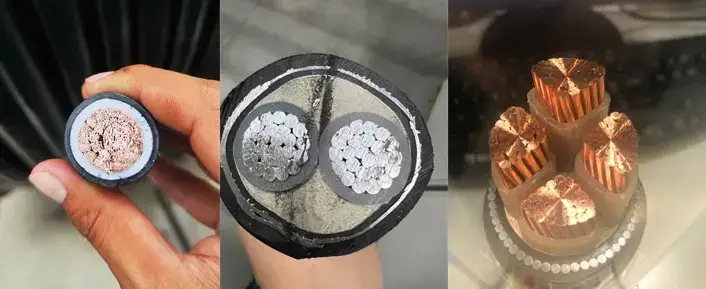
Flame retardant is not one performance level. It is four, defined by how much non-metallic material is burned in a bundle and how far the flame is allowed to travel.
GB/T 19666 sets the classes, and GB/T 18380.3 carries the test methods, which are identical in technical content to the IEC 60332-3 series. The class letter tells you the volume of combustible material per metre in the test ladder, which is a proxy for how crowded the real cable tray will be.
Table 2. Flame classes and their IEC equivalents.
On mobile devices, swipe horizontally to view the complete table.
| Class | Non-metallic volume in test | IEC test method | Where it is normally specified |
|---|---|---|---|
| ZA | 7 L per metre | IEC 60332-3-22, Category A | Dense trays in tunnels, metro, high-rise risers |
| ZB | 3.5 L per metre | IEC 60332-3-23, Category B | Crowded trays in plant rooms and substations |
| ZC | 1.5 L per metre | IEC 60332-3-24, Category C | General building services, the usual default |
| ZD | 0.5 L per metre | IEC 60332-3-25, Category D | Lightly loaded trays, single cable runs |
Source note: class definitions and non-metallic volumes follow GB/T 19666. GB/T 18380.33 to .36 correspond to IEC 60332-3-22 to .25 respectively. Note that IEC 60332-3-22 (Category A) and Category A F/R are not the same test: A F/R is for cables above 35 mm² and uses a spaced ladder arrangement, so a supplier’s “Class A” report should state which category it covers. The governing edition of the project standard takes precedence.
Two practical consequences follow from this table.
A bare ZR costs less than ZA, and that is usually why you got it. Class C is the easiest to pass, so when a drawing says only ZR-YJV, a supplier will build to Class C unless someone asks. If the specification requires A or B, the price difference is real: more flame retardant additive, slower extrusion speed, and a larger test sample. On a medium-size order it can move the cable price by several percent, and it moves the delivery date too.
A single-cable flame test is not a flame class. IEC 60332-1 tests one insulated wire held vertically. It says nothing about whether a tray of twenty cables will propagate fire. Suppliers sometimes present a 60332-1 report as evidence of flame retardancy, and it is not the same claim. If the project needs a class, ask for the 60332-3 report at the matching category.
There is also a design question underneath the class. Flame retardant cable stops the fire from spreading along the tray. It does not survive a fire, and it does not protect circuits that have to keep working during one. That is a fire resistant cable, which is a different model (WDZN-YJY and similar), tested under a different standard. Projects sometimes specify ZR when they meant fire resistant, and the mistake only becomes visible at commissioning.
Not sure which flame class your drawing actually requires?
If the BOQ says only “ZR-YJV”, send us the project type and cable tray density. We will tell you what class the installation needs, and quote both C and A so you can compare.
A ZR-YJV order needs three numbers that are often left vague on enquiries: how many cores, whether the cores are equal, and what cross-section. Each of them changes the price, and the core arrangement changes it the most.
Equal cores are the simple case. Four equal cores carry three phases plus a protective earth. Five equal cores add a neutral. Reduced arrangements exist because a neutral or an earth rarely carries the same current as a phase, so building it smaller saves copper without affecting the circuit.
Table 3. Core arrangements and their cost effect.
On mobile devices, swipe horizontally to view the complete table.
| Notation | Meaning | Relative cost | Typical use |
|---|---|---|---|
| 1×S | Single core | Lowest per metre | Feeder, duct, DC link |
| 2×S | Two equal cores | Low | Single phase, small loads |
| 3×S | Three equal cores | Baseline | Three phase, earth elsewhere |
| 4×S | Four equal cores | About 30% above 3×S | Three phase plus PE |
| 5×S | Five equal cores | Highest | Three phase plus N plus PE |
| 3×S+1×S/2 | Three main plus reduced PE | 10 to 15% below 4×S | Motors, feeders with separate earth |
| 3×S+2×S/2 | Three main plus reduced N and PE | 15 to 20% below 5×S | Distribution with light neutral |
| 4×S+1×S/2 | Four main plus reduced PE | About 10% below 5×S | Three phase plus full N |
Source note: relative cost figures reflect typical copper content differences and exclude armour and sheath. The reduced neutral is not permitted where harmonic currents are significant; check the design before substituting.
On cross-section, ZR-YJV runs from 1.5 mm² to 630 mm² in copper and from 16 mm² to 630 mm² in aluminium. Aluminium starts higher because small aluminium conductors are fragile at terminations and the current rating per unit area is lower.
Current ratings below are for copper conductors, XLPE insulation, 0.6/1 kV, and three loaded conductors, at an ambient air temperature of 30 °C in free air and a soil temperature of 20 °C (thermal resistivity 2.5 K·m/W) for buried installations. These baselines align with IEC 60364-5-52. The values are indicative, and derating for grouping, depth, soil thermal resistivity, and altitude must be applied on top for the final design.
Table 4. Indicative current rating, copper ZR-YJV, 0.6/1 kV.
On mobile devices, swipe horizontally to view the complete table.
| Cross-section (mm²) | Free air, tray (A) | Buried in duct (A) | Typical application |
|---|---|---|---|
| 1.5 | 22 | 22 | Control, lighting final circuit |
| 2.5 | 30 | 29 | Socket circuits, small equipment |
| 4 | 40 | 38 | Small motor branch |
| 6 | 51 | 47 | Sub-main, small feeder |
| 10 | 70 | 63 | Distribution board feed |
| 16 | 94 | 81 | Panel feeder, HVAC |
| 25 | 119 | 104 | Main distribution branch |
| 35 | 147 | 125 | Sub-main in plant |
| 50 | 179 | 148 | Building sub-main |
| 70 | 229 | 183 | Main feeder |
| 95 | 278 | 216 | Transformer to board |
| 120 | 322 | 246 | Main feeder |
| 150 | 371 | 278 | Main feeder, riser |
| 185 | 424 | 312 | Main feeder, riser |
| 240 | 500 | 361 | Incoming feeder |
| 300 | 576 | 408 | Incoming feeder |
| 400 | 656 | 469 | Transformer connection |
| 500 | 749 | 533 | Main incoming |
| 630 | 855 | 600 | Main incoming, large plant |
Source note: Indicative values derived from the order of magnitude of IEC 60364-5-52 for a single circuit in free air or buried in duct. Engineering caveat for large sizes (300 mm² to 630 mm²): When multiple multi-core cables are bunched on trays or share a duct, skin effect, proximity effect, and mutual heating drastically reduce current-carrying capacity. The values above assume an isolated circuit; always apply the grouping derating factors from the project’s installation standard before final cable sizing.
A ZR-YJV order without a voltage grade is assumed to be 0.6/1 kV. That assumption is right most of the time, and it is wrong often enough to be worth writing the voltage on the enquiry.
The Chinese low-voltage power cable range covers two grades under GB/T 12706.1: 0.6/1 kV and 1.8/3 kV. The second is used for heavy equipment, mining and large motor circuits where the voltage drop over a long run makes the higher grade worthwhile.
Table 5. Voltage grades and how the model code changes.
On mobile devices, swipe horizontally to view the complete table.
| U0/U | Um | Standard | Model notation | Where used |
|---|---|---|---|---|
| 0.6/1 kV | 1.2 kV | GB/T 12706.1, IEC 60502-1 | ZR-YJV | Building services, LV distribution |
| 1.8/3 kV | 3.6 kV | GB/T 12706.1, IEC 60502-1 | ZR-YJV-1.8/3 | Mining, heavy motors, long runs |
| 3.6/6 kV | 7.2 kV | GB/T 12706.2, IEC 60502-2 | ZR-YJV-3.6/6 | MV distribution |
| 6/10 kV | 12 kV | GB/T 12706.2, IEC 60502-2 | ZR-YJV-6/10 | MV distribution, industrial |
| 8.7/15 kV | 17.5 kV | GB/T 12706.2, IEC 60502-2 | ZR-YJV-8.7/15 | MV feeder, substation |
| 12/20 kV | 24 kV | GB/T 12706.2, IEC 60502-2 | ZR-YJV-12/20 | MV feeder |
| 18/30 kV | 36 kV | GB/T 12706.2, IEC 60502-2 | ZR-YJV-18/30 | MV feeder, utility |
| 26/35 kV | 40.5 kV | GB/T 12706.3, IEC 60502-2 | ZR-YJV-26/35 | Utility distribution |
Source note: voltage designations follow GB/T 12706 and IEC 60502. U0 is the phase-to-earth voltage and U the phase-to-phase voltage; Um is the maximum system voltage.
It is vital to separate 1.8/3 kV from the screened medium-voltage range (3.6/6 kV and above). While 1.8/3 kV sits at the very bottom of the MV band under IEC definitions, its physical construction uses the same unscreened extrusion principle as 0.6/1 kV—just with a thicker XLPE wall. It does not carry conductor or insulation screens.
Two things change fundamentally once you cross into 3.6/6 kV and above:
If your enquiry is for medium voltage, say so at the top. It routes to a different production line and a different quotation structure.
This is the most expensive misunderstanding in the whole ZR-YJV category, and it happens on real projects.
A specification says the cable must be flame retardant and low smoke. The buyer reads ZR as covering both, orders ZR-YJV, and receives a cable with a PVC sheath. It passes the flame test. It fails everything else the project asked for, because burning PVC produces hydrogen chloride and dense black smoke, which is exactly what a tunnel or a metro station cannot have.
Flame retardant and low smoke zero halogen are two different properties, measured by two different test series, and only one of them is in the ZR prefix.
Table 6. ZR-YJV against WDZ-YJY, the low smoke alternative.
On mobile devices, swipe horizontally to view the complete table.
| Property | ZR-YJV | WDZ-YJY | Test reference |
|---|---|---|---|
| Sheath compound | PVC with flame retardant additives | Halogen free polyolefin | GB/T 12706.1 compound requirements |
| Combustion products | Hydrogen chloride, carbon monoxide, dense smoke | Mainly water vapour and carbon dioxide | IEC 60754-1 and -2 |
| Halogen acid gas | Significant, acidic, corrosive to electronics | Below the threshold, conductivity and pH both pass | IEC 60754-1, IEC 60754-2 |
| Smoke density | High, light transmission falls quickly | Low, light transmission typically above 60% | IEC 61034-2 |
| Flame propagation | Class A, B, C or D | Class A, B or C | IEC 60332-3-22 to -25 |
| Relative price | Baseline | 15 to 30% higher, more on small sizes | Compound cost and slower extrusion |
| Where it belongs | General buildings, outdoor, plant rooms | Tunnel, metro, data hall, public assembly | Occupancy and evacuation risk |
Source note: fire test references follow IEC 60332-3, IEC 60754 and IEC 61034, which GB/T 18380, GB/T 17650 and GB/T 17651 adopt. Relative price reflects typical production cost differences and varies with size and sheath share of the total.
The practical rule is short. If the building has people who cannot evacuate quickly, or equipment that cannot be replaced quickly, the sheath needs to be halogen free. That means WDZ-YJY or WDZ-YJY23, not ZR-YJV, regardless of what the flame class says.
The price gap is why this goes wrong. LSZH compound costs more and extrudes slower, so a supplier quoting against a ZR-YJV line is quoting a cheaper cable. If the quotation came back noticeably below the others and the model says ZR-YJV while the specification said low smoke, that is the reason.
Not Sure Whether You Need ZR-YJV or WDZ-YJY?
Send Huanghe the occupancy type, the route and the specification clause. We will tell you which sheath the project actually requires, and quote both so you can see the difference.
There is no IEC model designation for ZR-YJV, because IEC 60502-1 defines constructions and test requirements rather than product names. Every market translates it differently, and some markets have no exact equivalent at all.
Table 7. ZR-YJV against British and North American equivalents.
On mobile devices, swipe horizontally to view the complete table.
| Chinese model | IEC construction description | British equivalent | North American analogue |
|---|---|---|---|
| ZR-YJV | Cu/XLPE/PVC, flame retardant, 0.6/1 kV, unarmoured | Conforms to IEC 60502-1. In UK practice, unarmoured XLPE/PVC industrial power cables are typically specified directly to IEC standards rather than BS 5467, which governs armoured (SWA) types. | Single core XHHW-2; multicore tray cable to UL 1277 where permitted |
| ZR-YJV22 | Cu/XLPE/STA/PVC, 0.6/1 kV | BS 5467 permits steel tape armour at this voltage | No direct equivalent; US practice favours conduit or tray cable |
| ZR-YJV32 | Cu/XLPE/SWA/PVC, 0.6/1 kV | BS 5467 steel wire armour, the closest match in the British range | No direct equivalent |
| WDZ-YJY | Cu/XLPE/LSZH, 0.6/1 kV | BS 6724 construction, low smoke zero halogen | LSZH tray cable where the specification permits |
| ZR-YJLV | Al/XLPE/PVC, flame retardant, 0.6/1 kV | Aluminium conductor is not a standard option in the BS 5467 range | Aluminium XHHW-2 is common in US distribution |
Source note: equivalences are descriptive, not certified substitutions. A design that specifies a British or North American product standard requires that standard to be met, and the substitution should be confirmed in writing by the designer.
The point of this table is not to encourage substitution. It is to let you read a Chinese drawing and a local specification side by side, so you can tell whether they describe the same cable or two different ones.
One pattern is worth noting. British practice puts armour on almost everything at 0.6/1 kV, because a great deal of it goes into the ground. Chinese practice uses unarmoured cable far more, because a great deal of it goes onto trays inside buildings. When a Chinese-designed project is built in a market with British-derived standards, the cable schedule often contains unarmoured models where the local reviewer expects armour. That is a design conversation, and it is better to have it before the order than after the delivery.

Huanghe Cable manufactures low-voltage power cable in China and exports to South America, Southeast Asia, Central Asia and Africa. ZR-YJV is one of the models we build continuously, not a special request.
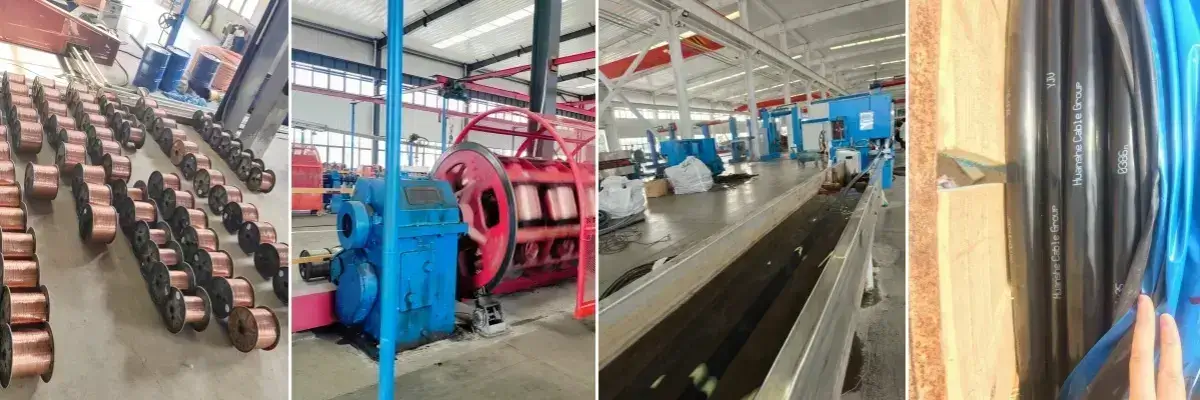
What matters for a buyer is that the process steps deciding whether a flame retardant cable performs are all done in-house: conductor stranding, XLPE extrusion and cross-linking, and sheath extrusion with the flame retardant compound. When the sheath is bought in from a compounder and extruded on someone else’s line, the flame class on the certificate and the flame class in the drum can drift apart.
What we build in this family.
Models: ZR-YJV, ZR-YJV22, ZR-YJV32, ZR-YJLV, ZR-YJLV22, ZR-YJLV32, and the WDZ-YJY and WDZ-YJY23 low smoke versions.
Cross-section: 1.5 mm² to 630 mm² copper, 16 mm² to 630 mm² aluminium.
Cores: 1, 2, 3, 4 and 5 equal, plus 3+1, 3+2 and 4+1 reduced arrangements.
Flame class: Class A, B and C to GB/T 19666, with the matching IEC 60332-3 test evidence.
Voltage: 0.6/1 kV and 1.8/3 kV in standard production. Medium voltage reviewed per project.
Standards: GB/T 12706.1 and IEC 60502-1. Constructions to BS 5467 and BS 6724 are also built.
What we hold. IEC test evidence for the constructions we build: conductor resistance, voltage withstand and insulation resistance per drum, plus flame propagation to IEC 60332-3 at the specified category, halogen acid gas to IEC 60754, and smoke density to IEC 61034 for the low smoke models.
What we do not hold. We do not hold BASEC or LPCB product certification, nor do we provide an EN 50575 CPR (Construction Products Regulation) classification. Because CE-marked CPR compliance is mandatory for permanent buildings within the European Union, our standard ZR-YJV line is not supplied for EU building projects requiring formal CPR Euroclasses. If your project is outside the EU (such as in Southeast Asia, Africa, or South America) where IEC standards apply directly, our IEC 60332-3 test reports provide full verification.
That distinction matters more in this product family than in most, because flame retardant performance is exactly the kind of claim that buyers cannot verify by looking at a drum. If a specification requires a third-party product certificate rather than a construction built and tested to a standard, tell us at enquiry stage. We will say plainly that we cannot supply it, and the enquiry can end there rather than at the port.
A note on flame class claims. “Flame retardant” on its own means very little, because it does not say which class. Ask for the class letter and the IEC 60332-3 category on the test report. A supplier who cannot state the category is either working to Class C by default or has not tested, and both are worth knowing before you place the order.

ZR-YJV is lighter than the armoured equivalent, so container loading is more generous. The production constraints are different, though, and they are what usually decides the delivery date.
MOQ. It applies per size, because each size is a separate extrusion and stranding run. A schedule with eight sizes is eight runs. Small quantities of large sizes are the combination that decides whether an order is workable, so flag them early.
Lead time. Three things move it. Flame class matters: Class A needs more additive and a slower line speed than Class C. Sheath material matters: LSZH runs slower than PVC because the compound is more sensitive to process temperature. Armour matters: a ZR-YJV32 takes longer than a ZR-YJV at the same conductor size, because wire drawing and armouring are extra steps.
Ask for the lead time in writing, separately for standard season and peak season. One number quoted in a quiet month is not a commitment.
Table 8. Approximate container loading for ZR-YJV copper cable.
On mobile devices, swipe horizontally to view the complete table.
| Size (mm²) | Mass (kg/m) | Approx. metres, 20GP | Approx. metres, 40HQ | Limiting factor |
|---|---|---|---|---|
| 25 | 1.55 | About 11,600 m | About 16,100 m | Volume, then payload |
| 50 | 2.75 | About 6,500 m | About 9,000 m | Payload |
| 95 | 4.60 | About 3,900 m | About 5,400 m | Payload |
| 150 | 6.80 | About 2,600 m | About 3,600 m | Payload |
| 240 | 10.7 | About 1,680 m | About 2,300 m | Payload and drum diameter |
| 400 | 17.4 | About 1,030 m | About 1,430 m | Payload and drum diameter |
| 630 | 27.2 | About 660 m | About 900 m | Drum diameter first, then payload |
Source note: indicative only, based on a 20GP payload of about 18 t and a 40HQ payload of about 25 t with typical drum sizes for unarmoured cable. Actual loading depends on drum diameter, drum count, port weight limits and road limits at destination. Confirm the drum plan before booking.
Two logistics details that cause problems after the order is placed.
Drum diameter at 400 and 630 mm². The drum becomes the constraint before the weight does. A drum that does not fit a standard flatbed, or that exceeds a destination road limit, turns into a re-packing job at the port. Agree the drum diameter in writing.
Destination axle limits. Some markets restrict axle load on the final road leg. A 40HQ at full payload may need two trucks, which changes the delivered cost. If your site is inland, say so at quotation stage.
An enquiry that reads “ZR-YJV 4×95, 500 m” produces quotations that cannot be compared, because the flame class, the voltage, the neutral arrangement and the drum length are all still open. Each of them moves the price.
Example enquiry, written so it can be answered
Model: ZR-YJV, flame class C
Voltage: 0.6/1 kV
Sizes: 4×95 mm², 620 m; 4×50 mm², 480 m; 3×240+1×120 mm², 300 m
Conductor: copper, Class 2 compacted
Route: cable tray in a plant room, 180 m buried direct in the yard section
Drum: 500 m preferred, split drums acceptable
Delivery: CIF Mombasa, copper basis LME cash settlement on order date, validity 7 days
Documents: routine test certificate per drum, IEC 60332-3-24 report, third-party inspection acceptable
That enquiry can be answered line by line, and two quotations built from it can be compared. The one above also exposes a decision: the route includes a buried section, so the 4×95 and 4×50 may need ZR-YJV22 rather than ZR-YJV. A supplier reading the route carefully will say so. A supplier quoting the model string alone will not.
Need a Printable Spec Sheet for Your Submittal?
If you are compiling a technical submittal for an engineering consultant or preparing a BOQ, copying tables from a webpage is inefficient. Send us your BOQ for a verified compliance review, or request a PDF datasheet for the exact construction.
ZR is flame retardant, YJ is XLPE insulation, V is PVC sheath, and the conductor is copper. A bare ZR-YJV without a class letter is normally built to flame class C. If the project needs Class A or B, the class has to be written into the specification, because the price and the test report both change.
No, and this is the most common mistake in the category. ZR-YJV has a PVC sheath, which releases hydrogen chloride and dense smoke when it burns. A low smoke zero halogen cable is WDZ-YJY or WDZ-YJY23, with a halogen free sheath tested to IEC 60754 and IEC 61034. Both can carry a flame class, but only one is suitable for tunnels, metro and crowded public buildings.
Four: ZA, ZB, ZC and ZD under GB/T 19666, corresponding to IEC 60332-3-22, -23, -24 and -25. The class defines how much non-metallic material is burned in the test, from 7 L per metre for Class A down to 0.5 L per metre for Class D. A higher class means a denser cable tray can be protected, and it costs more because it needs more additive and slower production.
1.5 mm² to 630 mm² per conductor in copper, 16 mm² to 630 mm² in aluminium. One to five equal cores, plus 3+1, 3+2 and 4+1 reduced arrangements. Above 300 mm² the drum diameter becomes the practical constraint, so the drum plan should be agreed before the order.
0.6/1 kV and 1.8/3 kV are standard production. Medium voltage from 3.6/6 kV up to 26/35 kV is reviewed per project, because the construction changes: screened cores, larger diameter, different termination kits. A medium voltage enquiry should state the U0/U grade at the top.
Yes. ZR-YJV22 is steel tape armour with PVC sheath, ZR-YJV32 is steel wire armour with PVC sheath, and the aluminium equivalents are ZR-YJLV22 and ZR-YJLV32. If the route includes a buried section, armour is normally required, and it is worth checking whether the drawing says so.
Yes. GB/T 12706.1 adopts IEC 60502-1, so the two are aligned in technical content. Constructions to BS 5467 and BS 6724 are also built. We do not hold BASEC or LPCB product certification and we do not hold a CPR classification under EN 50575, so if the specification requires a product certificate rather than a construction built to the standard, tell us before we quote.
Routine tests per drum covering conductor resistance, voltage withstand and insulation resistance. For flame performance, an IEC 60332-3 report at the category matching the class ordered. For low smoke models, IEC 60754 and IEC 61034 reports. A single-cable test to IEC 60332-1 is not a flame class and we do not present it as one.
MOQ applies per size, because each size is a separate production run. Lead time depends on the flame class, the sheath material and whether armour is required: Class A is slower than Class C, LSZH is slower than PVC, and an armoured model is slower than an unarmoured one at the same conductor size. Ask for the figure in writing, separately for standard and peak season.
On the metal content at a stated basis date, plus the flame class, the construction, the drum length and the freight term. Copper can move several percent in a month, so ask for the basis date and the validity period. A price without a basis is not a firm price.
For copper ZR-YJV, roughly 5,400 m of 4×95 mm² in a 40HQ, about 3,600 m of 4×150 mm², and about 900 m of 4×630 mm². Unarmoured cable loads more metres than the armoured equivalent. These are weight and drum limited estimates; actual loading depends on drum diameter and destination road limits.
Yes. SGS, BV, TÜV, Intertek or a nominated inspector, with the scope agreed before the visit and access to the test bay. We prefer the scope to be fixed at order stage, because inspection requirements added later usually arrive after the drum has been packed.
Sources and scope: Model designations and construction requirements follow GB/T 12706.1, GB/T 12706.2 and IEC 60502-1. Flame classes follow GB/T 19666, with test methods in GB/T 18380.3 corresponding to IEC 60332-3. Halogen and smoke test references follow IEC 60754 and IEC 61034. Current ratings are indicative and in the order of magnitude of IEC 60364-5-52; the edition in force for the project governs. Published November 2026.
Technical note: Cable selection, protective device coordination, fire strategy and earthing design remain the responsibility of the project engineer. The information on this page supports procurement decisions and does not replace the installation design.

Please contact us for a free quotation by the below form. We promise the quickest response within 12 hours.