Edited by Huanghe Cable Technical Team · Reading time: 16–19 minutes
Three core 95 mm² sits in an awkward place. It is the largest size most low voltage distribution boards will take without a parallel run, and it is the smallest size most 11 kV ring circuits are designed around. So the same six characters, 3×95, describe IEC 60502 standard copper power cables that sell from USD 37.00 a metre up to USD 60 a metre (and aluminium equivalents from USD 5.50), and buyers compare the two as if they were the same product.
Quick Summary & Key Data:
This page prices every variant at 13,256 USD copper and 3,004.50 USD aluminium, the LME and spot levels for 17 November 2026, and shows the conductor weight beside each line. That weight is what makes a quote checkable. It takes about ten seconds to run the arithmetic on someone else’s price, and it settles most arguments before they start.
Note on price basis: All prices in this article are calculated using the LME copper and spot aluminium settlement prices on the stated date. As metal prices fluctuate daily, these figures serve as an engineering benchmark. For a binding quotation, please request a quote based on today’s copper basis.
Short answer: 3×95 cable price per metre
FOB China, 1000 m order, copper at 13,256 USD/t and aluminium at 3,004.50 USD/t, 17 November 2026.
| Variant | Construction | USD per metre |
|---|---|---|
| 3×95 YJV, 0.6/1 kV | Cu / XLPE / PVC | 37.00 to 38.75 |
| 3×95 YJV22, 0.6/1 kV | Cu / XLPE / STA / PVC | 38.30 to 40.60 |
| 3×95 YJV32, 0.6/1 kV | Cu / XLPE / SWA / PVC | 38.90 to 41.40 |
| 3×95 NH-YJV, 0.6/1 kV | Cu / mica tape / XLPE / PVC | 43.20 to 49.80 |
| 3×95 YJLV, 0.6/1 kV | Al / XLPE / PVC | 5.50 to 7.55 |
| 3×95 YJV, 8.7/15 kV | Cu / XLPE / copper tape screen / PVC | 44.75 to 46.50 |
| 3×95 YJV32, 8.7/15 kV | Cu / XLPE / tape screen / SWA / PVC | 46.75 to 49.40 |
| 3×95 YJV, 18/30 kV | Cu / XLPE / copper wire screen / PVC | 53.70 to 55.45 |
On mobile devices, swipe horizontally to view the complete table.
Who is giving you these numbers. Huanghe has been building three core power cable since 1980, from 1.5 to 630 mm², in copper and aluminium, across LV and MV, to GB/T 12706.1, GB/T 12706.2 and IEC 60502. Every quotation we send states the copper basis date, the conductor weight per metre and the drum length, so the price can be checked against the tables on this page before it is compared with anyone else. If a bill of quantities already exists, send it and we will quote it on that basis.
Price a 3×95 Cable Schedule on a Stated Copper Basis
Send the model, the voltage grade and the drum lengths. The reply states the copper basis date, the conductor weight per metre and the validity period, so the arithmetic on this page can be run on our own numbers.
| Request a Quote | WhatsApp Us | Email Sales Team |
At a glance
| Copper basis | 13,256 USD/t, LME, 17 November 2026 |
| Aluminium basis | 3,004.50 USD/t |
| Conductor in a copper 3×95 | 2.584 kg per metre, USD 34.26 of metal |
| Conductor in an aluminium 3×95 | 0.786 kg per metre, USD 2.36 of metal |
| Copper share of an LV YJV | 88 to 93 percent |
| Floor price, any copper 3×95 | USD 34.26 per metre |
| Spread across all variants | USD 5.50 to 60.65 per metre |
| Aluminium as a share of copper price | 15 to 25 percent |
The one number worth memorising
A three core 95 mm² copper conductor weighs 2.584 kg per metre. At 13,256 copper that is USD 34.26 of metal before insulation, screening, armouring, sheathing, testing, packing or freight. The same conductor sits inside every copper 3×95 on this page, whatever the voltage grade.
So a copper 3×95 quoted below USD 34.26 per metre is not a bargain. It is a short conductor, a different metal, or a price that will not survive the order. That single figure settles most of the quotes that arrive from trading platforms, and it does so without needing to open a catalogue.
Contents
1. One size, nine products: the naming matrix
2. Start with 2.584 kg: the conductor weight
3. Low voltage: every variant priced
4. Medium voltage: what the insulation actually adds
5. Fire rated, flame retardant, low smoke: three different products
6. Copper vs. Aluminium: Why the 3×95 Price Spread is 4.4 to 1
7. Which 3×95 Cable Variant Does Your Project Actually Need?
8. Weigh a metre and check the quote
9. Drum lengths and container loads
A purchase order that says only “3×95 cable” tells a factory almost nothing. Three decisions have to be made before the price exists: the voltage grade, whether the cable is armoured, and what the sheath has to do under fire. Each decision moves the price, and they compound.
Chinese model codes carry all three decisions in a handful of letters, which is why they travel well in Asia and Africa and badly everywhere else. The table below maps them to the IEC and British designations a European or Gulf consultant is more likely to have specified.
Table 1. What 3×95 can mean, by model code
| Chinese code | DIN VDE / International equivalent | Construction | Voltage | Where it goes |
|---|---|---|---|---|
| YJV | N2XY | Cu / XLPE / PVC | 0.6/1 kV | Tray, duct, indoor |
| YJV22 | N2XBY | Cu / XLPE / steel tape / PVC | 0.6/1 kV | Direct burial, normal soil |
| YJV32 | N2XRY | Cu / XLPE / steel wire / PVC | 0.6/1 kV | Rocky ground, vertical shafts |
| ZR-YJV | N2XY, flame retardant | Cu / XLPE / PVC, FR compound | 0.6/1 kV | Tunnels, risers, plant rooms |
| NH-YJV | N2XH(F) | Cu / mica tape / XLPE / PVC | 0.6/1 kV | Fire pumps, emergency lighting |
| WDZ-YJY | N2XH | Cu / XLPE / LSZH | 0.6/1 kV | Airports, hospitals, metro |
| YJLV | NA2XY | Al / XLPE / PVC | 0.6/1 kV | Long LV runs, cost driven |
| YJV, MV | N2XSY | Cu / XLPE / copper tape screen / PVC | 6/10 to 18/30 kV | Ring main, substation feeder |
| YJV32, MV | N2XSRY | Cu / XLPE / screen / steel wire / PVC | 6/10 to 18/30 kV | Buried MV distribution |
On mobile devices, swipe horizontally to view the complete table.
Two things about this table cause most of the confusion in live enquiries. The first is that YJV22 and YJV32 are not interchangeable. The core difference is the type of mechanical stress they handle: YJV22 (steel tape) is designed for radial compression, making it ideal for direct burial where the cable bears the weight of soil or traffic. YJV32 (steel wire) is designed for axial tension, making it mandatory for vertical shafts, underwater crossings, or routes where the cable is pulled rather than laid. The second is that the medium voltage rows are not a different product family. They are the same conductor with more insulation and a screen, and the price difference is smaller than most buyers expect.
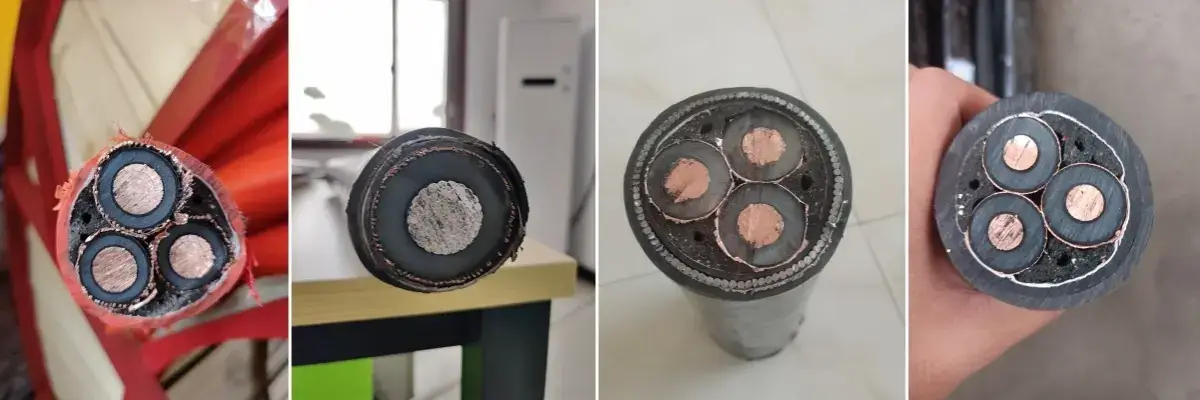
Before any price table makes sense, one calculation has to be done. A stranded copper conductor of nominal section A, in an n core cable, weighs:
m = n × A × 8.89 ÷ 1000 × 1.02
m in kg per metre, A in mm², 8.89 the density of copper in g/cm³, 1.02 the stranding factor for a class 2 compacted conductor
For 3×95 that gives 3 × 95 × 8.89 ÷ 1000 × 1.02 = 2.584 kg per metre. At 13,256 USD per tonne the metal alone is USD 34.26. For aluminium, substituting 2.703 for the density gives 0.786 kg per metre and USD 2.36 of metal.
Those two figures explain the entire price structure of this size. Copper is 88 to 93 percent of what an LV YJV costs, so almost everything a buyer argues about, the insulation compound, the sheath, the armouring, the packing, sits inside a band of 7 to 12 percent. Aluminium reverses that, because the metal is only 31 to 43 percent of the price and everything else dominates.
Table 2. Metal content of a 3×95, copper against aluminium
| Measure | Copper 3×95 | Aluminium 3×95 |
|---|---|---|
| Conductor weight, kg per metre | 2.584 | 0.786 |
| Metal price, USD per kg | 13.256 | 3.0045 |
| Metal cost, USD per metre | 34.26 | 2.36 |
| Metal share of an LV YJV | 88 to 93 percent | 31 to 43 percent |
| Weight ratio, copper to aluminium | 3.29 to 1 | |
| Metal cost ratio, copper to aluminium | 14.5 to 1 | |
On mobile devices, swipe horizontally to view the complete table.
Key Takeaway: A copper 3×95 uses 3.29 times more metal weight than aluminium, but the copper metal cost is 14.5 times higher. This is why aluminium is chosen for budget-driven long runs, despite the larger diameter.
The weight ratio and the cost ratio differ by a factor of 4.4, and that gap is the whole aluminium argument. Copper is 3.29 times heavier than aluminium for the same conductance, but it currently costs 4.41 times more per kilogram. Aluminium therefore wins on metal cost by 14.5 to 1, and then loses part of that advantage to the larger insulation, larger sheath and larger drum the bigger conductor needs.
How to use the floor price
Take any copper 3×95 quote, divide the price per metre by 34.26. The result is how many times the raw copper is being charged for. Below 1.00 the cable does not exist. Between 1.00 and 1.05 there is no insulation on it. A normal LV YJV lands at 1.08 to 1.13. A medium voltage cable lands at 1.25 to 1.60. Anything above 2.00 is being sold on something other than copper.
Low voltage 0.6/1 kV is where most 3×95 tonnage goes, and it is also where the widest spread of prices hides behind the narrowest spread of actual cost. Within the copper variants alone, the price varies by USD 12.80 per metre (from YJV to NH-YJV), and every one of those increments has a physical cause that can be inspected on a cut sample.
Table 3. Low voltage 3×95, all nine variants
Don’t read every line. The base YJV is 37.00/m. The biggest jump is for fire resistance (NH-YJV at 43.20/m). Aluminium (YJLV) is only 5.50/m.
| Model | Construction | USD per metre | Index | Bought for |
|---|---|---|---|---|
| YJV (Base) | Cu / XLPE / PVC | 37.00 to 38.75 | 100 | Indoor tray, duct, cable ladder |
| ZR-YJV | Cu / XLPE / PVC, flame retardant | 37.90 to 40.10 | 102 to 103 | Risers, tunnels, plant rooms |
| YJV22 | Cu / XLPE / steel tape / PVC | 38.30 to 40.60 | 104 to 105 | Direct burial, normal soil |
| YJV32 | Cu / XLPE / steel wire / PVC | 38.90 to 41.40 | 105 to 107 | Rock, shafts, pulled routes |
| WDZ-YJY | Cu / XLPE / LSZH | 40.10 to 43.30 | 108 to 112 | Metro, airport, hospital |
| NH-YJV | Cu / mica tape / XLPE / PVC | 43.20 to 49.80 | 117 to 129 | Fire pump, emergency lighting |
| YJLV | Al / XLPE / PVC | 5.50 to 7.55 | 15 to 19 | Long LV runs, cost driven |
| YJLV22 | Al / XLPE / steel tape / PVC | 6.50 to 8.90 | 18 to 23 | Buried LV distribution |
| YJLV32 | Al / XLPE / steel wire / PVC | 7.00 to 9.60 | 19 to 25 | Difficult ground, long spans |
On mobile devices, swipe horizontally to view the complete table.
Read the index column rather than the absolute price. It is stable across copper prices, because every row moves together, and it is the honest measure of what each construction costs to make. Armouring is cheap: 4 to 7 percent over the unarmoured cable. That surprises buyers who assume steel means money. A 3×95 YJV32 carries about 0.9 kg of galvanised steel wire per metre, and steel is not a significant cost at this size.
Fire performance is expensive, and it is the only row in the table that can triple the non metal content. NH-YJV carries two or three wrapped layers of mica tape between the conductor and the insulation, and those layers have to survive a 950 °C flame for the duration the specification calls for. The tape, the extra wrapping passes, and the testing behind it add 6.20 to 11.05 USD per metre on a base of 37.00. That is the single largest premium available in this size at low voltage.
The aluminium rows need a different reading. YJLV at 5.50 to 7.55 is not a cheaper version of the same cable. It is a cable with 78 percent of the current rating, often requiring a step up to 120 mm² (roughly 13 percent larger in conductor diameter) to match ampacity, and a set of termination rules that forbid mixing aluminium and copper without a bimetallic connector. The 15 to 19 percent index is real, and so is the installation cost that follows it.
Check a 3×95 Cable Quote Against the Copper Weight
Send the model code and the drum length. The reply states the conductor weight per metre beside the price, so the index column above can be run on our own numbers rather than on a competitor’s.
| Request a Quote | WhatsApp Us | Email Sales Team |
Buyers routinely assume a medium voltage cable costs two or three times its low voltage equivalent. On 3×95 it does not. The conductor is identical, 2.584 kg of copper per metre, and it is still 76 to 88 percent of the finished price. What changes is the insulation thickness, the two semi-conductive screens either side of it, the metallic screen over it, and the process needed to extrude all of that in one pass without contamination.
For complete specifications, conductor stranding, and voltage tier options across our entire product range, you can review our full range on the Huanghe XLPE Power Cable Series Overview page.
The insulation thickness is fixed by standard. For a 95 mm² conductor, IEC 60502-2 and GB/T 12706.2 specify 2.5 mm for 3.6/6 kV, 3.4 mm for 6/10 kV, 4.5 mm for 8.7/15 kV, 5.5 mm for 12/20 kV, and 8.0 mm for 18/30 kV. These five insulation levels, plus the progressive increase in metallic screen weight, account for almost the whole premium. Notably, the 18/30 kV grade requires a wire screen instead of tape, which explains the sharp cost jump in Table 5.
Table 4. Medium voltage 3×95, by voltage grade and armour
| Voltage grade | Insulation | Cu unarmoured | Cu armoured | Al unarmoured |
|---|---|---|---|---|
| 3.6/6 kV | 2.5 mm | 41.40 to 43.15 | 43.40 to 46.05 | 9.90 to 11.95 |
| 6/10 kV | 3.4 mm | 43.30 to 45.05 | 45.30 to 47.95 | 11.80 to 13.85 |
| 8.7/15 kV | 4.5 mm | 44.75 to 46.50 | 46.75 to 49.40 | 13.25 to 15.30 |
| 12/20 kV | 5.5 mm | 46.10 to 47.85 | 48.10 to 50.85 | 14.60 to 16.65 |
| 18/30 kV | 8.0 mm | 53.70 to 55.45 | 57.50 to 60.65 | 22.10 to 24.25 |
On mobile devices, swipe horizontally to view the complete table. Armoured prices assume steel tape to 12/20 kV and steel wire at 18/30 kV. Screens are typically copper tape up to 12/20 kV, and copper wire (16–25 mm² per core) at 18/30 kV to meet higher earth-fault current requirements.
On average, the 6/10 kV cable costs 17 percent more than the 0.6/1 kV one. The 8.7/15 kV costs 21 percent more. Even 18/30 kV, with the thickest insulation in the range and a wire screen instead of tape, lands at 45 percent more. That is the whole medium voltage premium on this size, and it is far smaller than the two to three times buyers expect.
Table 5. Where the medium voltage premium comes from, per metre
| Cost element | 6/10 kV | 8.7/15 kV | 12/20 kV | 18/30 kV |
|---|---|---|---|---|
| Diameter over insulation, mm | 17.8 | 20.0 | 22.0 | 27.0 |
| Extra XLPE over LV, USD | 0.42 | 0.75 | 1.08 | 2.03 |
| Semi-conductive screens, USD | 0.35 | 0.42 | 0.48 | 0.63 |
| Metallic screen, kg per metre | 0.134 | 0.151 | 0.166 | 0.533 |
| Metallic screen, USD | 1.78 | 2.00 | 2.20 | 7.07 |
| Bedding, fillers, barrier tapes, USD | 0.95 | 1.15 | 1.34 | 1.76 |
| Triple extrusion, curing, routine tests, USD | 2.80 | 3.40 | 4.00 | 5.20 |
| Total premium over LV, USD | 6.30 | 7.72 | 9.10 | 16.69 |
| Premium as share of LV YJV | 17 percent | 21 percent | 25 percent | 45 percent |
On mobile devices, swipe horizontally to view the complete table.
Key Takeaway: Upgrading from 0.6/1 kV to 6/10 kV only adds 17% to the total cost. Even 18/30 kV adds just 45%. The premium is small because the copper conductor (88% of the cost) never changes.
One line in that table is worth more attention than the rest. The metallic screen at 18/30 kV costs 7.07 USD per metre, which is more than everything else in the premium combined. That is because 18/30 kV three core cable carries a copper wire screen, typically 20 mm² per core, rather than the thin tape used at lower grades. When a supplier quotes 18/30 kV only slightly above 12/20 kV, the screen is the first thing to ask about, and the second is whether it is copper or copper-clad aluminium.
The process line matters for a different reason. Medium voltage XLPE has to be triple extruded, conductor screen, insulation and insulation screen, in one head without the layers touching air, then dry-cured (CCV line) in a pressurised nitrogen atmosphere rather than steam or water curing, preventing micro-voids and water treeing. Every routine test includes a partial discharge measurement at 1.73 times the rated voltage. A factory that cannot do partial discharge testing cannot legally ship this cable, and a price that is 30 percent below everyone else usually comes from a plant that is not doing it.
What the market platforms are quoting
Search 3×95 medium voltage on any B2B marketplace and you will find 11 kV armoured copper cable offered at USD 21 to 29 per metre. At the copper prices those listings were built on, roughly 9,850 to 10,500 USD per tonne, the bare conductor alone was USD 25.40 to 27.10. The lower half of that range is below the cost of the copper inside it.
At 13,256 copper the same conductor is USD 34.26, so an 11 kV cable at USD 21 would be selling metal it does not have. Treat any such listing as a starting point for questions, not a price. Ask for the conductor weight per metre, the screen construction, and the partial discharge test report, and the conversation changes quickly.
These three terms are used interchangeably in enquiries and they should not be. They describe different tests, different failure modes and, on 3×95, price premiums that differ by a factor of ten. For a deeper dive into fire resistance classes, test standards, and supplier auditing, you can also review our dedicated NH-YJV Cable: Fire Rating, BS 6387 Coverage and Supplier Checks guide.
Flame retardant means the cable will not propagate a fire along a tray or a vertical run. It is tested by burning a rack of cable and measuring how far the char travels. The compound change is small, the premium is 2 to 3 percent, and the cable still burns if you hold a flame to it.
Fire resistant means the cable keeps working while it is being burned. A mica tape is wrapped directly over the conductor, and when the polymer insulation decomposes the mica sintered glass layer holds the conductor apart and keeps the circuit alive. This is what feeds a fire pump or an emergency lighting circuit, and it is tested at 750 °C or 950 °C for 90 to 180 minutes depending on the standard.
Low smoke zero halogen is about what comes off the cable when it does burn. Standard PVC sheath releases hydrogen chloride, which is corrosive to electronics and lethal in a confined space, and dense smoke that hides exits. An LSZH sheath releases neither, at the cost of worse mechanical properties and a higher price.
Table 6. Function variants of 3×95 and what each adds
| Function | Model | What is physically added | Premium | USD per metre |
|---|---|---|---|---|
| Flame retardant | ZR-YJV | FR compound in insulation and sheath | 2 to 3 percent | 37.90 to 40.10 |
| Low smoke zero halogen | WDZ-YJY | XLPE insulation with LSZH polyolefin outer sheath (zero-halogen throughout) | 8 to 12 percent | 40.10 to 43.30 |
| Fire resistant | NH-YJV | Two or three mica tape wraps under the insulation | 17 to 29 percent | 43.20 to 49.80 |
| Fire resistant, low smoke | NH-WDZ-YJY | Mica tape plus LSZH sheath | 25 to 40 percent | 46.30 to 54.30 |
| Fire resistant, MV | NH-YJV 6/10 kV | Mica tape plus medium voltage insulation and screen | 17 to 29 percent | 49.50 to 56.10 |
On mobile devices, swipe horizontally to view the complete table.
A 3×95 NH-YJV costs about USD 9 more per metre than the same cable without mica. On a 300 metre fire pump feeder that is USD 2,700, and it is money well spent, because the alternative is a pump that stops working eleven minutes into a fire. What is not worth the money is buying NH cable for a circuit that has no life safety function, which happens more often than it should when a specification is copied from another project.
What we can and cannot certify
Huanghe manufactures NH-YJV and NH-WDZ-YJY in accordance with the classification of GB/T 19666. Every production batch carries a factory fire resistance test on the finished cable and is tested to the IEC 60331-21 standard (750°C for 90 mins with the circuit energized). We hold CB test certificates, ISO 9001, ISO 14001, CCC and SGS inspection reports.
We do not hold BASEC, LPCB or third party BS 6387 certification. If a project specification names one of those, we will say so at the quotation stage rather than at the factory audit. Where a consultant has written BS 6387 Category C into the specification, we can supply the cable to the construction and test it in house, and we can supply alongside a third party tested alternative if the certification is a contractual condition.
At 13,256 copper and 3,004.50 aluminium the two metals differ by a factor of 4.41 per kilogram. That is a wide spread by historical standards, and it makes the aluminium case for 3×95 stronger than it has been for several years. It also makes the decision harder, because the price gap and the engineering gap point in opposite directions.
Table 7. The same 3×95 in copper and in aluminium
| Property | Cu 3×95 YJV | Al 3×95 YJLV |
|---|---|---|
| Conductor weight, kg per metre | 2.584 | 0.786 |
| Metal cost, USD per metre | 34.26 | 2.36 |
| Cable price, USD per metre | 37.00 to 38.75 | 5.50 to 7.55 |
| Price index | 100 | 15 to 19 |
| Current in air at 30 °C | 252 A | 196 A |
| Current buried at 20 °C | 218 A | 170 A |
| Conductor diameter (95 mm² compacted) | 11.3 mm | 11.3 mm (12.8 mm if upsized to 120 mm²) |
| Overall diameter, LV YJV | 35 mm | 38 mm |
| Cable weight, finished | 3.17 kg per metre | 1.40 kg per metre |
| Voltage drop, 200 A over 100 m (400 V, 0.85 PF, 90 °C) | ~ 2.1 percent | ~ 3.2 percent |
| Termination | Standard copper lugs | Bimetallic lugs required |
On mobile devices, swipe horizontally to view the complete table. Current ratings are indicative for three core XLPE cable and must be recalculated for the actual installation method, ambient temperature and grouping.
The price difference is USD 31 per metre, which on a 500 metre run is USD 15,500. That is enough money to change a project decision, and it is why aluminium enquiries for this size have risen sharply as copper has moved. The aluminium case is strongest on long runs at moderate current, where the cable cost dominates the total installation cost and where the voltage drop can still be held inside limits by going up one size.
The case against is equally concrete. Aluminium carries 78 percent of the copper current at the same section, so a direct swap costs 22 percent of capacity. It needs bimetallic connectors at every termination and a jointing compound that is applied correctly, because aluminium oxide forms in minutes and a dry joint under load is a fire. It work hardens at bends. And many utility specifications in the Gulf and Southeast Asia simply prohibit it below a stated size, which ends the discussion regardless of price.
One practical point that catches buyers: when aluminium is chosen to save money, going up a size to recover the current rating, from 95 to 120 mm², removes about half the saving. A 3×120 aluminium cable costs roughly 7.00 to 9.40 per metre against 5.50 to 7.55 for 3×95, and it is still less than a quarter of the copper price, so the logic usually survives. But the arithmetic has to be run, not assumed.
Most wrong orders on this size come from specifying the cable that was used on the last project rather than the one the installation needs. The table below maps the common cases to the model that fits, with the reason stated so it can be argued with.
Table 8. Installation to model
| Installation | Model | Reason |
|---|---|---|
| Indoor tray in a substation | YJV | No mechanical protection needed |
| Buried under a car park | YJV22 | Tape armour takes the radial load |
| Buried in rocky or unstable ground | YJV32 | Wire armour resists point load and tension |
| Vertical shaft over 20 m | YJV32 | Wire armour carries the cable’s own weight |
| Tunnel or riser with fire load | ZR-YJV | Stops flame travelling along the cable |
| Metro, airport, hospital | WDZ-YJY | Smoke opacity and acid gas are the risk |
| Fire pump or emergency lighting | NH-YJV | Must stay live during the fire |
| 11 kV ring main, indoor | YJV 8.7/15 kV | Standard MV distribution grade |
| 11 kV feeder, normal soil burial | YJV22 8.7/15 kV | Steel tape armour resists radial soil pressure |
| 11 kV feeder, rocky ground or high tension | YJV32 8.7/15 kV | Steel wire armour resists axial pull and point loads |
| 33 kV substation feeder | YJV 18/30 kV | 8 mm insulation and wire screen, typically for short transformer tails or restricted 33 kV branch runs |
| 400 m LV run, budget fixed | YJLV | Metal cost dominates the total |
On mobile devices, swipe horizontally to view the complete table.
Two rows in that table are worth arguing about. The vertical shaft case is a genuine YJV32 application because steel wire armour takes the hanging load that tape armour cannot, and a 40 metre drop of 3×95 weighs about 144 kg plus drum pull, which tape will not hold indefinitely. The 33 kV row is the other one: 3×95 at 18/30 kV is a small conductor for that voltage, and it is normally used for short transformer tails rather than long feeders, where the charging current and the fault level both start to matter.
Not Sure Which Variant the Project Needs
Send the installation method, the voltage grade and the load. We will come back with the model, the conductor weight and a price on a stated copper basis, and say plainly if the specification is asking for something the site does not need.
| Request a Quote | WhatsApp Us | Email Sales Team |
A cut sample and a kitchen scale settle more arguments than any certificate. Every variant of 3×95 has a theoretical weight that follows from its construction, and the tolerance on a good cable is about 3 percent either side. Below that band, something has been removed, and the weight tells you roughly what.
Weigh a full metre, stripped of the drum tag but with the sheath on. Compare it with the table. Then cut the sheath back and weigh the copper alone: it should be 2.584 kg per metre for a copper cable, or 0.786 kg for aluminium. If the conductor is light, no amount of sheath thickness makes up for it.
Table 9. Theoretical weight per metre and the shortfall threshold
| Variant | Expected kg/m | Below this, query it | What a short weight usually means |
|---|---|---|---|
| YJV 0.6/1 kV | 3.17 | 3.05 | Conductor under nominal section |
| ZR-YJV 0.6/1 kV | 3.17 | 3.05 | FR compound replaced with standard PVC |
| YJV22 0.6/1 kV | 3.67 | 3.49 | Tape armour omitted or under gauge |
| YJV32 0.6/1 kV | 4.27 | 4.06 | Wire count or wire diameter reduced |
| WDZ-YJY 0.6/1 kV | 3.20 | 3.04 | LSZH replaced with PVC, lower density |
| NH-YJV 0.6/1 kV | 3.29 | 3.13 | Mica tape layers missing |
| YJLV 0.6/1 kV | 1.40 | 1.33 | Aluminium under section, or copper clad steel |
| YJV 6/10 kV | 3.85 | 3.66 | Insulation under thickness, screen missing |
| YJV 8.7/15 kV | 4.15 | 3.94 | Same, plus thin copper tape |
| YJV 12/20 kV | 4.44 | 4.22 | Same |
| YJV 18/30 kV | 5.55 | 5.27 | Wire screen reduced or replaced with tape |
| YJV32 8.7/15 kV | 4.85 | 4.61 | Screen or wire armour reduced |
On mobile devices, swipe horizontally to view the complete table. Weights are calculated for a class 2 compacted conductor and a nominal sheath thickness; a 3 percent tolerance either way is normal.
How to use this table: Take a 1-meter sample, strip the sheath and insulation, and weigh the bare copper. If it is below 2.584 kg for a 3×95 copper cable, the conductor is undersized. Do not accept the shipment.
The threshold column is set at 96.5 percent of nominal. Anything below it deserves a question, not necessarily a rejection, because sheath thickness varies with the compound and a soft LSZH sheath can weigh 10 percent less than PVC without being wrong. The conductor weight is the part that has no tolerance worth arguing about. Copper is 2.584 kg per metre or the cable is not 3×95.
At this size the container is limited by weight rather than volume, which is the opposite of small cable and catches buyers who plan on cubic metres. A 40 foot high cube carries about 26 tonnes of cargo. Divide that by the weight per metre and the answer is the maximum length, before any allowance for drums and packing.
A 1000 metre length of 3×95 LV YJV needs a drum about 1.8 m in diameter. Twelve of those drums fit in the floor space of a 40HQ, and they would weigh 38 tonnes, so eight is the practical limit. That arithmetic, not the drum size, decides the shipment plan.
Table 10. Practical 40HQ loading by variant
| Variant | kg per metre | Metres per 40HQ | Typical drum plan |
|---|---|---|---|
| YJV 0.6/1 kV | 3.17 | 8,200 | 8 drums of 1000 m |
| YJV22 0.6/1 kV | 3.67 | 7,000 | 7 drums of 1000 m |
| YJV32 0.6/1 kV | 4.27 | 6,000 | 6 drums of 1000 m |
| NH-YJV 0.6/1 kV | 3.29 | 7,900 | 7 drums of 1000 m plus one of 900 m |
| YJLV 0.6/1 kV | 1.40 | 18,500 | 18 drums of 1000 m |
| YJV 8.7/15 kV | 4.15 | 6,200 | 6 drums of 1000 m |
| YJV 18/30 kV | 5.55 | 4,600 | 4 drums of 1000 m plus one of 600 m |
On mobile devices, swipe horizontally to view the complete table. Figures assume a 26 tonne cargo limit and steel or plywood drums; wooden drums add roughly 120 to 180 kg each.
Drum length is worth deciding deliberately rather than accepting the default. Longer drums reduce jointing on site but add weight per drum, which matters for crane capacity and for the axle load on the truck that delivers to site. On a 3×95 LV run, 500 metre drums are the practical compromise for urban sites where the delivery vehicle cannot take a 2 tonne drum on a soft road.

A 3×95 enquiry that states these twelve items gets comparable prices back from every supplier. One that omits them gets quotes that cannot be compared, and the cheapest of those is usually the one that answered a different question.
Table 11. What a complete 3×95 RFQ contains
| No. | Item | Why it changes the price |
|---|---|---|
| 1 | Model code and voltage grade | YJV, YJV22, YJV32, NH-YJV, 0.6/1 kV or 8.7/15 kV |
| 2 | Conductor material and class | Copper or aluminium, class 1 or class 2 |
| 3 | Cores and neutral | 3×95 alone, 3×95+1×50, 3×95+2×50 |
| 4 | Armour type | None, steel tape, steel wire, or double steel tape |
| 5 | Sheath material | PVC, PE for UV exposure, or LSZH |
| 6 | Fire performance | None, flame retardant, or fire resistant |
| 7 | Standard | GB/T 12706.1, IEC 60502-1, BS 5467, AS/NZS 5000.1 |
| 8 | Drum length and drum type | 500 m or 1000 m, steel or wooden drum |
| 9 | Quantity and delivery schedule | Total metres and whether one shipment or phased |
| 10 | Destination port | FOB, CIF or DAP changes the number materially |
| 11 | Copper basis date | Ask for it in writing, so the price can be checked |
| 12 | Test certificates required | Routine, type test, or third party witness |
On mobile devices, swipe horizontally to view the complete table.
Item 11 is the one most buyers leave out and the one that causes the most disputes later. A quotation without a copper basis date is a number without a reference. When copper moves 800 USD per tonne, which it did twice this quarter, a 3×95 price moves about USD 2.10 per metre. On a 5,000 metre order that is USD 10,500 of exposure, and it has to sit with one party or the other by agreement, not by accident.
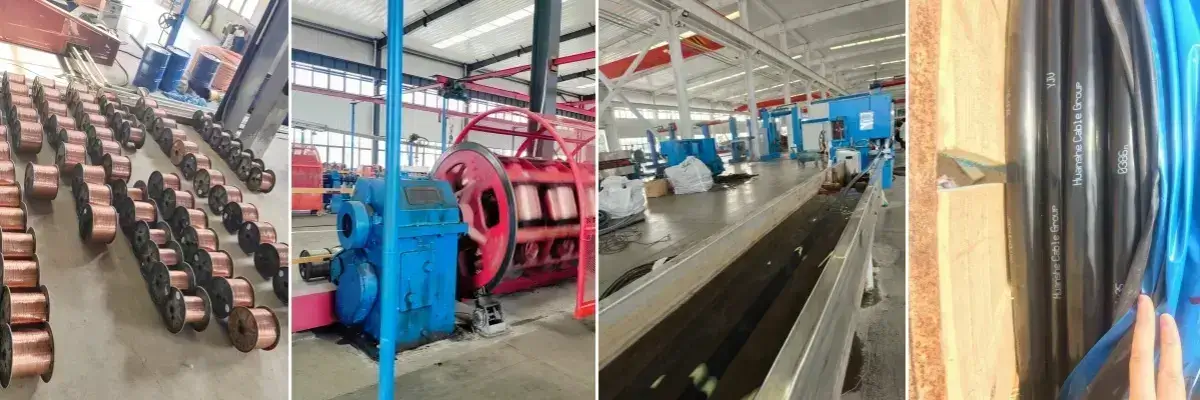
Huanghe has been making cable since 1980, on a 50,000 m² site with 60 production lines, and exports to more than 50 countries. Three core power cable sizes, from 1.5 to 630 mm², are produced in-house rather than outsourced, in copper and aluminium, LV and MV, with armoured, flame-retardant, fire-resistant, and LSZH variants built on the same extrusion and stranding equipment.
The plant holds CB test certificates, ISO 9001, ISO 14001 and CCC, and every order ships with SGS inspection reports where the buyer asks for them. Every drum is factory acceptance tested before it leaves, with conductor resistance, insulation resistance and, for medium voltage, partial discharge recorded against the drum number.
What that means for a 3×95 enquiry is narrow and specific. The conductor weight on the quotation is the real weight, not a nominal figure rounded to look favourable. The copper basis date is stated, so the price can be compared with the tables above. And if a specification asks for a certification we do not hold, it is said at the quotation stage rather than discovered at the audit.
Send the 3×95 Specification and Get a Checkable Price
Model, voltage grade, drum lengths and destination port. The reply states the conductor weight per metre, the copper basis date and the validity period, so every line can be checked against the tables on this page.
| Request a Quote | WhatsApp Us | Email Sales Team |
How much does 3×95 cable cost per metre?
At 13,256 USD copper, a three core 95 mm² LV YJV costs 37.00 to 38.75 USD per metre FOB China. Adding steel tape armour brings it to 38.30 to 40.60, steel wire to 38.90 to 41.40. Fire rated NH-YJV is 43.20 to 49.80. The aluminium equivalent is 5.50 to 7.55. Medium voltage runs from 43.30 at 6/10 kV to 55.45 at 18/30 kV, and armoured medium voltage from 45.30 to 60.65.
How much does 3×95 copper cable weigh per metre?
The conductor alone weighs 2.584 kg per metre, from 3 × 95 × 8.89 ÷ 1000 × 1.02. A finished LV YJV weighs about 3.17 kg per metre, YJV22 about 3.67, YJV32 about 4.27. Medium voltage rises with insulation thickness, from 3.85 kg at 6/10 kV to 5.55 kg at 18/30 kV. Aluminium conductor is 0.786 kg per metre and a finished YJLV about 1.40 kg.
How many kW can a 3×95 cable carry?
A copper 3×95 XLPE cable carries about 252 A in air at 30 °C and 218 A buried at 20 °C. At a full rated load in 400 V systems with a power factor of 0.85, that translates to roughly 148 kW in air and 128 kW buried. Aluminium carries about 78 percent of that, so 196 A in air and 115 kW. These are indicative figures; the actual rating depends on installation method, ambient temperature, grouping and soil thermal resistivity, and has to be recalculated for the project.
How much does 3×95 aluminium cable cost?
At 3,004.50 USD aluminium, a 3×95 YJLV costs 5.50 to 7.55 USD per metre, about 15 to 19 percent of the copper price. Armoured versions are 6.50 to 8.90 for steel tape and 7.00 to 9.60 for steel wire. Medium voltage aluminium runs from 11.80 at 6/10 kV to 24.25 at 18/30 kV. The metal cost inside that price is only 2.36 USD per metre, so most of what you pay is insulation, sheath and process rather than aluminium.
How much more does armoured 3×95 cost?
Armouring adds 1.30 to 2.65 USD per metre, which is 4 to 7 percent of the cable price. Steel tape (YJV22) is the cheaper option at 38.30 to 40.60; steel wire (YJV32) is 38.90 to 41.40 because it uses more steel and needs a bedding layer under it. On medium voltage the increment is 2.00 to 3.60 at lower grades and up to 5.20 at 18/30 kV. Armour is one of the cheapest upgrades available on this size, and buyers routinely overestimate it.
How much more does medium voltage 3×95 cost?
Only 17 percent more at 6/10 kV, 21 percent at 8.7/15 kV, 25 percent at 12/20 kV and 45 percent at 18/30 kV, against the LV cable at 37.00 to 38.75. The premium is smaller than most buyers expect because the conductor, which is 88 to 93 percent of an LV cable, does not change. What you pay for is insulation thickness, two semi-conductive screens, a metallic screen and the triple extrusion process with partial discharge testing.
How much more does fire rated 3×95 cost?
Flame retardant ZR-YJV adds 2 to 3 percent. Low smoke zero halogen WDZ-YJY adds 8 to 12 percent. Fire resistant NH-YJV adds 17 to 29 percent, taking the price to 43.20 to 49.80, because two or three mica tape wraps go on under the insulation and the finished cable has to pass a fire resistance test. Combining fire resistance with low smoke, NH-WDZ-YJY, adds 25 to 40 percent and lands at 46.30 to 54.30.
What is the price difference between 3×95 and 3×120?
A 3×120 copper YJV costs 46.50 to 48.50 USD per metre against 37.00 to 38.75 for 3×95, because the conductor goes from 2.584 kg to 3.264 kg per metre. That is 9.50 to 9.75 USD more, or about 26 percent. If a design is marginal on voltage drop or current, moving from 95 to 120 mm² is usually cheaper than adding a second run, and the arithmetic is quick: the extra copper is 0.68 kg per metre.
What is the price difference between 3×95 and 4×95?
A 4×95 copper YJV costs 48.30 to 50.10 USD per metre against 37.00 to 38.75 for 3×95. The fourth core adds 0.862 kg of copper, which is 11.42 USD at current prices, plus a slightly larger sheath. If the neutral is only needed for small unbalanced loads, a 3×95+1×50 at 43.30 to 45.10 does the same job for about 5 USD per metre less, and that saving is worth having on long runs.
How many metres come on a drum of 3×95?
Standard drum lengths are 500 m and 1000 m, with 2000 m available on larger drums for LV cable. A 1000 m length of 3×95 YJV needs a drum around 1.8 m in diameter and weighs about 3.2 tonnes including the drum. On medium voltage the same length weighs 4.2 to 5.6 tonnes, which affects both the crane capacity on site and the axle load of the delivery vehicle. Always state the drum length required, because it changes the packing and the freight.
How much 3×95 fits in a 40 foot container?
About 8,200 metres of LV YJV, 7,000 of YJV22, 6,000 of YJV32, 6,200 of 8.7/15 kV and 4,600 of 18/30 kV. Aluminium is much lighter at 1.40 kg per metre, so 18,500 metres fits. The limit is weight rather than volume: a 40HQ takes about 26 tonnes of cargo, and twelve drums of 3×95 would fit in the floor space but weigh 38 tonnes.
What is the lead time for a 3×95 order?
Typically 15 to 25 days for low voltage and 20 to 30 days for medium voltage from order confirmation, plus shipping. Fire rated and LSZH variants add a few days because the mica taping and the compound change are separate operations. Orders above 10,000 metres are scheduled across two production runs and the delivery is phased, which is worth agreeing at the quotation stage rather than after the order.
How long is a 3×95 quotation valid?
Normally 7 days when the copper basis is fixed at the date of quotation, because a 1,000 USD move in copper changes the price by about 2.60 USD per metre. Longer validity is available on request, either by agreeing a copper formula with a stated reference price and a monthly reset, or by fixing the copper cost at the time of order with a premium. Both are normal in export contracts; what is not normal is an open-ended price with no basis stated.
How do I check whether a 3×95 quote is real?
Divide the price per metre by 34.26, the cost of the copper inside it at 13,256. A genuine LV YJV lands at 1.08 to 1.13, an armoured one at 1.12 to 1.19, a medium voltage cable at 1.25 to 1.60. Below 1.00, the cable does not exist. Ask for the conductor weight per metre, the copper basis date and the partial discharge report for medium voltage. The arithmetic will expose any fake quote immediately.
Related reading
YJV Cable Price: What a Metre Actually Costs and Why Quotes Differ
SWA Cable Price Guide 2026: Cost Per Metre, Price Factors & RFQ Checklist
4 Core Armoured Cable Sizes & Specifications: Copper, Aluminium, SWA and STA
NH-YJV Cable: Fire Rating, BS 6387 Coverage and Supplier Checks
ZR-YJV Cable: Model Codes, Flame Classes, Sizes and Supplier Selection

Please contact us for a free quotation by the below form. We promise the quickest response within 12 hours.