Edited by Huanghe Cable Technical Team · Reading time: 12–14 minutes
As an experienced NH-YJV cable manufacturer, we know that if an NH-YJV cable is specified on your electrical drawing, you already know what it is for. Before sending your bill of quantities out for quotation, you need to verify three critical factors: the exact fire rating you are buying, whether the supplier can provide valid test reports, and what happens when a project reviewer asks for BS 6387 compliance.
This page answers those three, in that order, and it says plainly where NH-YJV stops. Most suppliers will not put that in writing. We do, because a cable that fails a fire test at commissioning costs more than the order is worth.
The distinction that matters most is not NH versus ZR. It is surviving a fire versus resisting the spread of one, and section 3 deals with it directly. If you have ever received a ZR-YJV when the drawing said NH-YJV, you already know why that section exists.
Contents
2. The NH-YJV Family and Which One Is on Your Drawing
3. NH Is Not ZR, and the Difference Is a Failed Commissioning
4. IEC 60331 and BS 6387: What Each Test Actually Proves
5. Where NH-YJV Stops and MI Cable Starts
6. Mica Tape: Why Two Quotes Differ by a Factor of Two
7. Sizes, Cores and Current Ratings
8. Choose a Trusted NH-YJV Cable Supplier: What We Build
9. MOQ, Lead Time and Container Loading
An NH-YJV Cable (classified as a fire-resistant XLPE insulated copper power cable under GB/T 12706 and IEC standards) is engineered with a strict abbreviation grammar. Each character in its model code corresponds to a precise physical property, material composition, or international standard compliance metric.
NH is 耐火, fire resistant. It is not a material and it is not a test result on its own. It tells you the cable has a mica tape layer on the conductor, which is what keeps the circuit alive after the insulation has burned off.
YJ is 交联聚乙烯, cross-linked polyethylene, XLPE. Continuous conductor temperature 90 °C, 250 °C for five seconds under short circuit.
V is 聚氯乙烯, polyvinyl chloride, PVC, used as the outer sheath.
The trailing digits describe armour, and the convention is the same across every Chinese power cable: 22 is steel tape armour with a PVC sheath, 23 is steel tape with PE, 32 is steel wire with PVC, 33 is steel wire with PE. No digits means no armour.
Then comes core count times cross-section. NH-YJV 4×25 is four cores of 25 mm². NH-YJV22 3×95+1×50 is steel tape armoured, three 95 mm² main cores plus a 50 mm² neutral.
That is the whole grammar. A model code you have never seen before reads the same way.
One thing the code does not tell you
NH-YJV does not state which fire test it passes, or for how long. Two cables both labelled NH-YJV can be tested to different severity levels—such as IEC 60331-21 (750 °C for 90 minutes) or higher-temperature/shock regimes—and the price difference between them is not small. Section 4 covers what to ask for, and section 6 explains why the gap exists.
The base model has no armour and runs on tray, in shaft and inside buildings. Add steel tape and it goes into the ground. Add steel wire and it climbs. Change the sheath to halogen free and the model code changes entirely, because it is a different product.
Table 1. Fire resistant and related models, by construction.
On mobile devices, swipe horizontally to view the complete table.
| Model | Insulation | Armour | Sheath | Typical route | Note |
|---|---|---|---|---|---|
| NH-YJV | XLPE | None | PVC | Tray, shaft, plant room | The base model, most quoted |
| NH-YJV22 | XLPE | Steel tape | PVC | Direct burial, underground | Adds crushing resistance |
| NH-YJV32 | XLPE | Steel wire | PVC | Vertical shaft, steep route | Carries its own weight |
| NH-VV | PVC | None | PVC | Older projects | 70 °C insulation, less current |
| NH-VV22 | PVC | Steel tape | PVC | Older buried routes | Still appears on old drawings |
| WDZN-YJY | XLPE | None | LSZH | Tunnel, metro, public building | Fire resistant plus halogen free |
| WDZN-YJY23 | XLPE | Steel tape | LSZH | Buried, fire critical | The spec you want in a tunnel |
| NH-KVV | PVC | None | PVC | Alarm and control circuits | 450/750 V control cable |
| BTTZ | MgO | Copper tube | None | Fire pump, riser, hazardous | Rigid mineral insulated, inorganic copper sheath and MgO, no polymer. |
| YTTW | Mica and mineral | Corrugated copper | Optional | Flexible MI, long routes | Flexible MI, copper corrugated sheath with mineral/mica composite. |
Source note: model codes follow GB/T 12706 and GB/T 19666. BTTZ and YTTW are mineral insulated constructions covered by IEC 60702, not by GB/T 12706, and are listed here because they appear on the same fire system drawings.
Two substitutions that get made on site and should not be.
NH-VV for NH-YJV. Both are fire resistant and both carry mica tape, so they look interchangeable. They are not. NH-VV has PVC insulation rated 70 °C, so the same cross-section carries noticeably less current. Substituting it without the designer’s approval leaves the circuit under-rated.
NH-YJV for WDZN-YJY. This is the expensive one. NH-YJV has a PVC sheath, which releases hydrogen chloride and dense smoke when it burns. WDZN-YJY has a halogen free sheath. In a tunnel, a metro station or a basement with an evacuation route, the PVC sheath is the problem, not the fire resistance.
Not sure which model your BOQ actually requires?
Send us your single-line diagram or circuit list. We will check if NH-YJV meets the fire safety requirement, or if you need an armoured or LSZH construction.
These two categories are confused more often than any other pair in the cable schedule, and the confusion is expensive because it only surfaces during a fire test or a commissioning inspection.
The distinction is one sentence. ZR stops a fire from spreading along the tray. NH keeps a circuit working while the fire is burning. They solve different problems and they are tested to different standards.
Table 2. Fire resistant versus flame retardant, side by side.
On mobile devices, swipe horizontally to view the complete table.
| Point | NH-YJV, fire resistant | ZR-YJV, flame retardant |
|---|---|---|
| Purpose | Keeps the circuit energised during a fire | Prevents fire from travelling along the cable tray |
| Key construction | Mica tape wrapped directly on the conductor | No mica tape; flame retardant additive in the sheath compound |
| Test standard | IEC 60331 series, or BS 6387 | IEC 60332-3 series |
| What the test does | Burns the cable at 750 to 950 °C and checks whether current still flows | Burns a ladder of cables and measures how far the flame travels |
| Typical circuits | Fire pump, smoke fan, emergency lighting, alarm, lift homing | General distribution, sub-mains, trays in plant rooms |
| Relative price | 40 to 80% above ZR-YJV at the same size | Baseline |
| If you get the wrong one | Fire pump does not run. The failure is found at commissioning, or during a fire. | Fire spreads along the tray. The failure is found by the fire investigator. |
Source note: test standards as published by IEC and BSI. Relative price reflects typical copper and mica tape content at the same conductor size and excludes armour.
There is a third category that gets mixed in, and it catches people who think they have solved the problem by buying the most expensive option.
WDZN-YJY is NH plus LSZH. It keeps the circuit alive and does not release halogen acid or dense smoke. It is the correct product for a tunnel, a metro station, a hospital corridor or any basement with an evacuation route. It costs more than NH-YJV and it is worth it in those locations. It is not necessary in a plant room with no occupants, and specifying it there is money spent on nothing.
Quick comparison: NH-YJV vs WDZN-YJY.
The check that takes thirty seconds
Read the circuit description, not the model code. If the circuit has to keep working during a fire, it needs NH or WDZN. If the circuit only has to avoid spreading fire to the next tray, ZR is enough.
A drawing that says ZR-YJV on a fire pump feeder has a specification error, and it is more common than it should be. Ask before you quote, because the answer changes the price by half.
Related: When a buyer for the Erdenet Copper Mine in Mongolia faced this exact ambiguity, they sent their engineering team to our factory to verify the mica tape wrapping before shipment.
For an NH-YJV Cable, fire resistance is defined by explicit test standards rather than generic marketing terms. The performance matrix links directly to international test parameters—such as flame temperature, duration, and mechanical or water exposure hazards—governed by the IEC 60331 and BS 6387 frameworks.
IEC 60331 is the international reference and it is split into parts. The part number tells you the test condition, and the part number is what you should ask for in writing.
Table 3. IEC 60331 parts and what each one tests.
On mobile devices, swipe horizontally to view the complete table.
| Part | Flame | Duration | Additional condition | Where it is asked for |
|---|---|---|---|---|
| 60331-21 | 750 °C | 90 min | None | The default for Chinese NH cable, and most Asian projects |
| 60331-11 | 750 °C | 180 min | None | Where the design needs three hours of survival |
| 60331-1 | 950 °C | 90 min | With mechanical shock, cable over 20 mm diameter | European and Gulf projects with a shock requirement |
| 60331-2 | 950 °C | 90 min | With mechanical shock, cable up to 20 mm diameter | The same requirement on smaller cables |
| 60331-3 | 950 °C | 90 min | Immersed in water during the test | Tunnels, pump rooms, any wet route |
Source note: test conditions and durations follow the IEC 60331 series as published. The Chinese standard GB/T 19216.21 is technically equivalent to IEC 60331-21, and GB/T 19216.11 to IEC 60331-11.
Now the part that matters for a British-derived specification. BS 6387 uses a different structure: three single letters, each testing one additional hazard on top of fire.
Table 4. BS 6387 categories and how they map onto Chinese NH cable.
On mobile devices, swipe horizontally to view the complete table.
| Cat | What the test does | Standard NH-YJV | What it takes to pass |
|---|---|---|---|
| C | 950 °C flame for 3 hours, cable alone | Yes, with heavier mica tape | Two or three mica tape layers, phlogopite grade |
| W | 650 °C flame for 15 min, then water spray for 15 min | Normally no | A sealed metallic barrier. Mineral insulated cable. |
| Z | 950 °C flame for 15 min, with mechanical shock for 15 min | Normally no | A rigid or corrugated metal sheath. Mineral insulated cable. |
| CWZ | All three, in sequence, on the same sample | No | Mineral insulated cable only |
Source note: BS 6387 category definitions as published. BS 8491 and BS EN 50200 now cover parts of the same ground, and some specifications use PH 30, PH 60, PH 90 or PH 120 instead of the C W Z letters. Where a project names a standard, the named edition governs. The assessment above describes standard mica tape construction and does not override a project-specific type test.
Read that table carefully, because it is the point where a lot of Chinese NH-YJV quotations fall apart.
Why W is hard. A mica tape wrapped on a conductor survives heat because mica is a mineral. It does not survive a water jet. Once the outer sheath and insulation have burned away, there is nothing left to stop water reaching the conductor, and the circuit fails. Passing W requires a continuous metallic barrier, which is a fundamentally different construction.
Why Z is hard. Mica tape is brittle once it has been through a fire. A mechanical shock at that point cracks it off the conductor. Passing Z requires the metal sheath to carry the mechanical load, which again means a mineral insulated cable.
Why C is achievable. C is heat only, with no water and no shock. A mica tape construction with enough layers and the right mica grade will pass it. That is a real engineering achievement and it is worth paying for, but it is not the same as CWZ.
A claim worth checking
If a supplier offers you NH-YJV against a BS 6387 CWZ specification, ask which category the type test report actually covers and which laboratory issued it. A report for Category C is a real report and a legitimate achievement. It is not evidence of W or Z, and a buyer who assumes otherwise finds out at the worst possible moment.
This section exists because it is the one most suppliers skip, and because getting it wrong is the most expensive mistake in the fire cable category.
NH-YJV covers a large part of the market. It does not cover all of it. Where the specification goes beyond heat alone, the product changes and the price changes with it.
Table 5. Reading the requirement and choosing the product.
On mobile devices, swipe horizontally to view the complete table.
| If the specification says | The product is | Relative price | Note |
|---|---|---|---|
| IEC 60331-21, 750 °C, 90 min | NH-YJV | 1.0 | The standard Chinese fire resistant cable |
| IEC 60331-11, 750 °C, 180 min | NH-YJV, heavier mica | 1.1 to 1.2 | More tape layers, slower line speed |
| IEC 60331-1 or -2, 950 °C, 90 min with shock | NH-YJV, project specific | 1.2 to 1.4 | Requires a type test, not an assumption |
| Fire resistant plus halogen free | WDZN-YJY | 1.3 to 1.5 | Tunnels, metro, public buildings |
| BS 6387 Category C | NH-YJV, heavy mica | 1.3 to 1.5 | Achievable, needs the right tape grade |
| BS 6387 Category W or Z | BTTZ or YTTW | 3 to 8 | Mineral insulated. Not a mica tape product. |
| BS 6387 Category CWZ | BTTZ, or YTTW with test evidence | 3 to 8 | Mineral insulated only |
| Fire pump feeder, high-rise riser | BTTZ, or NH-YJV where accepted | 1.0 to 8 | Depends entirely on the local code |
Source note: relative prices compare landed cost at the same conductor size and are indicative. Local fire codes differ by country and by building type, and the authority having jurisdiction governs over any general guidance here.
The jump from NH-YJV to BTTZ is not a price increase. It is a different order of magnitude, and it changes the installation as well.
BTTZ is rigid. Solid copper conductor inside compacted magnesium oxide inside a seamless copper tube. It does not bend around a corner without a factory-made bend, it needs specialist terminations, and the installation labour is a significant line item. It survives 1000 °C and it survives water and shock, which is why it is specified where nothing else is accepted.
YTTW is the flexible version. Corrugated copper sheath, with a mineral/mica composite insulation. Unlike BTTZ, YTTW does not use magnesium oxide (MgO) powder; it relies on mica tape to maintain circuit integrity, which makes it easier to route and faster to terminate. It is the practical choice for long or awkward routes where BTTZ would need too many joints. Its fire performance depends on the specific test evidence, so ask for the report rather than assuming it matches BTTZ.
The commercial consequence is simple. If your project genuinely requires CWZ, budget for mineral insulated cable and find a supplier who installs it, because a mica tape cable will not pass no matter what the datasheet says. If your project requires C, or IEC 60331-21, NH-YJV is the right product and paying for MI is money spent on nothing.
A note on Medium Voltage (MV) fire-resistant cables
If your project is 3.6/6 kV, 6/10 kV, or up to 26/35 kV, the construction changes fundamentally. You cannot simply wrap mica tape around the conductor of an MV cable, because it would disrupt the semi-conductive conductor screen and cause partial discharge.
For MV fire-resistant applications (such as substation feeders or tunnel ring mains), the fire barrier (ceramicized silicone rubber or a mica/EPR composite) is applied over the insulated cores or the metallic screen, not directly on the conductor. If your specification involves MV, please state the voltage grade in the RFQ, and we will quote a dedicated MV fire-resistant construction.

Two suppliers quote NH-YJV 4×25, both to IEC 60331-21, and one comes back at almost double the other. The copper is the same. The XLPE is the same. The difference is in a layer you cannot see from outside, and it is worth understanding before you pick the cheaper one.
Table 6. What changes inside the mica tape layer and what it costs.
On mobile devices, swipe horizontally to view the complete table.
| Variable | Cheaper version | Higher performance version | Effect |
|---|---|---|---|
| Mica type | Synthetic mica, lower cost, lower temperature ceiling | Phlogopite mica, natural mineral, stable above 1000 °C | Determines whether the cable holds at 950 °C or only at 750 °C |
| Tape layers | One layer, 50% overlap | Two or three layers, controlled overlap | Directly sets the survival time. One layer rarely reaches 90 min at 950 °C. |
| Tape thickness | 0.08 mm | 0.10 to 0.14 mm | Thicker tape adds mechanical strength after the fire |
| Wrapping method | Loose wrap, hand-tensioned | Machine wrapped at controlled tension | Gaps and voids are where the fire gets in |
| Conductor compaction | Uncompacted stranded conductor | Compacted, smooth surface | A smooth surface lets the tape sit tight without bridging over strand gaps |
| Type testing | Routine test only, no fire test report | Full IEC 60331 type test on the actual construction | The test is expensive. A supplier who has run it has paid for it, and that sits in the price. |
| Sheath compound | General purpose PVC | Flame retardant PVC, or LSZH for WDZN models | Affects flame spread and smoke, not fire survival |
Source note: these are the construction variables that most commonly explain price differences between fire resistant cable quotations at the same nominal specification. The relative weight of each varies with conductor size and order quantity.
Three practical tests you can run before placing an order.
Ask for the fire test report, not the datasheet. A datasheet says “fire resistant to IEC 60331”. A report names the part number, the flame temperature, the duration, the conductor size tested, and the laboratory. Only one of those documents can be checked.
Ask how many tape layers and which mica grade. A supplier who builds to a real standard knows the answer without checking. A trader who buys from whoever is cheapest that month usually does not.
Ask for a cross-section photograph of the actual production cable. Not a drawing. A photograph of a cut end shows the tape layers, the wrapping quality and the conductor compaction in a way no specification sheet does.
Want a transparent quote based on the actual mica tape build?
Send us your cable schedule with the required fire rating. We will specify the exact mica layers and copper content in our quotation, so you can compare it line-by-line with other suppliers.
NH-YJV runs from 1.5 mm² to 630 mm² in copper. Standard core configurations include 1, 2, 3, 4, and 5 equal cores, as well as 3+1, 3+2, and 4+1 reduced neutral arrangements. Smaller sizes (1.5–10 mm²) are typically 2–5 core control and alarm circuits, while larger sizes (16–630 mm²) are mostly 3, 4, or 5 core power feeders. The core arrangement changes the price more than the cross-section does at the same total copper weight.
Equal cores are the simple case: four equal cores carry three phases plus a protective earth, five add a neutral. Reduced arrangements exist because a neutral or an earth rarely carries the same current as a phase, so building it smaller saves copper without affecting the circuit.
Table 7. Core arrangements for NH-YJV and their relative cost.
On mobile devices, swipe horizontally to view the complete table.
| Notation | Meaning | Relative cost | Typical circuit |
|---|---|---|---|
| 1×S | Single core | Lowest per metre | DC link, single phase feeder |
| 3×S | Three equal cores | Baseline | Fire pump, three phase motor |
| 4×S | Four equal cores | About 30% above 3×S | Three phase plus PE |
| 5×S | Five equal cores | Highest | Three phase plus N plus PE |
| 3×S+1×S/2 | Three main plus reduced PE | 10 to 15% below 4×S | Motor feeders, separate earth |
| 3×S+2×S/2 | Three main plus reduced N and PE | 15 to 20% below 5×S | Distribution with light neutral |
Source note: relative cost reflects copper content differences at the same main cross-section and excludes mica tape, armour and sheath. Reduced neutral is not permitted where harmonic currents are significant.
Current ratings below are for copper conductors, XLPE insulation, 0.6/1 kV, three loaded conductors, at 30 °C ambient in free air and 20 °C soil temperature for buried routes. The mica tape adds a small amount of thermal resistance, so an NH-YJV carries roughly 3 to 5% less current than the same size ZR-YJV. That is a real difference and it is small enough that most designs ignore it, but it is not zero.
Table 8. Indicative current rating, copper NH-YJV, 0.6/1 kV.
On mobile devices, swipe horizontally to view the complete table.
| Cross-section (mm²) | Free air, tray (A) | Buried in duct (A) | Typical fire system use |
|---|---|---|---|
| 1.5 | 21 | 19 | Alarm loop, emergency lighting final circuit |
| 2.5 | 29 | 26 | Alarm loop, small fan |
| 4 | 38 | 36 | Emergency lighting sub-circuit |
| 6 | 49 | 45 | Small smoke fan, pressurisation unit |
| 10 | 67 | 60 | Smoke extraction fan branch |
| 16 | 90 | 78 | Fan feeder, lift homing supply |
| 25 | 114 | 100 | Fire pump branch, most quoted size |
| 35 | 141 | 120 | Fire pump feeder |
| 50 | 172 | 142 | Main fire pump supply |
| 70 | 220 | 176 | Riser feeder |
| 95 | 267 | 207 | Main riser, basement to roof |
| 120 | 309 | 236 | Main riser, high-rise |
| 150 | 356 | 267 | Main feeder |
| 185 | 407 | 300 | Main feeder, substation |
| 240 | 480 | 347 | Incoming feeder |
| 300 | 553 | 392 | Incoming feeder, large plant |
| 400 | 630 | 450 | Transformer connection |
Source note: indicative values derived from the order of magnitude of IEC 60364-5-52, reduced by 3 to 10% depending on size to account for the mica tape layer and the thermal resistance of the duct. Values assume an isolated circuit. Grouping, depth, soil thermal resistivity and altitude derating must be applied for the final design. For sizes above 300 mm², proximity and skin effect in bunched multicore installations reduce capacity further.

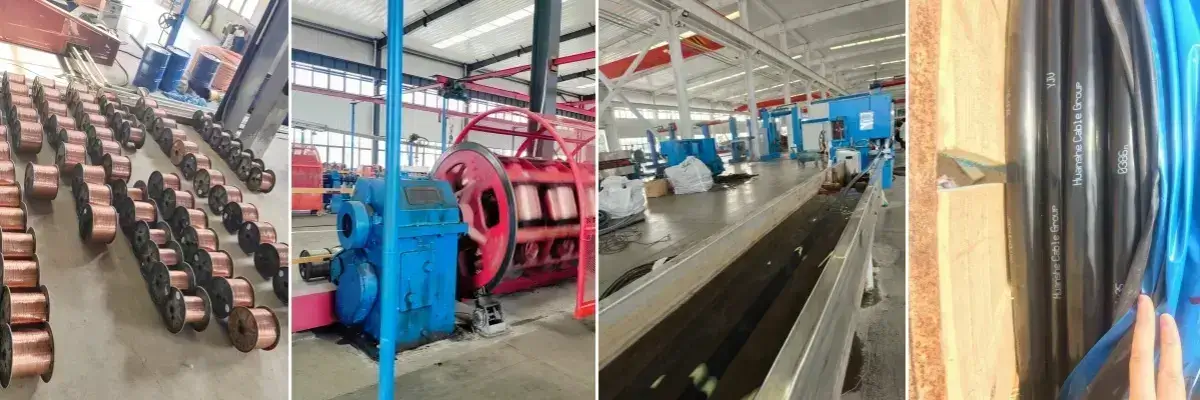
As an experienced NH-YJV cable supplier, Huanghe Cable has been manufacturing in Henan since 1980, originally as a state-owned plant, and the fire resistant range has been part of the line since long before it became a common export item. The plant covers over 50,000 m² with around 60 production lines, and we ship to more than 50 countries, mostly across Southeast Asia, Central Asia, Africa and South America.
What we build. NH-YJV, NH-YJV22, NH-YJV32, NH-VV, NH-VV22 and NH-KVV, from 1.5 mm² to 630 mm², 1 to 5 cores, with reduced neutral arrangements. The standard construction is mica tape on the conductor with XLPE insulation and a flame retardant PVC sheath, tested to IEC 60331-21. Heavier mica builds for IEC 60331-11 and for BS 6387 Category C are available on request and quoted separately, because they are a different construction and not a line item you can assume.
We also supply WDZN-YJY and WDZN-YJY23 for projects that need fire resistance plus a halogen free sheath, and mineral insulated cable including BTTZ and YTTW where the specification reaches W, Z or CWZ.
What we hold. A CB test certificate, ISO 9001 and ISO 14001 certification, CCC for the domestic range, and SGS inspection reports. Routine tests on every drum: conductor resistance, voltage withstand, insulation resistance. Type test evidence for the fire resistant construction is available for review under NDA, and we will tell you which sizes the report covers.
What we do not hold. We do not hold BASEC or LPCB product certification, and we do not hold a third-party BS 6387 certificate for the NH-YJV range. Where a project requires a named third-party certificate against a British Standard, we will say at quotation stage whether we can meet it, rather than accept the order and resolve the question later.
That last point is the one worth weighing. A supplier who claims every certificate for every size is the one to check hardest in this category, because the consequence of a false claim is a fire system that does not work. What we offer instead is verifiable: build to the standard, test to the standard, and let an inspector you appoint watch the testing happen. We accept pre-shipment inspection by SGS, BV, TÜV or Intertek, and we arrange the witness testing and the measurement access.
Project Delivery: Mongolia Erdenet Copper Mine
For the emergency power systems at the Erdenet Copper Mine, Huanghe supplied NH-YJV 4×25 mm² and 4×95 mm² tested to IEC 60331-21.
Because this was a critical facility with harsh winter conditions, the buyer’s engineering team flew to our plant for a pre-shipment inspection. We arranged the witness testing, allowed them to cut a cross-section to check the mica tape wrapping, and verified the drum lengths before they sealed the containers. We treat factory visits and third-party inspections as a standard part of the order process, not an exception.
Fire resistant cable is heavier than the equivalent power cable because of the mica tape and the thicker insulation wall. That matters for container planning, because a fire cable order that looks small in metres can fill a container in weight.
Table 9. Approximate weight for NH-YJV, four core copper.
On mobile devices, swipe horizontally to view the complete table.
| Size (mm²) | Approx. weight (kg/m) | Typical drum length (m) | 20GP reference |
|---|---|---|---|
| 4×6 | 0.46 | 500 | About 36 km by weight |
| 4×16 | 0.98 | 500 | About 17 km by weight |
| 4×25 | 1.65 | 500 | About 10 km by weight |
| 4×50 | 2.95 | 300 | About 5.7 km by weight |
| 4×95 | 4.85 | 200 | About 3.5 km by weight |
| 4×150 | 7.20 | 150 | About 2.3 km by weight |
| 4×240 | 11.3 | 100 | About 1.5 km by weight |
Source note: weights are indicative for NH-YJV four core copper with a PVC sheath and vary with mica tape build and sheath thickness. Container figures assume a 20GP loaded to roughly 18 tonnes and are a planning reference, not a loading plan. Confirm against the actual packing list before booking freight.
MOQ. For standard sizes, one drum or one pallet per size, which on 4×25 is a few kilometres. Mixed orders combining several sizes in one container are routine, and most of our fire cable orders ship that way because a project rarely needs one size only.
Lead time. Standard sizes from stock allocation run 10 to 18 days, longer than our power cable line because the mica taping stage is slower than a plain extrusion. Heavier mica builds and BS 6387 Category C constructions add time, and a third-party inspection adds the inspector’s scheduling window.
Drum length. Fire cable is often pulled in short runs inside a building, so the drum length should match the riser height rather than the container capacity. A 500 m drum that cannot be moved into a basement plant room is a problem you discover on site.
Most of the price spread on fire resistant cable starts in the enquiry, not in the factory. A request that says “please quote NH-YJV” produces quotations for four different products, and none of them can be compared.
Seven lines fix it, and the first one is the one that matters most.
1. The fire test requirement. Name the standard and the part: IEC 60331-21, or IEC 60331-11, or BS 6387 Category C. Not just “fire resistant”. This single line is the difference between a 750 °C cable and a 950 °C cable, and between a quote you can use and one you cannot.
2. Model and core arrangement. NH-YJV, NH-YJV22 or NH-YJV32, and the arrangement: 4×25, 3×95+1×50, 5×16.
3. Sheath requirement. PVC is standard. State it if the project needs halogen free, because that changes the model to WDZN-YJY and changes the price.
4. Quantity per size. In metres, and whether the order ships as one container or several.
5. Drum length. Match it to the installation. A riser and a basement route need different drums.
6. Copper basis and Incoterm. Ask for the copper reference date and the validity period, and state the port and the Incoterm.
7. Inspection requirement. State whether a third-party inspection is required and at which stage. Fire cable is a category where this is worth doing, and factories schedule differently when they know an inspector is coming.
Add one more if the specification is British-derived: state which BS 6387 categories the project actually requires. If the answer is C, a mica tape cable is viable. If the answer includes W or Z, the product is mineral insulated and the budget is different by a factor of three to eight. Getting that clear before the enquiry saves everyone a month.
Send Your NH-YJV Cable Schedule
Huanghe builds NH-YJV and NH-YJV22 from 1.5 to 630 mm² to IEC 60331-21, with heavier mica builds for IEC 60331-11 and BS 6387 Category C, plus WDZN-YJY where the sheath has to be halogen free. Send the BOQ and the fire test clause, and we will confirm what we can test to before you commit.
NH is 耐火, fire resistant. YJ is cross-linked polyethylene, XLPE insulation. V is polyvinyl chloride, the PVC sheath. A trailing 22 means steel tape armour, 32 means steel wire armour. So NH-YJV is a fire resistant, XLPE insulated, PVC sheathed copper power cable, rated 0.6/1 kV as standard.
NH-YJV keeps a circuit working during a fire, using a mica tape layer on the conductor. ZR-YJV prevents fire from spreading along a cable tray, using a flame retardant sheath compound and no mica tape. They are tested to different standards, IEC 60331 for NH and IEC 60332-3 for ZR, and they are not interchangeable. NH-YJV costs 40 to 80% more at the same size.
The standard construction is tested to IEC 60331-21, which is 750 °C for 90 minutes with the circuit energised. Heavier mica builds can reach IEC 60331-11 at 750 °C for 180 minutes, and BS 6387 Category C at 950 °C for 3 hours. Always ask which part number the test report covers, because the model code does not state it.
Category C, yes, with a heavier mica tape build. Category W and Category Z, normally no. W adds a water spray and Z adds mechanical shock, and both require a continuous metallic barrier that mica tape does not provide. Those categories need mineral insulated cable such as BTTZ or YTTW.
No. The standard NH-YJV has a PVC sheath, which releases hydrogen chloride and dense smoke when it burns. For a halogen free version, the model is WDZN-YJY, which uses an LSZH sheath. That is the correct specification for tunnels, metro stations and basements with an evacuation route.
NH-YJV22 adds steel tape armour. It is for direct burial and routes where the cable needs crushing resistance. NH-YJV has no armour and is used on cable tray, in shafts and inside plant rooms. The armour does not change the fire performance, only the mechanical protection.
About 114 A in free air on tray at 30 °C ambient, or 100 A buried in duct, for three loaded conductors. That is roughly 3 to 5% lower than the same size ZR-YJV because the mica tape adds thermal resistance. Grouping and ambient derating still apply on top.
Roughly 40 to 80% above the equivalent ZR-YJV at the same conductor size, depending on the mica tape build and whether a type test exists for the construction. A BS 6387 Category C build sits at the top of that range. For a firm number, send the size list and the fire test clause, and we quote against a stated copper basis.
Yes, for the constructions we build. We provide IEC 60331 type test evidence and will state which sizes the report covers, since a report for one size does not automatically cover another. We do not hold a third-party BS 6387 certificate for the NH-YJV range, and we say so at quotation stage.
One drum or one pallet per size for standard constructions, which on 4×25 is a few kilometres. Lead time is 10 to 18 days from stock allocation, longer than plain power cable because mica taping is a slower process. Custom mica builds and third-party inspection add time.
When the specification requires BS 6387 Category W, Z or CWZ, or when the local fire code demands circuit integrity beyond what a mica tape cable can deliver. Mineral insulated cable costs three to eight times more and needs specialist terminations, so it should only be used where the requirement is real.
Yes. Buyers appoint SGS, BV, TÜV, Intertek or another inspector to attend our plant, and we arrange witness testing, dimension measurement and quantity verification. For fire resistant cable we recommend it, because the construction that determines fire performance is inside the cable and cannot be checked after delivery.

Please contact us for a free quotation by the below form. We promise the quickest response within 12 hours.