Edited by Huanghe Cable Technical Team · Reading time: 15–18 minutes
Direct Answer: A 4×25 mm² YJV cable costs USD 13.30 to 14.10/m FOB China, based on LME copper at USD 13,399/t (16 Nov 2026). Copper accounts for 86–96% of the total price. Any quote significantly lower than this likely involves a conductor under-section, short metrage, or reduced testing scope.
A reasonable YJV cable price starts with knowing how the quote is built. You have a schedule in front of you and you want to know whether the number is fair. That is a narrower question than most cable articles answer, and it is the only one this page answers.
There is a short version. YJV is roughly 86 to 96 percent copper by value, so its price is not really a manufacturing number. It is the copper price plus a conversion fee, and the conversion fee is the only part anyone is actually competing on. Once you can calculate the copper weight yourself, most of the mystery disappears.
Core Pricing & Metric Reference:
Who is giving you these numbers. Huanghe has been building YJV, YJV22, YJV32 and YJLV cable since 1980, from 1.5 to 630 mm², in copper and aluminium, to GB/T 12706.1 and IEC 60502-1. Every quotation we send states the copper basis date, the copper weight per metre and the drum length, so the price can be checked against the tables on this page before you compare it with anyone else. If a schedule already exists, send it and we will quote it on that basis.
Need a benchmark for your current schedule?
One warning before the numbers. Every figure on this page assumes GB/T 12706.1 conductor dimensions, Class 2 stranded copper, and a standard PVC sheath. Change any of those and the price changes with it, which is exactly the point of section 6.
Contents
1. What a YJV Price Is Made Of
2. YJV Cable Price Per Metre, by Size and Core
3. The Copper Weight Formula You Can Run Yourself
4. How the Copper Price Moves the Number
5. YJV vs YJLV: Aluminium at a Fifth of the Price
6. Why One YJV Quote Is Half of Another
7. YJV, ZR-YJV and NH-YJV: The Price Ladder
8. MOQ, Drum Length and What Freight Adds
9. The RFQ That Gets a Comparable Price
Take a 4×25 and open it up. Six cost lines, and only one of them is large.
Table 1. Cost build-up for a 4×25 mm² YJV, copper at USD 13,399 per tonne.
← Swipe horizontally to view full table →
| Cost element | USD/m | Share | What moves it |
|---|---|---|---|
| Copper conductor | 12.15 | 88% | Copper price, conductor class, compacting ratio |
| XLPE insulation | 0.42 | 3% | Insulation thickness, compound grade, degassing |
| PVC sheath | 0.33 | 2% | Sheath thickness, virgin versus recycled compound |
| Fillers and binder tape | 0.12 | 1% | Core count, bedding, whether the profile is extruded |
| Conversion: labour, energy, line time | 0.55 | 4% | Line speed, run length, how often the line changes over |
| Drum, packing, inland haul to port | 0.28 | 2% | Drum size, distance to loading port, whether the drum is returnable |
| Total | 13.85 | 100% | Before margin and before freight |
Source note: figures are a representative factory cost model for GB/T 12706.1 construction at the stated copper price. Individual factories differ in the conversion and packing lines by 20 to 40 percent, which is the part that is genuinely competitive.
Read the middle column again. Copper is 88 percent. The other five lines together are 1.70 per metre, and the two that a factory actually controls are conversion at 0.55 and packing at 0.28.
This is the single most useful fact on the page, because it tells you what a price conversation can and cannot be about. If a supplier is 15 percent cheaper on a 4×25, they are not 15 percent better at making cable. They have around USD 2.08 per metre somewhere, and it can come from only four places: cheaper copper, less copper, cheaper compound, or less testing. Section 6 goes through all four.
The line that is not on the table
Margin. A Chinese YJV factory working on export orders typically runs 3 to 8 percent gross on copper-heavy sizes and rather more on small sizes, because the conversion content is larger. This is why small sizes look expensive per kilogram of copper and large sizes look cheap. It is not a pricing trick, it is the arithmetic of a thin conversion fee spread over a large metal cost.
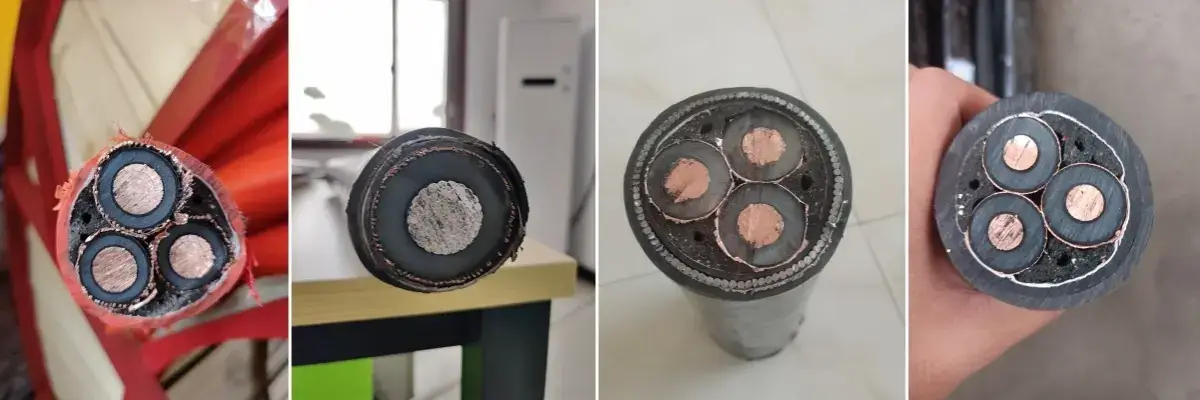
Four core is the volume construction for building distribution and the one most quotes are written against, so it gets its own table. Everything else follows below.
Table 2. YJV cable price per metre, four core, copper at USD 13,399 per tonne.
← Swipe horizontally to view full table →
| Size | Copper kg/m | Copper USD/m | FOB USD/m | Copper share |
|---|---|---|---|---|
| 4×16 | 0.580 | 7.77 | 8.72 to 9.37 | 83 to 89% |
| 4×25 | 0.907 | 12.15 | 13.30 to 14.10 | 86 to 91% |
| 4×35 | 1.269 | 17.00 | 18.40 to 19.35 | 88 to 92% |
| 4×50 | 1.814 | 24.31 | 26.06 to 27.26 | 89 to 93% |
| 4×70 | 2.539 | 34.02 | 36.17 to 37.62 | 90 to 94% |
| 4×95 | 3.446 | 46.17 | 48.77 to 50.52 | 91 to 95% |
| 4×120 | 4.353 | 58.33 | 61.38 to 63.43 | 92 to 95% |
| 4×150 | 5.441 | 72.90 | 76.50 to 78.90 | 92 to 95% |
| 4×185 | 6.710 | 89.91 | 94.21 to 97.06 | 93 to 95% |
| 4×240 | 8.705 | 116.64 | 121.84 to 125.29 | 93 to 96% |
Source note: copper weight uses 8.89 g/cm³ and a 1.02 stranding factor. The FOB range spans a single-layer standard build at the low end to a heavier sheath, tighter conductor tolerance and full routine testing at the high end. Excludes freight, insurance and any third-party inspection.
Table 3. YJV price per metre for single core, three core, five core and reduced neutral constructions.
← Swipe horizontally to view full table →
| Construction | Copper kg/m | FOB USD/m | Where it is used |
|---|---|---|---|
| 1×25 | 0.227 | 3.59 to 3.99 | Single phase, long feeders, DC strings |
| 1×95 | 0.861 | 12.74 to 13.64 | Sub-main, tray riser, transformer tail |
| 3×25 | 0.680 | 10.26 to 11.01 | Three phase, separate earth |
| 3×95 | 2.584 | 37.37 to 39.12 | Three phase sub-main, motor feeder |
| 3×150 | 4.081 | 58.52 to 60.87 | Main distribution, riser |
| 5×16 | 0.725 | 10.77 to 11.47 | Three phase plus neutral and earth |
| 5×25 | 1.133 | 15.92 to 16.82 | Distribution board feed, mixed load |
| 3×95+1×50 | 3.038 | 43.51 to 45.31 | Reduced neutral feeder, common on EPC schedules |
| 3×120+1×70 | 3.899 | 55.45 to 57.60 | Reduced neutral main feeder |
Source note: same basis as Table 2. Single core prices assume non-magnetic armouring if any is specified; steel tape or steel wire on a single core AC circuit requires derating and is quoted separately.
Two patterns are worth noticing before you use these tables.
Small sizes are relatively expensive per unit of copper. A 1×25 is USD 3.59 to 3.99 per metre and carries 0.227 kg of copper. That is roughly USD 16.7 per kilogram of copper content. A 4×240 carries 8.705 kg and costs USD 121.84 to 125.29, which is about USD 14.2 per kilogram. The difference is not a markup, it is the conversion and packing cost being spread over far less metal.
Reduced neutral saves less than people expect. A 3×95+1×50 is USD 43.51 to 45.31 against USD 48.77 to 50.52 for a 4×95. That is about 10.5 percent, not 25 percent, because the fourth core was never a full 95 mm² in the first place. If a schedule is being value-engineered, going from 4×95 to 3×95+1×50 is a real saving but not a dramatic one.
Price Your Own Schedule Against These Tables
Send the BOQ with sizes and drum lengths. We will quote each line at the current copper basis and show the copper weight beside the price, so the arithmetic above can be run on our own numbers rather than on a competitor’s.
You do not need a supplier to tell you how much copper is in a cable. You need one number and one multiplication.
Copper weight (kg/m) = number of cores × nominal cross-section (mm²) × 8.89 ÷ 1000 × 1.02
8.89 is the density of copper in grams per cubic centimetre. The 1.02 is a stranding factor: a stranded Class 2 conductor carries about 2 percent more metal than the same nominal section calculated as a solid block, because of the lay length and the compacting.
Run it for a 4×25. Four cores times 25 mm² is 100 mm² of copper. Times 8.89 is 889 grams per metre as a solid block. Times 1.02 gives 907 grams. At USD 13,399 per tonne that is USD 12.15 of copper in a cable selling for USD 13.30 to 14.10.
If the weight is short, do not argue about it. Ask for the DC resistance test report for that drum and compare it against the IEC 60228 value for the size. A conductor that is 5 percent light on copper will normally fail resistance as well, and a resistance figure on paper is much harder to explain away than a weight on a scale.
Why this matters more than any other check
Copper is 88 percent of the price. A supplier who wants to win on price has exactly one place to find the money, and it is the metal. Every other saving in the factory adds up to a few percent. A 7 percent conductor shortfall on a 4×95 is USD 3.23 per metre, which is more than the entire conversion and packing cost combined.
Here is a conversion worth memorising: a USD 1,000 move in the copper price changes a YJV cable price by about 7 percent, at every size.
That is not a coincidence. Copper is 86 to 96 percent of the total depending on size, so a proportional move in copper produces a nearly proportional move in the cable. The percentage stays flat, the absolute number scales with the size.
Table 4. YJV price against the copper price, three sizes.
← Swipe horizontally to view full table →
| Copper USD/t | 4×25 FOB USD/m | 4×95 FOB USD/m | 4×240 FOB USD/m | Against 13,399 |
|---|---|---|---|---|
| 12,000 | 12.03 to 12.83 | 43.95 to 45.7 | 109.66 to 113.11 | About 10% lower |
| 13,000 | 12.94 to 13.74 | 47.40 to 49.15 | 118.37 to 121.82 | About 3% lower |
| 13,399 | 13.30 to 14.10 | 48.77 to 50.52 | 121.84 to 125.29 | This page’s basis |
| 14,500 | 14.30 to 15.10 | 52.57 to 54.32 | 131.43 to 134.88 | About 7.5% higher |
Source note: non-copper content held constant at the mid-point of each size range. Real quotations may also move the conversion line, but not by enough to change the pattern.
Now put a date on it. A quotation with 30 days validity is exposed to whatever copper does in 30 days. In a month when copper moves USD 800, the cable moves about 5.5 percent. On a 4×95 that is USD 2.8 per metre, or USD 2,760 on a one-kilometre order.
This is why the three questions in section 9 are worth asking before you compare anything else: which copper price, which date, how long is the quote valid. Two quotes that look 5 percent apart may simply be using different copper dates.
A quick way to test a quote
Divide the quoted price by the copper weight for that size. If the result is below the current copper price per kilogram, the quote is not real, whatever the explanation.
For a 4×95 at 9.07 grams per metre per mm², the floor is 3.446 kg times the copper price. At USD 13,399 per tonne that floor is USD 46.17. A quote at USD 40 per metre means the metal is not all there.
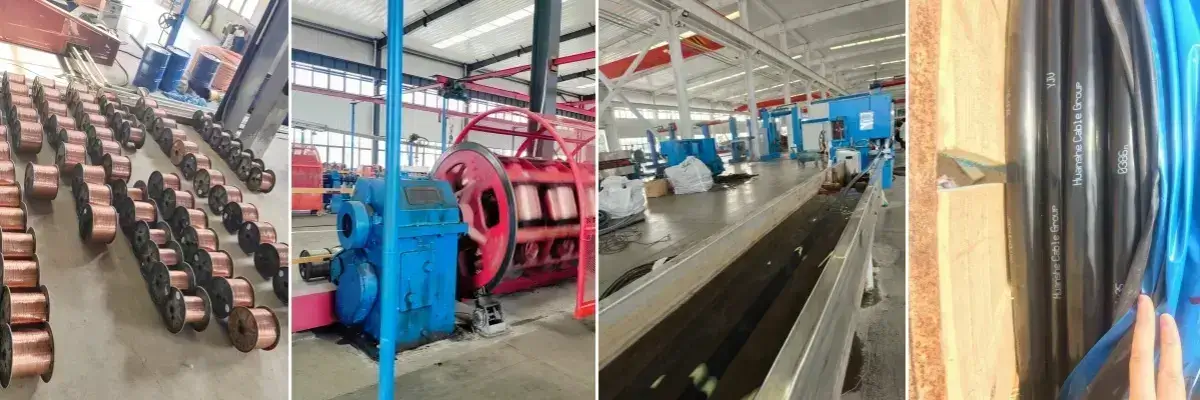
If the budget is the constraint and the route allows it, aluminium is the largest single lever available. Not 10 percent. A factor of four.
YJLV is the aluminium version of the same construction: aluminium conductor, XLPE insulation, PVC sheath. Aluminium costs about USD 2,500 per tonne against USD 13,399 for copper, and it is also lighter, so there is less metal per metre at the same nominal section.
Table 5. Copper against aluminium, matched on ampacity rather than on nominal size.
← Swipe horizontally to view full table →
| Copper YJV | Copper price USD/m | Aluminium YJLV | Aluminium price USD/m | Al as % of Cu |
|---|---|---|---|---|
| 4×25 | 13.30 to 14.10 | 4×35 | 2.36 to 3.31 | 17 to 24% |
| 4×50 | 26.06 to 27.26 | 4×70 | 4.08 to 5.53 | 15 to 21% |
| 4×95 | 48.77 to 50.52 | 4×150 | 7.73 to 10.13 | 15 to 20% |
| 4×150 | 76.50 to 78.90 | 4×240 | 11.81 to 15.26 | 15 to 20% |
Source note: aluminium priced at USD 2,500 per tonne and 2.70 g/cm³. The size match uses the usual 1.5 to 1.6 step, because aluminium carries about 78 percent of the current of copper at the same section. Actual matching should be done against the project ampacity table, not against this ratio.
The saving is real and it is large, but it is not free. Four things change when you move to aluminium.
The cable is bigger for the same current. A 4×150 aluminium is physically larger than a 4×95 copper. If the tray, duct or trench was sized around copper, it may not fit.
Terminations are different. Aluminium creeps under compression and oxidises at the surface. You need bimetallic lugs or a compound-filled termination, and a torque check after the first thermal cycle. A copper lug on an aluminium conductor is a failure waiting for a load cycle.
Bending radius is larger. Larger conductor, larger overall diameter, wider sweep. In a tight plant room this alone can rule it out.
Short-circuit performance per unit size is lower. Aluminium has lower thermal capacity per unit volume. For a given fault level, the aluminium conductor needs more section than the ampacity match alone suggests.
Where aluminium wins without argument: long runs where the cross-section is driven by voltage drop rather than by current, MV distribution where the conductor is large anyway, and overhead or aerial bundled work where weight matters. Where it loses: plant rooms, control panels, anything with frequent termination, and any circuit where the installer has never worked with aluminium before.
Need to verify a competitor’s quote?
Send us the same cable schedule. We’ll tell you exactly what their copper weight and testing scope should be.
Search any B2B platform for a 4×25 YJV and you will find prices from around USD 1 to over USD 50 per metre. Some of that is unit confusion, some is aluminium sold as copper, and some is a real cable built to a different standard. The table below covers the six mechanisms that survive a technical review.
Table 6. Six ways a YJV quote gets cheaper, and how to detect each one.
← Swipe horizontally to view full table →
| Mechanism | What is actually different | Effect | How you catch it |
|---|---|---|---|
| Lower copper purity | Scrap or blended copper at 85 to 92% IACS instead of annealed 100% IACS | 8 to 12% | DC resistance at 20 °C, per drum, against IEC 60228 |
| Conductor under section | Nominal 25 mm² built at 22.5 to 23.5 mm² actual | 6 to 10% | Weigh one metre of stripped copper against Table 4 |
| Short metrage | Drum marked 500 m contains 460 to 485 m | 3 to 8% | Measure the drum on site, or specify a positive tolerance only |
| Thin ends, thin middle | Ends meet the drawing, the middle of the run is reduced | 5 to 10% | Sample from both ends and from the middle, weigh all three |
| Recycled compound | Recycled PVC sheath and regrind XLPE, thickness run at the lower limit | 3 to 5% | Measure sheath and insulation thickness, then check the ageing test |
| Testing scope cut | Routine tests only, no type test evidence for the construction | 1 to 3% | Ask which type test covers which size range, and who issued it |
Source note: effect percentages are against the same nominal construction at the same copper price. Mechanisms can be combined, which is how a 40 percent gap is reached without anyone losing money.
Add the six up and you get 27 to 49 percent. That is the whole explanation for a quote arriving at half the market rate, and it is also why the phrase “same specification” in a comparison spreadsheet means almost nothing.
One thing this table does not say. It does not say that a cheap quote is fraudulent. It says a cheap quote has a reason, and the buyer is entitled to know which row of the table it came from. A supplier who can tell you, in writing, which of these six they have not done, is worth more than a supplier who simply has the lowest number.
The question that settles it
Ask for the copper weight per metre and the DC resistance for the exact size you are buying, in writing, on the quotation. A supplier who builds to specification answers in two minutes. A supplier who does not will change the subject to delivery time, which is also the answer.
YJV is rarely bought in isolation. The same schedule usually carries flame retardant and fire resistant variants, and buyers want to know what the upgrade costs before they commit to a specification.
Table 7. The same 4×25 across the common YJV family variants.
← Swipe horizontally to view full table →
| Type | FOB USD/m | Index | What the difference buys |
|---|---|---|---|
| YJV | 13.30 to 14.10 | 100 | Standard tray, duct and indoor installation |
| ZR-YJV | 13.69 to 14.66 | 103 to 104 | Flame retardant sheath and filler, IEC 60332-3 category |
| YJV22 | 14.09 to 15.36 | 106 to 109 | Steel tape armour, inner sheath, direct burial |
| NH-YJV | 15.42 to 18.18 | 116 to 129 | Mica tape, circuit integrity under fire, IEC 60331 |
| YJLV 4×35 | 2.36 to 3.31 | 17 to 24 | Aluminium at matched ampacity |
Source note: index is the ratio of each variant to the YJV mid-point. Cost-level differences are shown here. Market quotations for NH-YJV often run higher than the cost gap suggests, because mica builds are low-volume and the type test cost has to be recovered across a small number of drums.
The ZR step is small. Three to four percent buys you a flame retardant sheath and filler and a pass on the IEC 60332-3 vertical tray test. If the route passes through a public space or a cable tunnel, this is the cheapest risk reduction in the whole schedule.
The NH step is not small, and it is where most of the confusion lives. At cost level the mica tape adds 16 to 29 percent. In the market, an NH-YJV quote frequently comes in 40 to 80 percent above ZR-YJV for the same size. The extra is not mica. It is the type test amortisation, the slower line, and the risk premium a factory carries when it has to guarantee circuit integrity it cannot fully verify on every drum.
If you need fire resistance and the budget will not stretch, the honest answer is usually not a cheaper NH-YJV. It is a shorter fire-rated route, a smaller number of critical circuits on mica, and standard ZR-YJV everywhere else. You can check our full guide on NH-YJV cable fire ratings and BS 6387 coverage for more details on this, or review the ZR-YJV model codes and flame classes to find the right balance for your project.
Cable is heavy and bulky, and those two facts set the real minimum order far more than any factory policy does.
Table 8. Container loading for four core YJV.
← Swipe horizontally to view full table →
| Size | Weight kg/m | Drum length | 20GP capacity | What limits it |
|---|---|---|---|---|
| 4×25 | 1.45 | 500 m | 10 to 12 km | Drum diameter, not weight |
| 4×95 | 4.55 | 200 m | 3.2 to 3.6 km | Both weight and diameter |
| 4×240 | 10.70 | 100 m | 1.4 to 1.6 km | Payload weight |
Source note: 20GP assumed at 28 tonnes payload and 33 m³ usable. Figures assume single-size loading. Mixed schedules load less efficiently because drums cannot be nested.
Notice the inversion. On small sizes you run out of container volume long before you run out of weight, so the freight per metre is driven by how efficiently the drums stack. On 4×240 you hit the payload limit with the container still half empty. That is why a mixed order of large and small sizes usually ships at a better average freight rate than either alone.
On MOQ, the honest position is that a factory will run 1 km of a standard size without much argument, because a 1 km run fits a normal production slot. Below about 500 m the setup time starts to dominate, and the price per metre rises. Below 200 m most factories will quote, but the conversion line in Table 1 roughly doubles.
Freight is quoted separately and it does not track the cable price at all. As a working guide, a full container of mid-size YJV lands freight at 3 to 5 percent of cable value on a normal route to Southeast Asia or West Africa. An LCL shipment of the same cable can add 12 to 20 percent, which is why consolidating to a full container is often worth more than negotiating the cable price.
Most YJV quotations are not comparable, and it is usually the buyer’s enquiry that caused it. If the RFQ does not fix the variables, each supplier fixes them differently and the numbers cannot be lined up afterwards.
Two of these are worth more than the rest. The copper basis, because without it the numbers are from different weeks. And the drum schedule, because a 500 m drum that arrives at 470 m is a 6 percent price increase that nobody notices until the pull is short.
There is a version of this enquiry you can send as a single paragraph. Something like: “Please quote YJV 4×25 mm² and 4×95 mm² to GB/T 12706.1, 0.6/1 kV, Class 2 compacted copper, PVC sheath black, 500 m and 200 m drums respectively, positive tolerance only, routine test report per drum, FOB Ningbo, stating your copper basis and date, quotation valid 15 days.” A supplier who can answer that paragraph precisely is a supplier who can also build to it.
Ready to send your RFQ?
Send us the schedule as described above. We’ll reply with a line-by-line quote that states the exact copper weight, DC resistance, and LME basis.
We have been making cable since 1980, when the plant was state owned, and we have been exporting for most of the time since. Today that is 50,000 square metres of production floor, around 60 lines, and customers in more than 50 countries, weighted towards Southeast Asia, Central Asia, Africa and South America. YJV and YJV22 in copper and aluminium are core products, not a sideline. For heavy-duty projects, you can also explore our armoured cable manufacturing capabilities.
What we hold. A CB test certificate, ISO 9001 and ISO 14001 certification, CCC for the domestic range, and SGS inspection reports. Routine tests on every drum: conductor resistance, voltage withstand, insulation resistance. We will send the routine test report with the drum, not on request afterwards.
What we do not hold. We do not hold BASEC or LPCB product certification, and we do not hold a third-party CPR classification. Where a project requires a named third-party certificate against a European standard, we will tell you at quotation stage whether we can meet it, rather than accept the order and resolve the question later.
Our Promise on Price Integrity
We will not quote a price that requires a conductor under the nominal section, and we will not match a competitor who has. If a quote you have received elsewhere is 30 percent below ours on the same drawing, the useful next step is to ask that supplier for the copper weight and the resistance figure.

A 4×25 mm² YJV costs about USD 13.30 to 14.10 per metre FOB China at a copper price of USD 13,399 per tonne. A 4×95 is USD 48.80 to 50.50, and a 4×240 is USD 121.80 to 125.30. Copper accounts for 86 to 96 percent of each figure, so the price tracks the metal far more than it tracks the factory.
Six mechanisms account for most of it: copper purity, conductor section below nominal, short metrage on the drum, thin ends and thin middle, recycled compound, and a reduced testing scope. Together they can move a price by 26 to 48 percent without anyone operating at a loss.
Multiply the number of cores by the nominal cross-section in mm², multiply by 8.89, divide by 1000, then multiply by 1.02 for the stranding factor. For a 4×25 that gives 0.907 kg per metre. A one-metre sample stripped and weighed should come within 5 percent of that figure.
Six to nine percent at 4×25, which buys the steel tape armour, the inner sheath and suitability for direct burial. Below ground without a duct, that is usually worth paying. Above ground on a tray, it usually is not.
Not automatically, but a price below the copper floor means the cable is not built to the drawing. The useful test is not the price itself but whether the supplier will state the copper weight and the DC resistance for the exact size, in writing, on the quotation.

Please contact us for a free quotation by the below form. We promise the quickest response within 12 hours.