Edited by Huanghe Cable Technical Team · Reading time: 9–11 minutes
You typed Cu/XLPE/SWA/PVC cable into a search engine because the construction is already fixed on the drawing. Copper conductor, XLPE insulation, steel wire armour, PVC sheath. The voltage, core count and cross-section are decided. What you need now is a supplier who will quote that exact construction without quietly changing one of those five letters.
This page is not a selection guide. It is a procurement reference for buyers who already know what they want, and who want to know how to tell a real quote from a repackaged one before the drum leaves the factory.
Definition: Cu/XLPE/SWA/PVC Armoured Cable
Cu/XLPE/SWA/PVC is an armoured power cable construction consisting of a stranded copper conductor (Cu), cross-linked polyethylene insulation (XLPE), galvanised steel wire armour (SWA) for mechanical pulling strength and impact protection, and a polyvinyl chloride oversheath (PVC). Low-voltage cables (0.6/1 kV) are built mainly to IEC 60502-1 or BS 5467, while medium-voltage versions (3.6/6 kV to 18/30 kV) follow IEC 60502-2 or BS 6622 with conductor and insulation screening. They are used for direct burial, duct runs, and vertical or inclined industrial installations.
Construction Breakdown
| Cu | Stranded copper conductor, typically Class 2 compacted |
| XLPE | Cross-linked polyethylene insulation, 90°C continuous / 250°C short-circuit |
| SWA | Galvanised steel wire armour, for tensile strength and direct burial protection |
| PVC | Polyvinyl chloride oversheath, ST1 or ST2 grade, standard black |
Who is giving you these numbers. Huanghe Cable has been building this construction since 1980, from 1.5 to 400 mm², in copper and aluminium, to IEC 60502-1, and to BS 5467 dimensions where a project asks for that standard, with both SWA and STA options. Every quotation we send states the copper basis date, the conductor weight per metre and the drum length, so the arithmetic on this page can be run on our numbers before you compare them with anyone else’s.
Price a Cu/XLPE/SWA/PVC Schedule on a Stated Copper Basis
Send the size list and drum lengths. The reply states the copper basis date, the conductor weight per metre and the validity period, so you can check it against the arithmetic below.
In this page
Almost every SWA price difference we are asked to explain traces back to one of these four elements being altered. The table is the checklist to run against any quote that looks unusually low.
Table 1. Where a Cu/XLPE/SWA/PVC quote can be quietly changed
| Element | What You Specified | What a Cheap Quote Might Use |
|---|---|---|
| Cu | Class 2 compacted, 100% IACS | Scrap-blended copper at 85–92% IACS, or undersized section |
| XLPE | Nominal thickness to IEC 60502-1 | Thickness run at the lower tolerance limit, or regrind compound |
| SWA | Galvanised steel wire, specified diameter | Fewer wires, thinner wire, or ungalvanised wire |
| PVC | Standard PVC, specified thickness | Recycled compound, lower density, thinner wall |
On mobile devices, swipe horizontally to view the complete table.
One point about this table often causes confusion in live enquiries: the medium voltage rows are not a different product family. They are the same conductor with more insulation and a screen, and the price difference is smaller than most buyers expect.
The hidden details that cause site disputes
Two quotes that both state “Cu/XLPE/SWA/PVC” can still fail on site if the internal construction is not pinned down. Before you approve the purchase order, make sure the supplier confirms these three secondary details:
Tenders reference IEC 60502-1 or BS 5467, but drawings from different regions use different designations for what is physically the same 0.6/1 kV armoured copper XLPE cable. The table maps the ones we see most often, including two that are frequently confused.
Table 2. Designation equivalents for Cu/XLPE/SWA/PVC
| Designation | Where it is used | Procurement note |
|---|---|---|
| IEC 60502-1 | Global industrial and EPC projects | Construction, wall thicknesses and routine test scope for 0.6/1 kV extruded cable |
| IEC 60502-2 | Medium-voltage industrial, utility and EPC projects (3.6/6 kV to 18/30 kV) | Covers extruded MV cables with conductor/insulation screens and metallic screen; confirm fault current and screen area in the RFQ |
| BS 5467 | UK, Commonwealth, British-spec tenders | Adds armour conductance requirements where the armour is used as the earth path |
| BS 6622 | UK, Commonwealth and British-spec MV projects (3.8/6.6 kV to 19/33 kV) | British equivalent for MV screened XLPE armoured cables; note voltage pairs such as 6.35/11 kV (IEC 6/10 kV class) and confirm screen/armour sizing |
| N2XRY (DIN VDE 0276) | Germany, Central Asia, parts of Africa | German designation for Cu/XLPE/wire armour/PVC. The R denotes round wire armour |
| NYFGbY (NF C 33-226) | France, Algeria, Morocco, Tunisia, francophone Africa | Very common in North African tenders. Confirm on the drawing whether the armour is steel tape or steel wire before ordering |
| YJV32 (GB/T 12706) | China, Central Asia, Southeast Asia | Chinese designation for Cu/XLPE/wire armour/PVC. The 3 is wire armour, the 2 is PVC oversheath. YJV42 is heavy wire armour |
| YJV22 (GB/T 12706) | China, Central Asia | The 2 in the third position means steel tape armour. Different product, different price, not interchangeable with YJV32 |
On mobile devices, swipe horizontally to view the complete table.
YJV22 and YJV32 are not interchangeable, even though both sit under GB/T 12706. The difference comes down to mechanical stress and armour form: YJV22 uses steel tape armour for radial compression in direct burial where the cable bears soil or traffic load, whereas YJV32 uses steel wire armour (SWA) for axial tension and impact protection on vertical shafts, long pulls, or routes where the cable is pulled rather than simply laid. If a supplier offers YJV22 against a drawing that calls for SWA, the quote is for tape armour—cheaper to make, easier to bend, and unable to carry the pulling load your route requires. This substitution happens often enough in Central Asian and regional tenders that you should state the exact code in the RFQ.
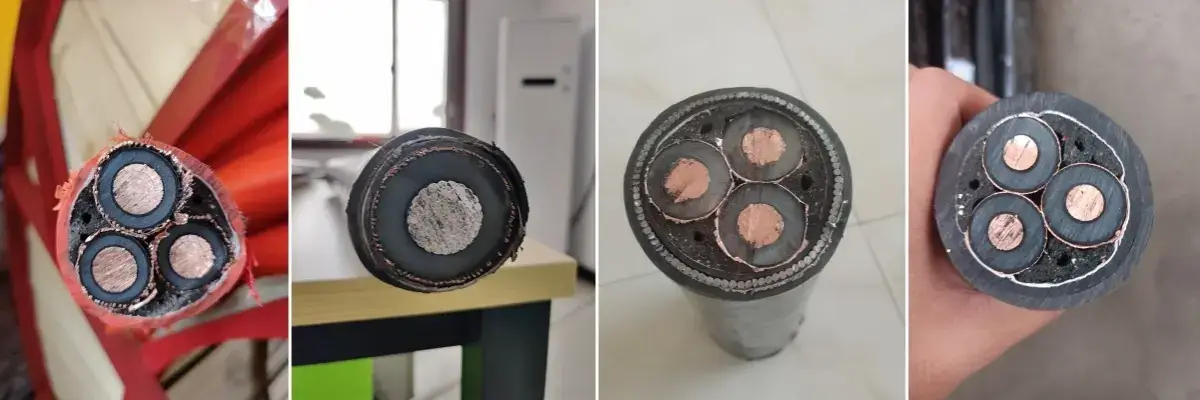
SWA is specified for two reasons. The wires carry the pulling load during installation, which matters on long pulls, duct routes and vertical shafts. And they resist point loads and rodent attack after burial.
It does not replace correct burial depth, sand bedding or warning tape. It does not make a cable suitable for continuous flexing. And on a single-core AC circuit, standard steel wire armour carries induced losses that either require non-magnetic armour or a derated current rating.
If your schedule is single-core and says SWA
Confirm the armour material before the order is placed. On single-core cable above 1 kV the field has nothing to cancel it, the steel wires develop eddy currents, and the derating can reach 40 percent. Aluminium wire armour (AWA) is the usual answer. Below 1 kV the effect is smaller but single-core steel armoured cable is still uncommon. On multi-core cable none of this applies, because the three core fields cancel in the centre.
One more point that catches buyers on medium voltage cable. The steel armour is a mechanical layer. It does not carry earth fault current. That job belongs to the copper screen, which is sized for the system fault level. Increasing the armour wire size does not improve the earth fault path, it only adds weight and cost.
Every quote can be checked in about ten seconds. The conductor weight per metre is fixed by the nominal section and the core count, and it does not change with the supplier, the standard or the destination port.
m = n × A × 8.89 ÷ 1000 × 1.02
m is copper weight in kg per metre, n the number of cores, A the nominal section in mm², 8.89 the density of copper in g/cm³, and 1.02 the stranding factor for a Class 2 compacted conductor
The price basis used on this page is copper at 12,526.00 USD per metric tonne and aluminium at 2,869.50 USD per tonne, both based on London Metal Exchange cash settlement prices for 20 November 2026. That works out at 12.53 USD per kilogram of copper.
Table 3. Copper weight and floor price for common Cu/XLPE/SWA/PVC sizes
| 4 core size | Cu weight (kg/m) | Cu cost (USD/m) | Cable price (USD/m) | Price / Cu |
|---|---|---|---|---|
| 4 x 16 mm² | 0.580 | 7.26 | 9.00 to 9.85 | 1.24 |
| 4 x 25 mm² | 0.907 | 11.36 | 13.50 to 14.75 | 1.19 |
| 4 x 50 mm² | 1.814 | 22.72 | 25.95 to 28.30 | 1.14 |
| 4 x 95 mm² | 3.446 | 43.16 | 47.45 to 51.75 | 1.10 |
| 4 x 150 mm² | 5.441 | 68.15 | 74.05 to 80.65 | 1.09 |
| 4 x 240 mm² | 8.705 | 109.04 | 117.75 to 128.25 | 1.08 |
Four-core Cu/XLPE/SWA/PVC, 0.6/1 kV to IEC 60502-1, FOB China, full container, copper at 12,526 USD per tonne. On mobile devices, swipe horizontally to view the complete table.
The last column is the useful one. It is the quoted price divided by the copper inside the cable. Below 35 mm² it sits around 1.19 or higher, because steel, sheath and labour are a large share of a small number. From 95 mm² upward it flattens at 1.08 to 1.10 and stays there.
That flatness is what makes it a test. A quote for 4 x 240 at a ratio of 1.02 is not a discount, it is roughly 225 mm² of copper under a 240 mm² label. At this copper price the manufacturing content of a large cable is too thin for a 6 to 7 percent gap to come from efficiency.
Running it on three live quotes
Ask three suppliers for 4 x 185 mm². Copper weight is 6.71 kg per metre, so the copper inside each metre is 84.05 USD at 12,526 USD per tonne. Divide each quotation by that figure. Three honest quotes land between 1.08 and 1.13. If one lands at 0.99, you have found the problem before the deposit is paid, and you can still ask the question in writing while the order is open.
Check a quote against the copper inside it
Send the model code and drum length. The reply states the conductor weight per metre beside the price, so you can run the arithmetic on our numbers rather than a competitor’s.
| Request a Quote | Email Sales Team |
Conductor weight answers the price question. Overall diameter and cable weight answer the installation questions: gland size, tray and trench space, drum handling, and transport load. The table gives both for the four-core range to IEC 60502-1.
| Nominal size | Overall dia. (mm) | Cable weight (kg/m) | Direct burial (A) | In air (A) |
|---|---|---|---|---|
| 4 x 16 mm² | 22.5 | 1.47 | 93 | 80 |
| 4 x 25 mm² | 26.0 | 2.03 | 121 | 106 |
| 4 x 35 mm² | 29.0 | 2.56 | 145 | 131 |
| 4 x 50 mm² | 32.5 | 3.60 | 171 | 158 |
| 4 x 70 mm² | 37.5 | 4.59 | 212 | 202 |
| 4 x 95 mm² | 42.5 | 5.81 | 252 | 248 |
| 4 x 120 mm² | 47.0 | 7.41 | 287 | 289 |
| 4 x 150 mm² | 51.5 | 8.85 | 323 | 332 |
| 4 x 185 mm² | 57.0 | 11.20 | 364 | 383 |
| 4 x 240 mm² | 64.0 | 13.77 | 421 | 454 |
| 4 x 300 mm² | 70.5 | 16.54 | 472 | 520 |
Four-core Cu/XLPE/SWA/PVC, 0.6/1 kV. Weights are calculated from the construction and include conductor, insulation, filler, bedding, armour and oversheath. Ratings are indicative at 90°C conductor temperature, 20°C soil and 30°C ambient air, single circuit, no grouping. Soil thermal resistivity and installation method vary widely between projects; confirm final ratings to IEC 60364-5-52 using the resistivity from your route survey. On mobile devices, swipe horizontally to view the complete table.
4 x 400 mm² is also in production; dimensions and ratings for that size are issued per project because the drum and handling limits depend on the route.
The weight column has a second use that costs nothing. Weigh one metre of the delivered cable. Four-core 95 mm² should come in at 5.81 kg. If the scale reads 4.95 kg, about 300 grams of copper is missing per metre. If the missing weight is copper, that is roughly 1 mm² off each core. If the missing weight is steel, the wire diameter is undersized. A scale that reads to 10 grams is enough to catch it, and no laboratory is needed.
Above 1 kV, the construction moves from IEC 60502-1 to IEC 60502-2 (covering rated voltages from 3.6/6 kV up to 18/30 kV), or to BS 6622 (3.8/6.6 kV to 19/33 kV) on British-standard schedules. The same four core materials appear, but two screening layers are added around the insulation and the insulation wall roughly doubles. That is why the same 95 mm² conductor costs 47.45 USD per metre in low voltage and 54.85 USD at 18/30 kV.
The first added layer is a semi-conductive screen bonded to the outside of the insulation. It removes the air voids at the insulation surface where partial discharge would begin. The second is a metallic screen, copper tape up to 12/20 kV and copper wire at 18/30 kV, which carries the capacitive charging current and the earth fault current.
| 3 core size | Cu weight (kg/m) | 6/10 kV | 8.7/15 kV | 12/20 kV | 18/30 kV |
|---|---|---|---|---|---|
| 3 x 95 mm² | 2.584 | 42.65 to 46.50 | 44.30 to 48.30 | 46.55 to 50.75 | 54.85 to 59.80 |
| 3 x 120 mm² | 3.264 | 51.90 to 56.60 | 54.25 to 59.15 | 55.90 to 60.95 | 64.20 to 70.00 |
| 3 x 150 mm² | 4.081 | 63.80 to 69.55 | 65.50 to 71.40 | 67.20 to 73.25 | 75.50 to 82.30 |
| 3 x 185 mm² | 5.033 | 76.75 to 83.65 | 78.55 to 85.60 | 80.30 to 87.55 | 88.60 to 96.55 |
| 3 x 240 mm² | 6.529 | 97.05 to 105.80 | 98.90 to 107.80 | 100.80 to 109.90 | 109.10 to 118.90 |
| 3 x 300 mm² | 8.161 | 119.05 to 129.80 | 121.05 to 131.95 | 123.00 to 134.05 | 131.30 to 143.10 |
Three-core Cu/XLPE/screen/SWA/PVC to IEC 60502-2 / BS 6622, FOB China, copper at 12,526 USD per tonne. On mobile devices, swipe horizontally to view the complete table.
Look at the price steps rather than the absolute numbers. From 6/10 kV to 8.7/15 kV the wall grows from 3.4 mm to 4.5 mm and the 95 mm² cable costs 1.65 USD more per metre. From 12/20 kV to 18/30 kV the same cable costs 8.30 USD more, because the screen changes from copper tape to copper wire. It is a construction change, not a thickness change.
Where the voltage class decision costs the most
On a 240 mm² cable, moving from 8.7/15 kV to 12/20 kV adds about 2 USD per metre. Moving from 12/20 kV to 18/30 kV adds about 9 USD per metre. On 3 km of route that is 27,000 USD, decided by a system voltage that is often fixed early and rarely revisited. It is worth more attention than the supplier selection.
Medium voltage cable is also where the screen gets substituted most often. Copper tape is specified by thickness and overlap, copper wire by diameter and count. A quotation that says only “copper screen” has not told you which. Ask for the screen cross-section in mm², because that is what carries your fault current for the clearing time.
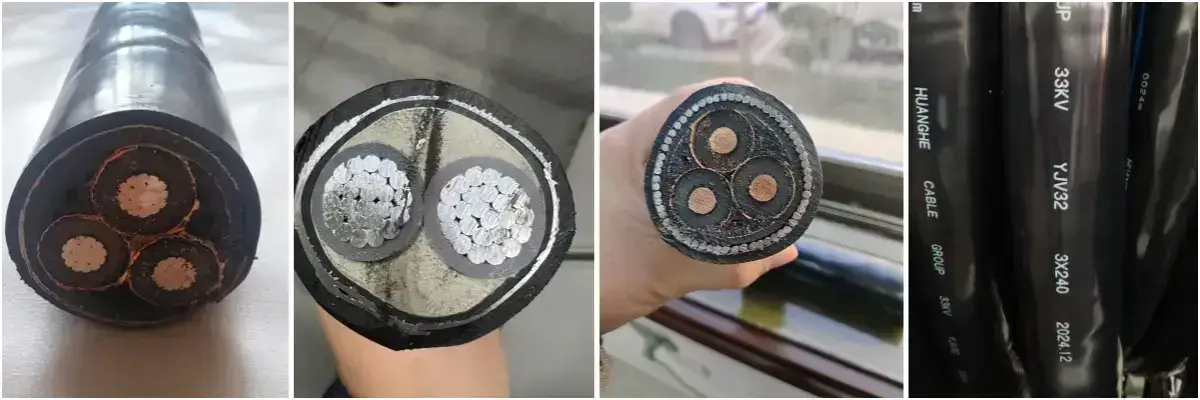
If the drawing says SWA, it is steel wire armour. If a supplier offers a similar cable at a lower price and the datasheet says STA or DSTA, that is steel tape armour. The two are not interchangeable for the same duty.
Wire armour resists axial tension and radial impact, so it suits vertical shafts, long pulls and routes where the cable hangs or the ground may settle. Tape armour resists radial compression only, so it suits static installations where the cable will never be pulled under load. A quote that substitutes STA for SWA on a vertical run is cheaper for a reason that will show up during installation.
The price gap is real but smaller than most buyers assume. On the same conductor size, STA typically costs 5 to 15 percent less than SWA, because tape application uses less steel and fewer process steps than wire drawing and stranding. That is a five to fifteen percent difference on the armour portion, not a 20 percent swing on the whole quotation.
One more difference that matters on single-core. Steel tape covers a larger area than steel wire and sits closer to the conductor, so the eddy current problem is worse, not better. If a supplier offers single-core tape armoured cable for an AC medium voltage circuit, the answer is no.
The construction is settled. What usually is not settled is the commercial and verification basis, and that is where two quotations for the same cable end up 15 percent apart with nobody able to explain why.
| Item to state | Why it changes the price |
|---|---|
| Copper basis date | Two quotes may be built on LME prices two weeks apart. At 5 percent copper movement a 95 mm² cable shifts 2.16 USD per metre |
| Drum length and tolerance | A 500 m drum that arrives at 470 m is a hidden 6 percent increase on delivered cost |
| Test report scope | Routine test per drum, or type test evidence for the construction, or both |
| Standard and voltage class | IEC 60502-1, BS 5467 or a national equivalent. Insulation and sheath tables differ between them |
| Armour specification | Wire diameter, wire count and coating class. Hot dip and electro-galvanised are not the same product |
| Incoterm and port | FOB and CIF quotes for the same cable differ by freight, insurance and port charges |
On mobile devices, swipe horizontally to view the complete table.
A one-paragraph RFQ that covers all six, and can be sent as it stands:
Please quote Cu/XLPE/SWA/PVC, 4 x 95 mm², 0.6/1 kV, to IEC 60502-1, Class 2 compacted copper, hot dip galvanised steel wire armour, 500 m drums with positive tolerance only, routine test report per drum, FOB [port], stating your copper basis date and quotation validity.
A reply that answers those six points can be compared with another reply that does the same. One that gives a single price and no basis cannot, and the comparison you are about to make will be between two different products.
Price decides whether a quotation is competitive. Lead time and payment terms decide whether the project can use it. Both are worth settling before the price negotiation starts, because a 10 percent discount on a cable that arrives after the foundation pour is not a discount.
| Item | Typical position |
|---|---|
| Lead time, standard LV | 15 to 20 days after deposit and drawing approval |
| Lead time, LV 300 mm² and above | 20 to 25 days, limited by armouring line speed rather than conductor |
| Lead time, medium voltage | 25 to 35 days, longer at 18/30 kV because of the wire screen and the higher test voltage |
| Third-party inspection | Add 5 days for SGS, Bureau Veritas or Intertek pre-shipment inspection |
| Payment | 30 percent T/T deposit with 70 percent against bill of lading copy |
| Minimum order | No hard minimum, but a run below 500 m carries a 10 to 15 percent changeover charge |
| 20GP payload | About 21 tonnes net of cable, which is roughly 3,600 m of 4 x 95 mm² |
| 40HQ payload | About 26 tonnes net, roughly 4,400 m of 4 x 95 mm². Above 185 mm² the container goes out by weight before it goes out by volume |
Positions as at November 2026, confirmed against the production schedule at order. On mobile devices, swipe horizontally to view the complete table.
Two numbers in that table are worth working through before you plan the shipment. A 40HQ of 4 x 95 mm² leaves at 26 tonnes, which is 4,400 metres. A 40HQ of 4 x 16 mm² also leaves at 26 tonnes, which is about 17,600 metres. Both are weight limits rather than space limits, because cable is dense. The same container carries four times the length in small cable as it does in large cable, which is why freight per metre varies so much across a schedule.
Drum length is the other constraint. Four-core 95 mm² at 5.81 kg per metre in a 500 m drum weighs 2.9 tonnes with the drum. Check that against the crane or forklift at the receiving end before the order is fixed, and check it against the drum handling capacity at the port of discharge, not just at our end.
Huanghe Cable builds this construction to IEC 60502-1 for low voltage (0.6/1 kV), IEC 60502-2 for medium voltage (6/10 kV to 18/30 kV), and to BS 5467 (LV) or BS 6622 (MV) where a project calls for British standards, from 1.5 to 400 mm², in copper and aluminium, with SWA and STA options. Every drum ships with a routine test report stating conductor resistance and voltage withstand results.
Certification, stated plainly
We hold CB test certificates, ISO 9001, ISO 14001, CCC and SGS inspection reports. We do not hold BASEC, LPCB or BS 6387 third-party certification, and we do not claim it. If your specification requires those marks, tell us at enquiry stage and we will say whether we can meet the requirement, rather than letting it surface at the port.
We will not quote a price that requires an undersized conductor, thinner armour wire or a reduced test scope to reach. If a competing quote on the same drawing is significantly below ours, the useful next step is not to ask us to match it. Ask that supplier for the conductor weight per metre and the DC resistance for the exact size, and run the arithmetic in section 4. The result will tell you which row of the first table moved.
What every quotation from us states
The copper basis price and its date, the conductor weight per metre, the drum length and tolerance, the armour wire diameter, and how long the price is held. If any of those is missing from a quotation you receive from us, ask and it will be corrected.
Send your Cu/XLPE/SWA/PVC schedule
Sizes, drum lengths and destination port. The reply states the copper basis and the conductor weight per metre, so you can check it against the figures on this page before comparing it with anyone else’s.
| Request a Quote | WhatsApp Us | Email Sales Team |

For export orders, drum dimensions, gross weight and container utilisation move the landed cost almost as much as the ex-works price. A 500 m drum of 4 x 95 mm² runs about 1.6 m in flange diameter and 2.9 tonnes gross, which is past the capacity of a standard site forklift. Confirm drum length against the handling equipment at site before locking the order, not after.
Drums are timber, with steel-reinforced flanges once the diameter passes about 1.8 m. Each drum is stencilled on both flanges with the size, length, gross weight, drum number and rolling direction. The cable itself carries sequential metre markings, and each drum ships with its own routine test certificate rather than a certificate covering the batch. If a shipment arrives with one certificate for twelve drums, the per-drum test was not run.
At site, three things are worth checking before the drums go into storage. Compare the stencilled gross weight with the calculated weight in section 5, allow the drum tare, and see whether the difference is inside 3 percent. Check that the drum numbers run consecutively and match the packing list. Read the test certificate against the actual drum number. All three take under ten minutes per delivery.
Yes. A PVC oversheath over galvanised steel wire armour is a standard direct burial construction, provided the trench depth, sand bedding and warning tape follow local installation rules. In soils where termites or rodents are active, the standard PVC sheath is not sufficient on its own; an anti-termite nylon sheath or polyamide outer layer adds roughly 6 to 10 percent to the cable price.
Usually one of six things: the copper basis date, conductor purity and stranding, armour wire diameter or count, oversheath thickness and compound grade, drum length tolerance, or test and shipping scope. The copper basis date alone accounts for most of the gap when the two quotes are weeks apart.
Standard, voltage rating, core count and section, conductor class, armour wire diameter and coating class, oversheath grade and colour, drum length with tolerance, test report scope, Incoterm, destination port, and the copper basis you want the price built on. The template in section 8 covers all of them in one paragraph.
Use SWA where pulling tension, vertical runs or impact resistance matter. STA suits static installations and normal soil where radial compression is the only load. For single-core AC circuits, neither steel option is correct; specify aluminium wire armour.
3.446 kg, which is 43.16 USD at copper of 12,526 USD per tonne. The finished cable weighs 5.81 kg per metre, so the conductor is 59 percent of the total weight and remains the dominant driver of the price.
About 1.65 USD per metre on a 95 mm² three-core cable, and about 2 USD per metre on 240 mm². The insulation wall grows from 3.4 mm to 4.5 mm and XLPE is a cheap material, so the step is smaller than most buyers expect. The expensive step is 12/20 kV to 18/30 kV, where the screen construction changes.

Please contact us for a free quotation by the below form. We promise the quickest response within 12 hours.