Updated 2026/11/10 · Edited by Huanghe Cable Technical Team · Reading time: 12–14 minutes
Direct answer: The exact 6mm² solar cable price (specifically H1Z2Z2-K, bare copper, FOB China) is approximately USD 0.95 to 1.15 per metre at an LME copper price of USD 13,900/tonne. A 100 m coil lands at roughly USD 95 to 115. Tinned copper (Huanghe’s default), third-party certification, and small orders sit at the upper end of this range. The rest of this page shows how that figure is built, so you can check any quotation against it.
Six square millimetre is the workhorse size in a solar array. Most string designs land on either 4mm² or 6mm², and the larger one wins whenever the run is long, the current is high, or the voltage drop starts eating into yield.
That also makes it the size where quotations spread widest. The same 6mm² H1Z2Z2-K cable, same 100 m coil, can come back at prices that differ by 40% between suppliers, and almost none of that gap is profit. It is copper weight, tinning, cross-linking method, certification and drum length.
This page gives you the cost structure so you can price a 6mm² order yourself, and then the questions that explain the rest of the difference.
Treat those figures as a structure, not a quotation. Copper moved by more than a third within a single year recently, and a price quoted against the wrong basis date is meaningless within weeks. The formula is the part that stays useful.
Contents
1. Why 6mm² Solar Cable and Not 4mm² or 10mm²
2. Types and Standards: H1Z2Z2-K, PV1-F, IEC 62930, UL 4703
3. How the Price Per Metre Is Actually Built
4. Why Quotations for the Same 6mm² Differ by 40%
5. Current Rating, Voltage Drop and Derating
6. Verifying Quality Before the Container Leaves
7. Huanghe: Range, Standards and What We Hold
8. Packaging, MOQ and Container Loading
Solar string design lands on 6mm² for a reason that has nothing to do with fashion. It is the smallest size that keeps voltage drop and current density comfortable on a typical commercial string, and it is the largest size that still handles well on a roof.
Three numbers decide it.
Current. A 6mm² H1Z2Z2-K conductor carries around 70 A in free air at 30 °C, which is far above what a single string produces. The string current, not the cable rating, is what limits the design. A modern module runs 13 to 14 A, and two parallel strings give 26 to 28 A, still less than half the cable capacity. So 6mm² is rarely chosen for thermal reasons.
Voltage drop. This is the real driver. On a 1000 V DC string running 80 m from the last module to the inverter, the round-trip conductor length is 160 m. At 6mm², with a conductor resistance of about 3.39 Ω per km, the drop is roughly 1.1% at 10 A. At 4mm² it is closer to 1.7%. That difference is small per string and adds up across an array.
Mechanical handling. Above 10mm², the cable stops being comfortable to pull through a roof clip or a module connector. Installers notice, and a design that ignores it gets changed on site.
There is also a commercial reason. 6mm² sits in the highest-volume band of the solar cable market, so it is the size where competition is sharpest and where a well-negotiated price saves the most across a project. A 1 MW array with average string lengths uses several kilometres of it.
Solar cable is one of the few cable categories where the product standard is genuinely different from an ordinary building cable, and the differences are not cosmetic. The insulation and sheath are cross-linked polyolefin, halogen free, rated for 1.5 kV DC and for continuous exposure to sun, ozone and temperature cycling from -40 °C to +90 °C (with up to +120 °C permitted for a limited duration).
The model code most buyers see is H1Z2Z2-K. It is a harmonised European designation: H for harmonised, 1 for the 1.0/1.0 kV voltage class, Z for cross-linked insulation, Z2 for the cross-linked sheath, and K for a flexible Class 5 conductor. The DC rating under EN 50618 is 1.5 kV.
PV1-F is the older TÜV designation under 2 PfG 1169/08.2007. It still appears on drawings and in supplier catalogues, and a great deal of cable in service carries it. It has been superseded by EN 50618 in Europe, but it has not disappeared.
Table 1. Solar cable standards and how the same 6mm² cable is designated.
On mobile devices, swipe horizontally to view the complete table.
| Standard | Designation | Voltage | Market | Notes |
|---|---|---|---|---|
| EN 50618 | H1Z2Z2-K | 1.5 kV DC | Europe, and most projects that follow European practice | The current reference standard for solar cable |
| IEC 62930 | No letter code; described as PV cable to IEC 62930 | 1.5 kV DC | International tenders, Asia, Africa, Latin America | Technically close to EN 50618; the reference for non-European tenders |
| TÜV 2 PfG 1169 | PV1-F | 0.6/1 kV | Legacy European, still widely quoted | Superseded by EN 50618 but still on many drawings |
| UL 4703 | PV Wire | 2.0 kV | North America | Different conductor classes and a higher voltage rating |
| GB/T 29631 | PV1-F | 0.6/1 kV | China domestic and Chinese-designed projects abroad | Follows the older PV1-F structure |
Source note: voltage ratings and designations follow EN 50618, IEC 62930, UL 4703 and GB/T 29631 as published. A cable meeting one standard does not automatically meet another; the conductor class and the test regime can differ.
Two consequences for a buyer.
The voltage on the datasheet may not match the voltage on the drawing. A PV1-F cable is marked 0.6/1 kV, while an H1Z2Z2-K cable is marked 1.5 kV DC. Both are sold as solar cable. If the system voltage is 1500 V DC, the PV1-F version is not the right product, even though it is cheaper.
Certification is per standard, not per product family. A supplier may hold a TÜV certificate for PV1-F and describe the whole range as “TÜV certified”. Ask which standard the certificate covers, and which sizes are listed on it.
On construction, a 6mm² solar cable is a single core, Class 5 fine-stranded copper conductor, cross-linked polyolefin insulation and sheath, halogen free, flame retardant to IEC 60332-1-2, and normally supplied in black and red to distinguish polarity. Note on conductor material: While bare copper is the industry baseline, Huanghe’s standard H1Z2Z2-K construction defaults to tinned Class 5 copper for enhanced corrosion resistance in solar farms. Bare copper is available on request if the project specification permits it.

When evaluating any 6mm² solar cable price, almost every solar cable cost question resolves into copper. The other components are real but smaller, and once you know their range you can audit any quotation in about two minutes.
Step one, copper mass. Copper has a density of 8.89 g/cm³. A 6mm² conductor one metre long contains 6 cm³ of nominal copper volume, which is 53.3 g. Fine-stranded Class 5 construction adds a stranding factor, so the practical figure is about 55 g per metre, or 0.055 kg.
Step two, copper cost. Multiply the copper price in USD per tonne by 0.055 and divide by 1000.
Table 2. Copper cost per metre of 6mm² conductor at different copper prices (LME reference).
On mobile devices, swipe horizontally to view the complete table.
| Copper price (USD/t) | Copper cost per metre | Indicative FOB per metre | 100 m coil, indicative |
|---|---|---|---|
| 13,000 | USD 0.72 | USD 0.92 to 1.06 | USD 92 to 106 |
| 13,900 (Current) | USD 0.76 | USD 0.95 to 1.15 | USD 95 to 115 |
| 14,500 | USD 0.80 | USD 1.00 to 1.20 | USD 100 to 120 |
| 15,000 | USD 0.83 | USD 1.03 to 1.22 | USD 103 to 122 |
Source note: copper mass based on 6mm² nominal section with a Class 5 stranding factor. FOB ranges assume EN 50618 or IEC 62930 construction, bare copper, standard packing, and order quantities above 10 km. At the copper price of USD 13,900/tonne shown, this yields a base FOB of roughly USD 0.95 per metre for bare copper, before tinning or certification premiums. Tinned copper, third-party certification and small orders sit at the upper end or above.
Step three, the non-copper part. This is where the 40% spread comes from, and it breaks into five components.
Add the copper cost and the non-copper cost and you have a defensible price range. If a quotation sits below the copper cost on the day, one of three things is happening: the copper basis is stale, the conductor is undersized against the nominal section, or the quotation is not for the product described.
Want a Price Against Today’s Copper?
Send Huanghe the size list, the standard and the quantity. We quote against a stated copper basis date with a stated validity, so the number you receive can actually be compared with the others.
| Request a Quote | WhatsApp Us | Email Sales Team |
Why this matters for your order: A 2026 shipment of our solar cable to a Madagascar off-grid telecom project underwent full SGS in-plant inspection before dispatch. We welcome third-party inspectors because it moves the risk from after the ship sails to before the container is sealed.

Send one specification to six suppliers and the range will look impossible for a cable that has a published copper content. It is not impossible. It is eight decisions, and most of them are invisible in a price table.
Table 3. The variables that move a 6mm² solar cable price.
On mobile devices, swipe horizontally to view the complete table.
| Variable | The cheaper version | The compliant version | What it changes on site |
|---|---|---|---|
| Copper basis date | A price quoted on a favourable day, no basis stated, no validity. | A stated reference date and a stated validity period. | Copper can move several percent in a month. Without a basis, the number is not comparable with any other quote. |
| Tinned or bare copper | Bare copper, which is standard and perfectly serviceable. | Tinned copper where the site is coastal, humid or exposed to sulphur. | Tinning adds 5 to 8%. It is worth it in some environments and unnecessary in others. |
| Conductor section | A conductor that meets the resistance limit but sits at the lower edge of the tolerance. | Nominal section with the measured resistance comfortably inside the limit. | Both pass, but a conductor at the lower edge carries less current and drops more voltage. |
| Cross-linking method | A process that meets the test but with a narrower process window. | Electron beam or controlled peroxide curing, with the gel content checked. | Under-cross-linked insulation degrades faster under UV and heat, which shows up after several summers, not on delivery. |
| Sheath thickness | Nominal thickness at the lower tolerance along the whole length. | Nominal thickness with the minimum point checked as the standard requires. | A thin sheath point is where UV and abrasion start the failure. |
| Certification scope | A certificate for a different size or an older standard, described as covering the range. | A type test report for the specific construction and size, with the standard and edition named. | At technical review, the consultant asks which sizes are listed. A certificate that does not include 6mm² does not cover 6mm². |
| Testing depth | Routine spark and voltage test only. | Routine tests plus third-party witness inspection before shipment. | The second is what protects you when the goods are already on the water. |
| Coil or drum length | Short coils, which reduce handling and freight weight per metre. | The length stated in the order, with fewer joints on site. | A 50 m coil instead of 100 m doubles the number of joints and connector pairs. |
| Payment and freight term | EXW, full prepayment, no freight included. | FOB or CIF with a defined port and a defined Incoterm. | EXW looks cheaper until freight and insurance are added. Compare like with like. |
Source note: these variables reflect common differences between offers in the solar cable market. Which of them matter depends on the project specification. They are a questioning aid for comparing quotations, not an accusation against any supplier.
The single question that surfaces most of this: ask each supplier to state, in the quotation, the standard, the conductor class, whether the copper is tinned, the coil length and the copper basis date. A quotation that answers all five can be compared. One that answers none cannot, however the total looks.
There is one more thing worth checking, and it is specific to this product. Solar cable sits in the sun for twenty-five years. Ask whether the compound is UV stabilised to the standard and whether the supplier can show the weathering test, because that is the failure mode that shows up long after the warranty conversation has ended.
Want to avoid the 40% price trap?
Tell us your target standard (e.g., EN 50618) and site conditions (e.g., coastal humidity requiring tinned copper). We will provide a compliant, no-compromise quotation for 6mm² solar cable.
Get a Compliant QuoteSolar cable current ratings are generous compared with building cable, because the insulation is rated for 90 °C conductor temperature and the installation is usually single cable in free air. That means the thermal limit is almost never what constrains a string design. Voltage drop usually is.
Table 4. Indicative current rating, single circuit solar cable, free air at 30 °C.
On mobile devices, swipe horizontally to view the complete table.
| Section (mm²) | Free air, 30 °C (A) | Max conductor resistance (Ω/km) | Typical string use |
|---|---|---|---|
| 1.5 | 30 | 13.7 | Module leads, short jumpers |
| 2.5 | 41 | 8.21 | Small residential strings |
| 4 | 55 | 5.09 | Short residential runs |
| 6 | 70 | 3.39 | Commercial strings, the common choice |
| 10 | 98 | 1.95 | Long runs, array to inverter |
| 16 | 132 | 1.24 | DC main, combiner to inverter |
| 25 | 176 | 0.795 | DC main, long distance |
| 35 | 218 | 0.565 | DC main, utility scale |
Source note: indicative values in the order of magnitude of EN 50618 and IEC 62930 current rating tables for single cable in free air at 30 °C, and Class 5 conductor resistance limits from IEC 60228. Values assume a 90 °C continuous conductor temperature; note that IEC 62930 permits up to 120 °C for a limited duration (max 20,000 hours). Derating for ambient temperature above 30 °C, grouping and conduit installation applies on top.
Voltage drop is the calculation worth doing. For a DC circuit, the drop over the round trip is:
Voltage drop (V) = 2 × current (A) × length (m) × resistance (Ω/m)
The factor of 2 accounts for the positive and negative conductors, because both carry the current in a DC string.
Worked example on 6mm². A string carries 12 A, the one-way run to the inverter is 80 m, and the conductor resistance is 3.39 Ω/km, or 0.00339 Ω/m.
Drop = 2 × 12 × 80 × 0.00339 = 6.5 V. On a 1000 V system that is 0.65%, comfortably inside the 1 to 2% design limit most projects use. Push the run to 200 m and the drop becomes 16.3 V, or 1.6%, which is where designers start stepping up to 10mm².
Two derating points that catch people out.
Roof surface temperature. Cable clipped to a roof in direct sun sits well above 30 °C ambient. Per IEC 60364-5-52 Table B.52.14, an XLPE-insulated cable at 60 °C ambient carries a correction factor of 0.71. Applied to the 70 A figure above, that gives an effective capacity of about 50 A — still above typical string current, but the margin narrows fast. In hot climates, apply this derating before the cable is selected, not after.
Bundled cable in conduit. Once solar cable goes into a conduit or a bundle, it is no longer single cable in free air. Grouping factors apply, and the 70 A figure for 6mm² stops being the right number.
Maximum pulling tension. When pulling 6mm² solar cable through long conduits or along mounting structures, the conductor can be damaged if the pulling force exceeds the cable’s rated tensile limit. A common industry reference is 50 N/mm² of conductor cross-section, which for 6mm² gives approximately 300 N. Some manufacturers specify lower limits (as low as 15 N/mm²), so confirm the figure on the datasheet for the exact construction before planning a long pull. Exceeding this limit risks conductor necking and insulation thinning that will not show up until years into service.
Solar cable is hard to assess on delivery. The failure modes are slow: under-cross-linked insulation, a thin sheath point, a conductor at the bottom of the tolerance band, a compound that is not properly UV stabilised. None of them show up in a visual inspection, and all of them show up three to five years into a twenty-five year service life.
That is why the verification step matters more here than in most cable categories, and it has to happen before the goods ship.
Three levels of evidence, in increasing order of usefulness.
Routine tests. Every factory runs these. A spark test on the insulation and sheath, a voltage withstand test on the finished cable, and a conductor resistance measurement. They catch gross defects on the line. They do not tell you whether the compound is right.
Type tests. These are the ones that matter for a solar project: weathering and UV resistance, thermal ageing, dynamic penetration, cold impact, halogen content, smoke density, flame propagation. A type test report for the specific construction and size is what a consultant asks for at technical review. Ask which sizes are listed on it, because a report covering 4mm² does not automatically cover 6mm².
Third-party inspection before shipment. This is the level most buyers skip and most regret skipping. An independent inspector attends the factory, witnesses the tests, measures the conductor and sheath, and confirms the quantity and the marking. It costs a small fraction of the order value and it moves the risk from after the ship sails to before the container is sealed.
A shipment worth describing
Huanghe supplied a batch of solar cable to Madagascar for an off-grid power installation serving a telecom network. The site conditions were the reason the specification was strict: high ambient temperature, strong UV, coastal humidity, and no realistic prospect of returning a failed drum.
Before the goods left the factory, the buyer appointed SGS to attend our plant and inspect the batch on site. That meant witnessing the routine tests, measuring conductor and sheath dimensions against the standard, checking the marking and confirming the packed quantity against the order.
We treat that as normal practice rather than an exception. A buyer who arranges inspection before shipment is doing the right thing, and a factory that resists it is telling you something.
One practical note on how to run the inspection. Fix the scope at order stage, not later. Once the drums are packed and the container is booked, an inspection request usually means unpacking, and factories handle that differently. The clean sequence is: agree the inspection scope in the purchase order, book the inspector for the production end date, and hold the shipment until the report is issued.
Need third-party (SGS/BV) inspection for your project?
Our pre-shipment testing and independent inspection workflow is built for strict overseas projects. Contact us to request a sample test report or arrange an online factory walkthrough.
Request Test Report WhatsApp Us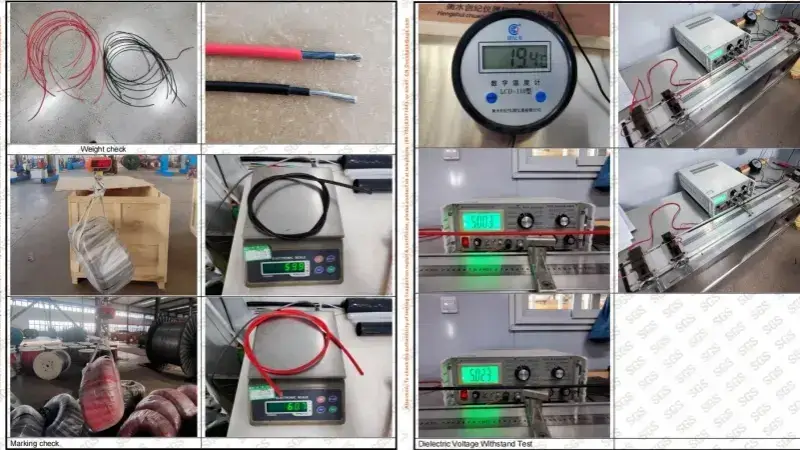
Huanghe Cable manufactures solar cable at our own plant in Henan, China, on the same site as our power cable lines. The solar cable range runs from 1.5mm² to 185mm² in single core, with 2 core and twin parallel constructions on request, in the standard black and red polarity colours plus custom colours for orders above the minimum.
What we build to. The main construction is H1Z2Z2-K to EN 50618, with IEC 62930 as the reference for tenders outside Europe. We also build PV1-F to the older TÜV 2 PfG 1169 structure where a drawing still calls for it. Conductor is Class 5 fine-stranded copper, bare or tinned. Insulation and sheath are cross-linked polyolefin, halogen free, UV stabilised.
What we hold. IEC and EN test evidence for the constructions we produce: conductor resistance, voltage withstand and insulation resistance on every drum, plus the type test regime for the solar construction covering thermal ageing, weathering, halogen content, smoke density and flame propagation to IEC 60332-1-2, with halogen gas to IEC 60754 and smoke density to IEC 61034.
What we do not hold. We do not hold a current TÜV certificate for the full solar range, and we do not hold UL 4703 listing. Where a project requires a named third-party certificate, we will tell you at quotation stage whether the specific size is covered or not. We do not issue declarations we cannot support.
That last paragraph is deliberate. In this category, a supplier claiming every certificate for every size is the one worth checking hardest. What we can do instead is straightforward: build to the standard, test to the standard, and let an inspector you appoint watch us do it. That is how the Madagascar batch was handled, and it is how we handle inspection requests generally.
Where our solar cable goes. Our export markets are Southeast Asia, Central Asia, Africa and South America, which shapes the product more than a catalogue does. Coastal humidity in West Africa makes tinned copper worth the 5 to 8% premium. High ambient temperatures in the Middle East and Sahel push derating factors below the European defaults. Long inland freight in Central Asia makes drum length and packing a cost item rather than an afterthought.
Solar cable is light for its volume, which means most containers fill by cubic space rather than by weight. Getting the coil format right matters more than negotiating the last cent per metre.
Table 5. Approximate weight and loading for single core solar cable.
On mobile devices, swipe horizontally to view the complete table.
| Section (mm²) | Approx. OD (mm) | Approx. weight (kg/km) | 100 m coil, gross (kg) | 20GP reference coils |
|---|---|---|---|---|
| 1.5 | 4.6 | 42 | 4.6 | 2,600 |
| 2.5 | 5.0 | 55 | 5.9 | 2,200 |
| 4 | 5.3 | 72 | 7.6 | 1,800 |
| 6 | 5.7 | 88 | 9.2 | 1,500 |
| 10 | 6.6 | 130 | 13.4 | 1,050 |
| 16 | 7.6 | 190 | 19.4 | 720 |
| 25 | 9.2 | 285 | 28.9 | 480 |
Source note: weights and diameters are indicative for H1Z2Z2-K construction and vary with sheath thickness and compound. Container figures assume 100 m coils in cartons, a 20GP filling by volume rather than weight, and are a planning reference only. Confirm the final loading plan against the actual packing list.
Coil format. Standard export packing is a 100 m coil in a printed carton, palletised. Alternatives are 50 m coils for installers who work in shorter runs, 500 m or 1000 m wooden drums for utility-scale projects, and plastic reels where the buyer wants to pull directly. Drum length changes the joint count on site, which changes labour cost more than the cable cost.
MOQ. For standard sizes and colours, our minimum is one pallet per size and colour combination, which on 6mm² is a few kilometres. Mixed containers are normal, and a mixed container of 4, 6 and 10mm² in black and red is a routine order for us.
Lead time. Standard sizes from stock allocation run 10 to 15 days. Custom colours, tinned conductor or a specific drum length add a few days. Orders that require third-party inspection add the inspector’s scheduling window, which is why the inspection scope should be agreed at order stage rather than the week before shipment.
Most price differences between suppliers start with the enquiry, not the factory. A request that says “please quote 6 mm² solar cable” produces six different products at six different prices, and none of them can be compared.
Six lines fix it.
1. Standard and designation. H1Z2Z2-K to EN 50618, or PV cable to IEC 62930, or PV1-F. Name one. If the project has a specification, send the clause.
2. Size and quantity. 6mm², and how many kilometres. Include the other sizes in the same container so the freight is calculated once.
3. Conductor. Bare or tinned copper. Tinned adds 5 to 8% and is worth it on a coastal or high-humidity site.
4. Colour. Black and red as standard. State if the project needs a specific colour code.
5. Packing. 100 m coil, 500 m drum, or a length that matches the site.
6. Copper basis and Incoterm. Ask for the copper reference date and the validity period, and state the port and the Incoterm. This one line removes most of the ambiguity from the comparison.
Add a seventh if inspection matters: state whether a third-party inspection is required and at which stage. Factories price and schedule differently when they know an inspector is coming, and it is better to know that before the order than after.
Send Your 6mm² Solar Cable Enquiry
Huanghe builds solar cable from 1.5 to 35mm² to EN 50618 and IEC 62930, in bare or tinned Class 5 copper, with third-party inspection welcome before shipment. Send the size list, the standard and the quantity, and we will quote against a stated copper basis with a stated validity.
| Request a Quote | WhatsApp Us | Email Sales Team |
Around USD 0.95 to 1.15 per metre FOB China at a copper price of USD 13,900 per tonne, for standard H1Z2Z2-K construction. The copper alone accounts for about USD 0.76 of that. Tinned copper, third-party certification and small orders push the figure to the upper end or above. A 100 m coil typically lands between USD 95 and 115.
Three reasons. The insulation and sheath are cross-linked polyolefin rather than PVC, which costs more and needs a cross-linking process. The conductor is Class 5 fine-stranded rather than solid or coarse stranded. And the cable carries a heavier test regime covering weathering, thermal ageing and halogen content. The difference is usually 30 to 60% over a comparable PVC building cable.
H1Z2Z2-K is the designation under EN 50618, rated 1.5 kV DC. PV1-F is the older TÜV 2 PfG 1169 designation, rated 0.6/1 kV. Both are halogen free solar cable, but the voltage rating differs, which matters on 1500 V DC systems. For new projects, H1Z2Z2-K is the reference. PV1-F still appears on older drawings and remains available.
No. Ordinary PVC-insulated cable is not rated for continuous UV exposure, does not carry the 1.5 kV DC rating, and its insulation degrades under the temperature cycling a roof array produces. The saving on the cable is small compared with the cost of replacing it in a live array.
Around 70 A for a single cable in free air at 30 °C, with a 90 °C conductor rating. In practice the string current is far below that, and voltage drop rather than thermal capacity drives the size selection. Derating applies above 30 °C ambient and for bundled or conduit installation.
It depends on the site. Tinned copper resists corrosion in coastal, high-humidity and sulphur-bearing environments, and adds 5 to 8% to the price. For an inland installation with a dry climate, bare copper is often adequate. For a coastal site in West Africa or an island installation, tinning is cheap insurance. Note that Huanghe’s standard H1Z2Z2-K construction uses tinned copper by default; bare copper can be quoted on request where the specification permits.
For standard sizes and colours, one pallet per size and colour combination. On 6mm² that is a few kilometres. Mixed containers combining several sizes are routine, and most of our solar cable orders ship that way.
Ten to fifteen days for standard sizes from stock allocation. Custom colours, tinned conductor or a specific drum length add a few days. If a third-party inspection is required, add the inspector’s scheduling window, which is why the inspection scope should be fixed when the order is placed.
Yes, for the constructions we build. We provide IEC and EN test evidence covering conductor resistance, voltage withstand, thermal ageing, weathering, halogen content, smoke density and flame propagation. We do not hold a current TÜV certificate for the full range or UL 4703 listing, and we will say so at quotation stage rather than after the order.
Yes. Buyers appoint SGS, BV, TÜV, Intertek or another inspector to attend our plant before shipment, and we arrange the witness testing and the measurement access. A previous solar cable batch for a Madagascar off-grid telecom power project went through SGS in-plant inspection before dispatch.
Black and red as standard, to distinguish polarity on a string. Other colours are available above the minimum order quantity. Some projects specify a colour code for the whole array, and it is worth stating that in the enquiry rather than discovering it at packing stage.
Standard is a 100 m coil in a printed carton on a pallet. Alternatives are 50 m coils, 500 m or 1000 m wooden drums for larger projects, and plastic reels. Container loading is limited by volume rather than weight, so the coil format affects how much fits far more than the cable weight does.
Related reading
H1Z2Z2-K Solar Cable Product Range (1.5 to 185mm²)
Solar Cable Manufacturer in China: PV Cable Solutions for Utility Scale Projects
How to Source a Reliable PV Wire Supplier for Your Solar Project: A B2B Procurement Guide
ZR-YJV Cable: Model Codes, Flame Classes and Supplier Selection
4 Core Armoured Cable: Sizes, SWA and STA Construction, and Quotation Comparison

Please contact us for a free quotation by the below form. We promise the quickest response within 12 hours.