Edited by Huanghe Cable Technical Team · Updated: October 2026 · Reading time: 12–14 minutes
Searching for custom silicone rubber cable manufacturer prices often means that a project already has a defined cable type, conductor size, voltage rating or operating environment. Buyers may need a price per meter for YGZ or YGC cable, compare a shielded design with an unshielded version, or source international silicone cable types such as SIAF, SIHF or H05S-K from a reliable power cable manufacturer in China.
The difficulty is that silicone rubber cable is a broad product category. A single-core flexible wire, a multicore YGC cable, a fiberglass-braided cable, a shielded cable and a reinforced construction can differ in conductor class, insulation, sheath, rated voltage, dimensions and intended use. A meaningful price comparison must start with the complete cable specification.
As an experienced industrial cable supplier, Huanghe Cable focuses on YGZ and YGC silicone rubber cable series and can also supply a wider range of silicone cable sizes and constructions to customer specifications. This includes selected international market designations, single-core and multicore arrangements, braided protection, copper-braid shielding and customized constructions, subject to technical specification review.
This guide covers silicone rubber cable prices, YGZ and YGC models, international silicone cable designations, cross-sections from 0.5mm² to 300mm² in applicable designs, core configurations, voltage ratings, temperature requirements and the information buyers should include when requesting a factory quotation.
The price of silicone rubber cable depends on the model or requested specification, conductor material and cross-section, number of cores, insulation and sheath construction, shielding or fiberglass braid, reinforcement, rated voltage, order quantity, inspection requirements and delivery terms. Huanghe Cable can quote its YGZ and YGC focus series and review customized international specifications. For an accurate price, send the cable model or drawing, required quantity, operating conditions and delivery destination.
Have a silicone cable model, drawing or BOQ?
What are YGZ and YGC cables? YGZ and YGC are standard Chinese industrial designations for silicone rubber-insulated and sheathed flexible cables engineered for high-temperature and harsh operating environments.
Buyers search for silicone rubber cable using Chinese model numbers, European harmonized designations, manufacturer-specific product names and UL AWM style numbers. Huanghe can review requests using these market designations and supply suitable silicone cable constructions to the agreed specification. The exact model definition, required construction and any certification requirements must be confirmed for each order.
| Model | Market description | Typical rated voltage | Quotation information |
|---|---|---|---|
| YGZ | Silicone rubber cable series commonly associated with medium-duty flexible industrial connections. | 300/500V (typical); selected heavy-duty constructions up to 450/750V | Cross-section, core count, voltage, insulation and sheath construction. |
| YGC | Silicone rubber cable series commonly used for heavier-duty flexible cable requirements. | 450/750V (typical); 0.6/1kV cited in some manufacturer-specific heavy-duty constructions | Conductor class, dimensions, voltage rating, temperature and mechanical requirements. |
| Shielded silicone cable | Silicone-insulated cable with a specified conductive braid screen. | Depends on construction | Screen material, coverage, grounding requirements and finished-cable dimensions. |
| Reinforced silicone cable | Selected constructions incorporating separately insulated steel reinforcement cores. | Depends on construction | Drawing, reinforcement arrangement, dimensions and mechanical purpose. |
| Customized silicone cable | A construction based on a customer drawing, datasheet or project specification. | Depends on construction | All required layers, materials, ratings, tolerances and inspection requirements. |
Model conventions can vary between manufacturers and markets. YGZ or YGC should therefore be treated as the starting point for specification review rather than a complete construction description. If the project requires a particular standard or customer drawing, include it in the RFQ.
International buyers may search for silicone cable using designations from European harmonized cable systems, manufacturer product families or specific insulation and sheath constructions. Huanghe can review these requirements and discuss supply to the requested construction, size and performance specification.
Note: Harmonized designations beginning with H (e.g., H05S-K, H05SS-K) are defined under EN 50525-2-41 (cross-linked silicone rubber insulated single core cables, rated voltage up to and including 300/500 V, maximum conductor operating temperature 180°C).
| International model / family | Common market description | What to specify |
|---|---|---|
| H05S-U | Harmonized designation for solid-conductor silicone-insulated wire per EN 50525-2-41. | Conductor construction, cross-section, voltage, standard and insulation requirements. |
| H05S-K | Flexible single-core silicone-insulated cable family (300/500V, Class 5, core scope 0.5mm²–2.5mm²). | Flexible conductor class, size, rated voltage, colour and applicable standard. |
| H03S-K | Harmonized designation for flexible silicone-insulated single-core cable for internal wiring, per EN 50525-2-41; lower voltage class than H05S-K (confirm rated voltage with supplier). | Conductor class, nominal area, rated voltage and conformity documentation. |
| H05SJ-K / H05SJ-U | Harmonized silicone-insulated single-core types with a glass-fibre braid over the insulation (K = flexible conductor, U = solid conductor), 300/500V. | Exact governing specification, conductor construction, size and rating. |
| H05SS-K | Harmonized designation for silicone-rubber insulated and sheathed single-core cable per EN 50525-2-41 (300/500V, Class 5, 0.5mm²–2.5mm²). | Confirm the exact standard, conductor class, size and sheath construction rather than relying on the designation alone. |
These international types are relevant when preparing a customized silicone cable inquiry. Huanghe can review the requested design and discuss manufacturing to the agreed specification. Where the buyer requires formal compliance with a harmonized standard, the specific requirements and supporting documents must be confirmed separately.
Some North American buyers identify silicone-insulated wire by a UL Appliance Wiring Material (AWM) style number. Search terms can include UL AWM silicone wire, Style 3123 silicone wire, Style 3132, Style 3135, Style 3239 and Style 3512.
| Search term | Information required for quotation |
|---|---|
| UL AWM Style 3123 | Exact style specification, conductor, insulation, dimensions and required recognition status. |
| UL AWM Style 3132 | Required construction, rated voltage and temperature, and supporting compliance documents. |
| UL AWM Style 3135 | Exact style requirements, conductor size, insulation and applicable test criteria. |
| UL AWM Style 3239 | The required construction and evidence of conformity for the intended application. Confirm the required temperature rating with the supplier. Do not assume that 180°C silicone capability applies to every 3239-listed product. |
| UL AWM Style 3512 | Style-specific dimensions, materials, ratings and recognition requirements. |
These style numbers are included as buyer search terms and specification references, not as a claim that every listed style is UL-recognized under Huanghe’s name. If UL recognition or a specific UL AWM style is mandatory, identify this clearly in the RFQ so the required approval status can be reviewed before quotation.
Looking for YGZ, YGC or an international silicone cable type?
Specific searches such as YGZ cable 1.5mm², YGC cable 4mm², silicone cable 10mm², 25mm² silicone wire and 300mm² silicone cable can indicate a more defined purchasing requirement than a generic search for silicone rubber cable.
Huanghe can supply a broad range of silicone cable sizes and discuss customized combinations of cross-section, core count and construction. The following size groups show common market specifications that can be used as a starting point for quotation. Final availability depends on the required design and agreed technical specification.
| Size range | Common reference sizes | Typical quotation considerations |
|---|---|---|
| Small and general flexible sizes | 0.5, 0.75, 1, 1.5, 2.5, 4, 6mm² | Conductor class, single-core or multicore design, voltage and insulation thickness. |
| Medium conductor sizes | 10, 16, 25, 35, 50, 70mm² | Cable dimensions, number of cores, conductor construction, voltage and sheath requirements. |
| Large conductor sizes | 95, 120, 150, 185, 240, 300mm² | Application conditions, single-core or specified multicore layout, dimensions, installation and handling requirements. |
The listed sizes are common market specifications that Huanghe can review for supply or customized production. They do not mean that every size is automatically available in every model, core count, voltage rating or construction. For larger sizes, complex multicore arrangements or special screening, provide the complete drawing or technical specification for confirmation. You can also explore standard configurations directly on our Huanghe Silicone Rubber Cable product page before submitting your BOQ.
For H05S-K specifically, EN 50525-2-41 lists 0.5mm² to 2.5mm² for Class 5 conductors. Larger sizes advertised by some manufacturers should be treated as manufacturer-specific offerings and checked against their datasheet; do not assume they fall within the standard size scope.
Silicone rubber cable can be requested as a single-core wire or as a multicore cable. Typical inquiries include 1 × 1.5mm², 1 × 10mm², 2 × 1.5mm², 3 × 2.5mm² and 4 × 4mm². These are example order descriptions; the precise model, rated voltage, insulation and sheath arrangement must be stated separately.
| Example specification | Information to confirm | RFQ note |
|---|---|---|
| 1 × 1.5mm² | Conductor class, insulation, colour, voltage and whether an outer sheath is required. | Specify whether the requirement is for insulated wire or a sheathed cable. |
| 1 × 10mm² | Conductor construction, voltage, insulation thickness and operating conditions. | Confirm the required rating for the exact size and product family. |
| 2 × 1.5mm² | Core identification, insulation, outer sheath, voltage and finished dimensions. | State the core colours and any special core requirements. |
| 3 × 2.5mm² | Core layout, conductor class, voltage, sheath and operating temperature. | Confirm whether a protective-earth core or special identification is required. |
| 4 × 4mm² | Core arrangement, overall diameter, flexibility and bending conditions. | Confirm the requested model and construction before finalizing the price. |
| Shielded multicore cable | Core count and size, screen material, coverage, sheath and grounding arrangement. | Include shielding requirements in the drawing or RFQ. |
Voltage ratings differ between silicone cable families. Certain international types are rated 300/500V, while some product families use 600/1000V for specified sizes and installation conditions. Other harmonized types have their own rated-voltage requirements. Always use the rating specified for the exact cable rather than applying one voltage value to all silicone cable designs.
| Voltage reference | Where buyers may encounter it | Confirmation required |
|---|---|---|
| 300/500V | For example, the H05S and H05SS cable types within EN 50525-2-41. | Confirm the exact designation, conductor size and applicable standard. |
| 300/500V | Other silicone cable families, including some SIAF/SIHF market products, may also use this rating; verify each product datasheet. | Model, size, construction and manufacturer specification. |
| 450/750V | Heavy-duty flexible silicone power connections and specific YGC market variants. | Confirm that the requested insulation thickness matches the 450/750V rating. |
| 0.6/1kV | Power-grade silicone cables or specially designed heavy-duty constructions. | Some manufacturer-specific heavy-duty constructions may be offered at 0.6/1kV. Confirm this rating from the exact product datasheet; it is not within the EN 50525-2-41 H05S-K/H05SS-K scope. |
For customized orders, Huanghe can review the required voltage rating alongside the conductor size, core count, insulation thickness, sheath and applicable standard. The final rating must be confirmed for the agreed finished-cable construction.
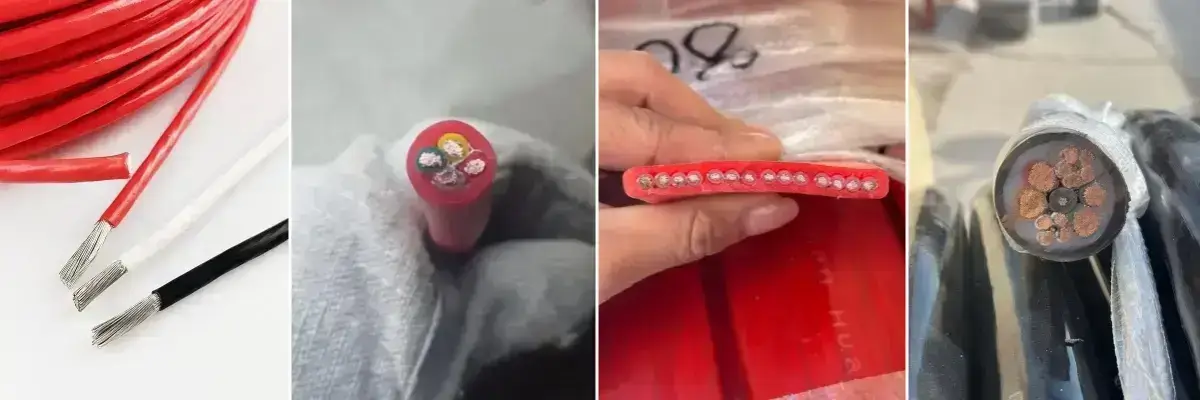
The complete cable construction is an important part of a silicone rubber cable quotation. Two products described as silicone cable may differ in conductor material, insulation layers, outer sheath, protective braid, screen and reinforcement. Buyers should describe the layers required for their application.
Silicone rubber cables can be specified with bare copper or tinned copper conductors. For high-temperature applications, tinned copper is often specified to prevent oxidation and maintain solderability over long-term operation. However, bare copper is also permitted under applicable standards such as EN 50525-2-41; confirm the conductor material required for your specific application and supplier datasheet. State the nominal cross-section and flexibility class clearly in your inquiry.
Silicone rubber can be used as the electrical insulation and, where specified, the outer sheath. The required insulation thickness, rated voltage, temperature range, colour and finished dimensions should be confirmed for the selected model. Some wire types have insulation without a separate silicone outer sheath, while other cable designs use a complete sheathed construction.
Certain high-temperature silicone cable designs use fiberglass-braided protection. When requesting a SIAF-GL-type construction or a customized equivalent, specify the required layers, dimensions and operating environment. Fiberglass braid and silicone outer sheathing are different construction choices; the required arrangement should be made clear in the RFQ.
A shielded silicone cable may use a tinned copper wire braid between the insulated cores and the outer sheath. Huanghe can review selected constructions using flexible tinned copper conductors, silicone rubber insulation, a tinned copper wire braid and a silicone rubber sheath. Braid coverage and finished-cable dimensions should be confirmed for the specific design.
If the project requires a particular shielding effectiveness, braid coverage, grounding arrangement or electrical performance, state the requirement explicitly. The term “shielded cable” by itself does not define a specific screening performance.
Selected customized constructions can incorporate a central anti-tension element (such as a high-strength steel wire rope or aramid fibre/Kevlar) or external steel wire braiding to withstand mechanical stress and pulling forces. This is a specialized engineered feature rather than a standard component of basic YGZ or YGC series. Submit a mechanical drawing or operating load requirements so the reinforcement arrangement can be properly designed.
| Construction element | Available specification options | Information to confirm |
|---|---|---|
| Conductor | Copper or tinned copper, subject to design | Material, cross-section and conductor class |
| Insulation | Silicone rubber (optionally over a glass-fibre or protective tape layer in specified designs) | Thickness, voltage and temperature requirements |
| Protective braid | Fiberglass braid in specified designs | Braid arrangement and intended protection |
| Shield | Tinned copper wire braid where specified | Coverage, grounding and electrical performance requirements |
| Reinforcement | Central steel wire, aramid fibre, or external steel braiding for tensile/mechanical load | Load requirements, pulling force, drawing and mechanical purpose |
| Outer sheath | Silicone rubber or another agreed protective layer | Material, colour, dimensions and environmental requirements |
Silicone rubber cable is often selected for equipment and industrial environments where flexibility and temperature capability are important. The permissible temperature range depends on the exact insulation and sheath compound, cable construction and applicable product specification.
Some manufacturer datasheets for silicone cable types designed to EN 50525-2-41 specify a continuous conductor operating temperature of up to 180°C, and product-specific ambient ranges may extend down to -60°C. These values apply to the particular cable construction and service conditions stated in the datasheet, not to every silicone cable. Some individual datasheets also specify a short-circuit conductor temperature of 350°C for a limited duration; this must not be treated as a universal rating or assumed without confirmation for the exact offered product. Huanghe will need to review the requested operating conditions against the proposed construction and supporting technical data.
| Operating requirement | Information to provide |
|---|---|
| Continuous operating temperature | Normal ambient conditions, conductor operating conditions and expected duration. |
| Low-temperature operation | Minimum service temperature and whether bending or movement occurs at that temperature. |
| Short-duration heat exposure | Peak temperature, exposure duration and frequency. |
| Movement and bending | Fixed or moving installation, bending radius, torsion and movement cycles where applicable. |
| Environmental resistance | Oil, chemicals, moisture, UV, ozone, abrasion or other specific exposure. |
Silicone insulation alone does not automatically mean that the complete cable is fire-resistant, circuit-integrity rated, oil-resistant, abrasion-resistant or suitable for continuous immersion. These are separate requirements that must be defined and supported by the appropriate construction and test evidence.
Buyers searching for silicone rubber cable price per meter, YGZ cable price, YGC cable price or high-temperature silicone cable price usually need a price for a defined product or project. The most useful quotation comparison is between offers that cover the same construction, quantity, inspection scope and delivery terms.
Check that every offer uses the same conductor material and cross-section, number of cores, conductor class, insulation and sheath construction, voltage rating and applicable standard. An unshielded cable is not directly comparable with a shielded version, and a fiberglass-braided construction is different from a cable with a copper-braid screen.
Check whether the quotation is per meter, roll or drum. State the total length, required cut lengths, maximum drum length and any special packing requirements. For projects with multiple cable sizes, list each model and quantity as a separate BOQ line.
Identify the tests and documents required by the project, including routine electrical tests, inspection records, third-party inspection or product-specific conformity documents. Ask the supplier to identify what is included in the offer. A general company certificate does not establish that every cable model has the same product certification.
Request quotation validity, production lead time, packaging, shipping term, destination and payment terms. These details help procurement teams compare the complete commercial scope instead of focusing only on the headline price.
| Quotation checkpoint | What to check |
|---|---|
| Model and construction | Is the exact model or requested construction identified? |
| Electrical specification | Are voltage, conductor size, core count, construction layers and applicable tests confirmed? |
| Materials and layers | Are insulation, sheath, fiberglass braid, copper-braid screen or reinforcement included as required? |
| Quantity and packing | Are total length, cut lengths, drum sizes and packaging method stated? |
| Quality documents | Which test reports, inspection records and conformity documents are included? |
| Commercial terms | Are quotation validity, lead time, delivery term and payment terms clear? |
There is no single reliable price per meter for every silicone rubber cable. If a published price does not identify the conductor, cross-section, core configuration, voltage rating and construction, treat it as indicative until the complete specification is confirmed.
Need a quotation for multiple silicone cable items?
Silicone rubber cable is used in selected industrial and equipment applications where flexibility and temperature capability are important. The correct design depends on electrical requirements, installation conditions, movement, environmental exposure and the applicable product specification.
For industrial equipment, specify the voltage, core count, conductor size, operating temperature and whether the cable is fixed or subject to movement. If vibration or repeated bending is involved, include the mechanical conditions in the technical inquiry.
Silicone cable may be considered for selected connections around industrial heating equipment, ovens, furnaces and other elevated-temperature environments. The complete cable must be suitable for the actual temperature and exposure duration, not merely described as silicone-insulated.
Where electrical interference is a concern, define the screening requirement and grounding arrangement. A tinned copper wire braid may be used in selected designs, but the cable should be reviewed against the required electrical performance.
Drag-chain cable, reeling cable and VFD cable describe application or design categories; they are not automatically silicone rubber cable types. Repeated flexing, torsion, tensile load, travel distance and bending radius must be considered. Do not select a cable for dynamic duty solely because its insulation is flexible.
For applications with special movement or mechanical requirements, provide the equipment details, installation drawing, movement cycle and environmental conditions. This gives the manufacturer a better basis for reviewing the requested construction.
A complete request for quotation helps the manufacturer identify the cable without guessing. A model number is useful, but a drawing or datasheet is preferable when the project uses an international designation or a customized construction.
| RFQ field | Information to provide |
|---|---|
| Model or drawing | YGZ, YGC, SIAF, SIHF, H05S-K, another requested type or a customer drawing. |
| Conductor | Copper or tinned copper, cross-section and conductor class where specified. |
| Core configuration | Number of cores, cross-section per core, colours and any reinforcement elements. |
| Construction | Silicone insulation, sheath, fiberglass braid, copper-braid screen or other required layers. |
| Electrical requirements | Rated voltage, operating conditions and applicable electrical tests. |
| Temperature and environment | Minimum and maximum service temperatures, movement and any oil, chemical, UV or moisture exposure. |
| Standard and documents | Required standard, test reports, inspection requirements and product-specific certification. |
| Quantity and delivery | Total meters, cut lengths, packaging, destination and preferred trade term. |
Use this template as a starting point and fill in the actual project requirements.
If a BOQ, drawing or technical datasheet is already available, attach it to the inquiry rather than manually repeating every detail.
For multi-item projects, list each cable model and quantity separately. Ask the supplier to identify any deviation from the requested specification in writing, including differences in material, conductor construction, voltage rating, testing, packaging or delivery.

A suitable silicone rubber cable manufacturer should be able to review the technical specification, clarify construction details and provide a quotation that identifies the proposed product. Buyers should assess technical fit, manufacturing capability and documentation alongside price.
Ask whether the supplier can provide the required model, cross-section, core count, voltage rating, insulation, sheath and protective layers. For customized international types, provide the applicable specification or drawing and request written confirmation of the proposed construction before production.
Review the manufacturer’s relevant production capability and quality-control arrangements. Confirm which inspections and tests apply to the cable being quoted and request supporting records when required. General manufacturing capability does not mean that every model has the same certification or test status.
If the project calls for IEC, EN, GB/T, UL AWM or another specification, identify the exact requirement in the RFQ. Request the relevant datasheet and supporting conformity documents for the offered construction. A similar model name or material description is not sufficient evidence of compliance with a specific standard.
For export orders, confirm cable length per drum, packaging method, shipping marks, required documents, destination and delivery terms. Clear confirmation helps reduce quotation revisions and misunderstandings between the buyer and supplier.
Huanghe Cable has manufactured cables since 1980, with YGZ and YGC as key silicone rubber cable series. The company can review additional international silicone cable specifications and customized constructions according to the customer’s requirements. Buyers can submit a model, BOQ or drawing so the proposed cable, technical requirements and quotation scope can be confirmed before an order is finalized.
Visit the Huanghe Silicone Rubber Cable product page for product information, or send your specification to the sales team.
There is no single price per meter for all silicone rubber cables. The price depends on model, conductor material and size, number of cores, insulation and sheath construction, protective braid or shielding, quantity, required tests and delivery terms. Submit a complete specification to obtain a comparable factory quotation.
YGZ and YGC are common Chinese-market designations for silicone rubber cable families. YGZ is generally associated with medium-duty flexible connections (typically 300/500V), while YGC is used for heavier-duty power connections (often listed at 450/750V, with 0.6/1kV cited in some manufacturer-specific constructions). Exact definitions and available specifications can vary, so confirm the conductor, core count, voltage, dimensions and complete construction from the proposed datasheet.
Huanghe can review a broad range of common market sizes from 0.5mm² to 300mm² in applicable designs, with YGZ and YGC as key series. The available combination depends on the model, conductor construction, core count, voltage and required layers. Send the requested size and cable configuration for confirmation.
Huanghe can review these international designations as customized supply requests. Provide the exact model, standard, cross-section, voltage, temperature rating and construction. Any required formal conformity or certification status must be confirmed separately for the specific product.
Selected customized designs can include fiberglass-braided protection or a tinned copper wire braid screen. Specify the intended function, construction layers, screen coverage or performance requirements and finished dimensions so the design can be reviewed.
Huanghe can review requests that specify a UL AWM style number, such as Style 3123, 3132, 3135, 3239 or 3512. The exact construction and required recognition status must be confirmed before an order. Do not assume that a product is UL-recognized simply because a style number is included in the inquiry.
Temperature capability depends on the compound and complete cable construction. Some product datasheets for silicone cable types under EN 50525-2-41 specify a conductor operating temperature up to 180°C, and some products publish a service range down to -60°C. Certain individual datasheets also specify 350°C for short-circuit exposure, but this is not a universal rating for all silicone cables. Confirm the exact product datasheet and distinguish continuous service, ambient temperature, installation conditions and short-duration exposure.
No. Flame retardancy, fire resistance and circuit integrity are separate performance requirements. Silicone insulation is designed for elevated-temperature applications, and many silicone compounds are halogen-free; however, material properties and finished-cable classifications must be verified against the specific product data and test evidence. If one of these properties is required, specify the applicable standard and request evidence for the offered cable construction.
Some silicone cable compounds offer good weathering, ozone and UV resistance, but outdoor suitability must be confirmed for the complete cable and its intended exposure. However, the finished cable performance also depends on the sheath compound, colour, mechanical protection and the specific environment. For long-term direct sunlight or harsh outdoor exposure, confirm the recommended sheath and colour with the supplier.
Provide the model or drawing, conductor material and cross-section, number of cores, rated voltage, insulation and sheath construction, temperature and environmental conditions, applicable standard, quantity, required tests, packaging and destination. If some details are unknown, describe the application and operating conditions so the supplier can propose a suitable construction and confirm the remaining parameters before quotation.
Silicone rubber cable is not a single product with one price. The model, conductor material and cross-section, core count, insulation and sheath construction, shielding or braid, rated voltage, temperature requirement and inspection scope all influence the factory quotation. YGZ and YGC remain Huanghe’s key silicone rubber cable series, while harmonized types such as H05S-K and H05SS-K, UL AWM style requests and customized constructions can be reviewed against the agreed specification.
For the most useful comparison, prepare a complete requirement before contacting suppliers: the cable model or drawing, conductor and size, core configuration, voltage, temperature and environment, applicable standard, quantity, required documents and delivery destination. That single step avoids most quotation revisions and specification misunderstandings in export projects.
| Related Product / Guide | What It Covers |
|---|---|
| Welding Cable | Product information for flexible welding cables used to connect welding equipment and support demanding working conditions. |
| H07RN-F & H05RN-F Rubber Cable | Rubber-sheathed flexible cable options for suitable industrial equipment, portable tools and other applications, depending on the cable type and installation requirements. |
| H07RN-F Cable Specifications, Applications & RFQ Requirements | Technical specifications, application considerations and the key information buyers should prepare when requesting an H07RN-F cable quotation. |
Send the model or drawing, conductor and size, core count, voltage, temperature and environment, quantity and destination. Our team will review the specification and confirm the proposed construction and quotation scope.
Standards note: EN 50525-2-41 covers single-core cables with cross-linked silicone-rubber insulation rated up to 300/500V, with a maximum conductor operating temperature of 180°C for the cable types in its scope. Other model designations, voltage ratings, temperature limits and UL AWM requirements are product- and specification-specific. Confirm the applicable standard, datasheet, availability and any required certification or recognition status for the exact offered construction.

Please contact us for a free quotation by the below form. We promise the quickest response within 12 hours.