Updated 2026/10/27 · Edited by Huanghe Cable Technical Team · Reading time: 16–20 minutes
Direct Answer: Finding a reliable xlpe cable manufacturer in China starts with evaluating five critical factors before sending a deposit — the voltage grades the factory actually extrudes (0.6/1 kV to 26/35 kV), the standards it can document for your cable type, whether it operates its own CCV insulation line, how it tests every drum rather than every shipment, and whether it can meet your MOQ, lead time, and inspection terms. Price comes after those five.
China remains the leading global hub for XLPE insulated power cables across industrial, renewable, and utility projects. However, because the number of market suppliers has grown faster than actual manufacturing facilities, the verification steps detailed below are far more critical than any product catalogue.
Key Takeaways
Contents
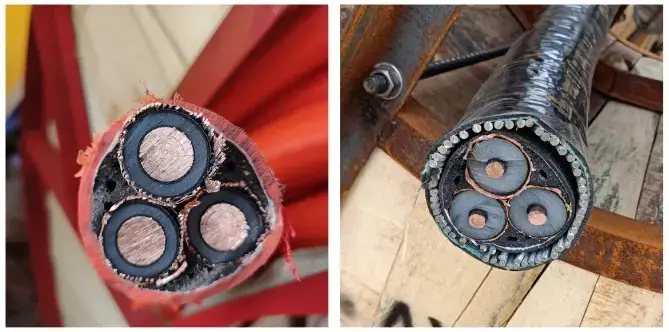
XLPE stands for cross-linked polyethylene. It starts as ordinary polyethylene, then undergoes a chemical cross-linking reaction under heat and pressure that turns the linear polymer chains into a three-dimensional network. The material stops being a thermoplastic and becomes a thermoset. That single structural change explains almost every practical difference between an XLPE cable and a PVC cable of the same dimensions.
What it means for a buyer sizing a circuit:
The standard range is built to these properties: 0.6/1 kV to 26/35 kV, copper or aluminium, 1.5 mm² to 800 mm². The LV and MV XLPE power cable range lists every model designation held as standard.
Swipe horizontally to view all table columns on mobile.
| Layer | Material | Function | Fitted on |
|---|---|---|---|
| 1. Conductor | Copper or aluminium, Class 1, 2 or 5 to IEC 60228 | Carries the load current | LV and MV |
| 2. Conductor screen | Semi-conductive compound | Smooths the electric field at the conductor surface | MV only |
| 3. Insulation | Cross-linked polyethylene (XLPE) | Primary dielectric | LV and MV |
| 4. Insulation screen | Semi-conductive compound | Creates an equipotential surface | MV only |
| 5. Metallic screen | Copper tape (CTS) or wire (CWS) | Carries capacitive and earth-fault current | MV only |
| 6. Armour | Steel tape (STA) or steel wire (SWA); aluminium wire (AWA) for single-core | Mechanical protection | Optional |
| 7. Outer sheath | PVC, PE or LSZH | Environmental and UV protection | LV and MV |
Two of those layers are where quotations quietly diverge. Insulation thickness is fixed by voltage class and standard, not by preference — a 0.6/1 kV cable carries 0.7 mm nominal from 1.5 to 16 mm², rising to 1.6 mm at 500–630 mm². If a supplier cannot state the nominal insulation thickness of the cable being quoted, there is not yet a specification — only a price.
Swipe horizontally to view all table columns on mobile.
| Property | XLPE | PVC | What it changes on site |
|---|---|---|---|
| Maximum continuous conductor temperature | 90 °C | 70 °C | More current per mm², or a smaller cable for the same load |
| Short-circuit temperature (5 s) | 250 °C | 160 °C | Easier protection coordination at the LV board |
| Thermal behaviour | Thermoset — chars | Thermoplastic — softens and deforms | No insulation flow under overload |
| Dielectric constant | ≈ 2.3 | 3.5–8.0 | Lower charging current, longer MV runs |
| Water absorption | Low | Higher | Direct burial and wet ground |
| Typical best fit | Underground distribution, MV, high ambient, renewables | Indoor trays, LV control and auxiliary circuits, short cost-driven runs | — |
PVC still has a place: short internal runs, control and auxiliary circuits, and installations where the cable will be re-terminated often. For anything buried, anything above 1 kV, and anything where the ambient temperature sits above 35 °C, XLPE is the default rather than the upgrade. Where the two are being weighed at low voltage, the PVC cable range uses the same conductor and armour options, so the comparison is like for like.
Choosing between XLPE and PVC for a project?
Send the cable schedule or the circuit details, and the construction can be reviewed against the installation conditions before a quotation is issued.
Voltage grade is the first filter to apply to any supplier, because it determines which insulation line, which screening equipment and which test set the factory has to own. The range held as standard is summarised below; a cable schedule or datasheet will confirm the exact construction for a given line item.
Swipe horizontally to view all table columns on mobile.
| Voltage class | Rated voltage U0/U (Um) | Typical constructions | Typical applications |
|---|---|---|---|
| Low voltage | 0.6/1 kV (1.2 kV) | YJV / YJLV unarmoured; YJV22 / YJLV22 steel tape; YJV32 / YJLV32 steel wire; YJVR flexible; VDE equivalents N2XY / N2XBY / N2XRY | Plant distribution, commercial buildings, sub-mains, pump and HVAC feeders |
| Low voltage, 3 kV class | 1.8/3 kV (3.6 kV) | YJV / YJLV, armoured on request | Mining, port equipment, heavy industry |
| Medium voltage | 3.6/6 kV (7.2) · 6/10 kV (12) · 8.7/15 kV (17.5) · 12/20 kV (24) · 18/30 kV (36) | Single and three-core, copper or aluminium, copper tape or copper wire screened, unarmoured or STA / SWA / AWA | Substation feeders, plant ring mains, wind and solar collector circuits |
| Medium voltage, 35 kV class | 21/35 kV (40.5) · 26/35 kV (40.5) | Screened single and three-core, copper tape plus wire screen, SWA or STA | Utility 33 kV networks, long plant feeders, mining distribution |
| Special constructions | Any of the above | Flame retardant (IEC 60332), fire resistant (IEC 60331), LSZH, anti-termite, UV-stabilised | Tunnels, metro, oil and gas, termite-prone regions |
Note the 35 kV class, because it is where many quotations stop short. IEC 60502-2 runs to 30 kV (Um 36 kV), so a supplier working only from that table will quote a ceiling of 18/30 kV. The 21/35 kV and 26/35 kV grades sit at Um 40.5 kV, above that ceiling, and are produced to project specification, utility standards, or applicable national standards (such as GB/T 12706.2).
On a 33 kV network the question needs to be asked directly: 18/30 kV is not the same cable as 26/35 kV, and the difference is 8.0 mm of insulation against 10.5 mm. For 33 kV utility grids requiring higher insulation margins under specific regional codes, 26/35 kV builds are fully available upon request.
For a worked selection example at the 11 kV level, see how to select the right 11 kV XLPE cable.
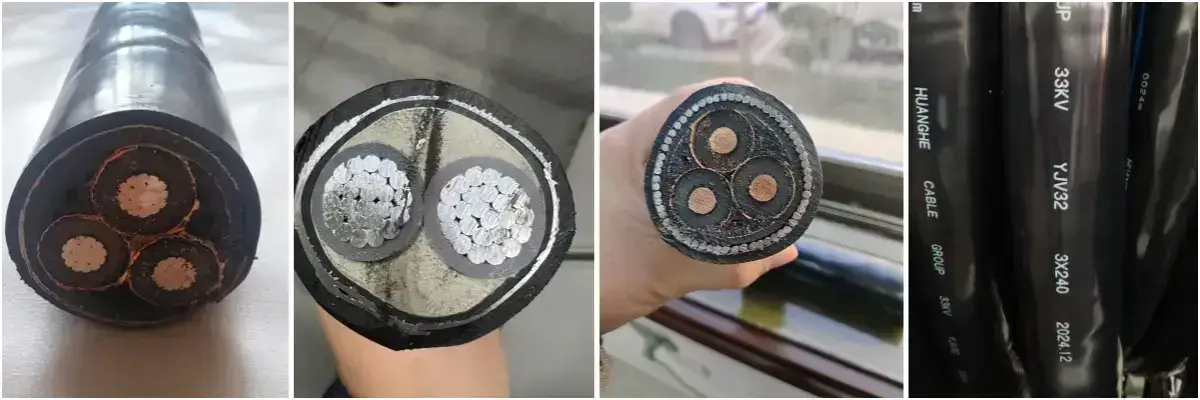
The same cable carries three different names depending on who is asking. Chinese factories quote YJV, European consultants specify N2XY, and a British-influenced utility may ask for BS 5467. The mapping below is the one used internally when a project arrives with a mixed set of drawings.
Swipe horizontally to view all table columns on mobile.
| Construction | GB/T 12706 | IEC / VDE | Typical application |
|---|---|---|---|
| Cu / XLPE / PVC, unarmoured | YJV | N2XY | Indoor, cable tray, duct |
| Cu / XLPE / steel tape / PVC | YJV22 | N2XBY | Direct burial in trench |
| Cu / XLPE / steel wire / PVC | YJV32 | N2XRY | Direct burial, vertical riser, high tensile duty |
| Cu / XLPE / steel tape / PE | YJV23 | N2XB2Y | Moisture-prone burial |
| Cu / XLPE / steel wire / PE | YJV33 | N2XR2Y | Wet ground, crossings |
| Al / XLPE / PVC, unarmoured | YJLV | NA2XY | Long runs, cost-sensitive distribution |
| Al / XLPE / steel tape / PVC | YJLV22 | NA2XBY | Direct burial, large section |
| Al / XLPE / steel wire / PVC | YJLV32 | NA2XRY | Vertical and high tensile duty |
| MV screened, unarmoured | YJV (MV) | N2XSY / N2XS2Y | Substation feeders, indoor MV |
| MV screened, copper tape, steel tape | YJV22 (MV) | N2XSEBY / NA2XSEBY | MV direct burial |
| MV screened, copper tape, steel wire | YJV32 (MV) | N2XSEYRY / NA2XSEYRY | MV vertical and shaft duty |
| MV screened, copper wire, aluminium wire | — | N2XSEAY / NA2XSEAY | Single-core MV, non-magnetic armour |
Decoding the Chinese designation is mechanical once the letters are known: Y is polyethylene, J marks it as cross-linked, V is PVC, L marks an aluminium conductor, 22 is double steel tape with a PVC sheath, 23 is steel tape with a PE sheath, 32 is steel wire with PVC and 33 is steel wire with PE. A trailing S in the VDE system marks a copper screen.
Two warnings. First, the VDE designations are construction descriptions, not certificates — a supplier writing “N2XY” on a datasheet is claiming a construction, and the standard edition the cable is tested to still has to be asked for.
Second, a single line that mixes systems, such as “YJV / N2XY / BS 5467” offered as one product, should not be accepted. Those are three different construction conventions and at most one of them is what will be delivered.
Conductor size is the second question after voltage, because it drives both ampacity and price. The standard range runs from 1.5 mm² to 800 mm²; what changes across that range is which core configurations are practical.
Low-voltage (0.6/1 kV) core configurations by size:
Insulation thickness is a function of voltage class alone above 1 kV. A 3×95 mm² 8.7/15 kV cable and a 3×240 mm² 8.7/15 kV cable both carry 4.5 mm nominal. That is worth knowing, because a supplier who quotes a thinner wall “for this size” is not optimizing — the wall is being substituted.
Nominal insulation thickness by voltage class (IEC 60502-1 and IEC 60502-2 reference values):
Reference values only. The figures should be confirmed against the edition of the standard cited in the project specification, because addenda and national deviations exist. For a first read of a supplier datasheet, the 12-point datasheet verification guide walks through the fields that are most often wrong.
Need a custom insulation thickness or verified XLPE quote?
Send your cable schedule to sales@huanghecables.com for a guaranteed 12-hour technical response.
Conductor material is a cost and termination decision more than a performance one, provided the cable is sized correctly for the metal in use.
Armour is a separate decision, and supplier literature often blurs the two — a cable is not an “armoured conductor”. Three armour types cover almost every project requirement:
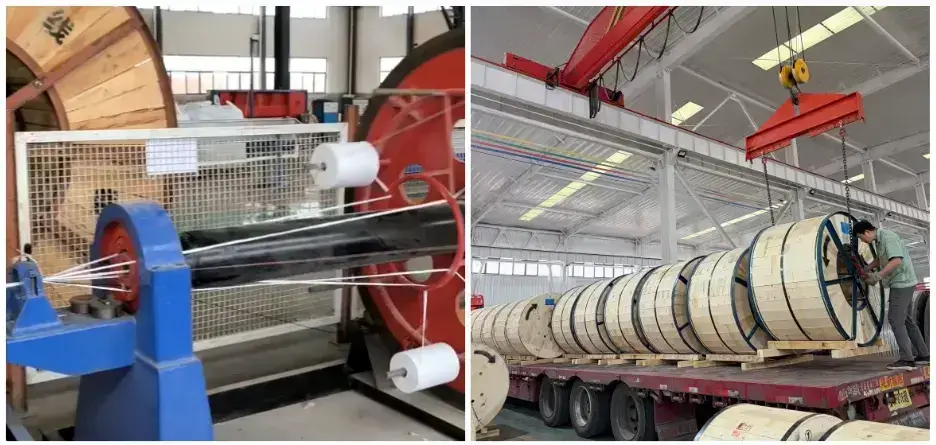
Buyers routinely ask for “IEC standard cable” and then discover at handover that the consultant meant a particular edition, or a national standard, or a utility addendum on top of IEC. It is worth knowing exactly what each standard covers.
Core IEC standards referenced in XLPE cable specifications:
Markets differ in which standard they reach for, and the difference is not cosmetic — it changes conductor conventions, sheath options and drum marking.
Standards commonly specified by market:
Five things to confirm in writing before production starts:
A word on certificates. A CB test certificate, an ISO 9001 certificate and a product approval are three different documents, and they are routinely offered interchangeably. The certificate that matters is the one that names the cable type and voltage class.
Huanghe XLPE cables are manufactured to the applicable IEC requirements, and the company holds IEC, CB, ISO and CCC certification, with SGS factory inspection available before shipment. Where a project requires a national approval that is not held, this is stated before quotation rather than after.
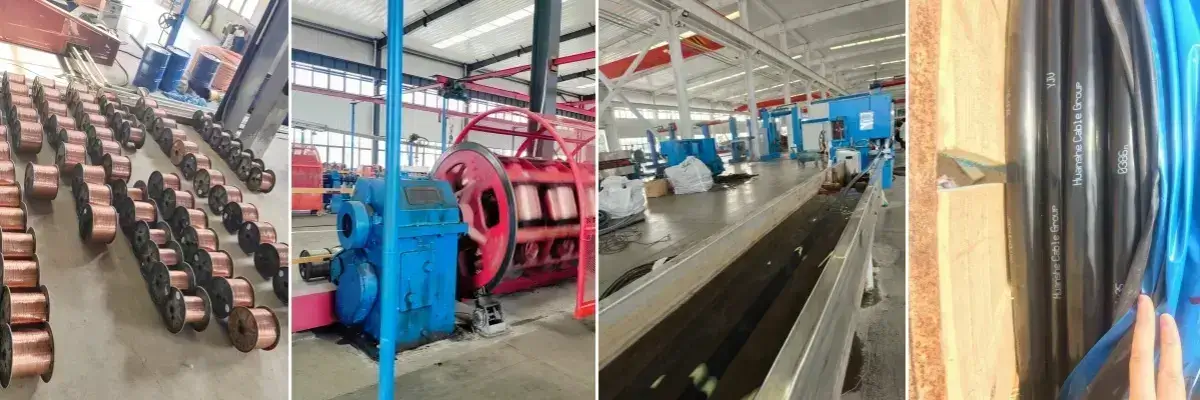
The most expensive mistake in this category is buying from a trading company that presents as a factory. It is usually not fraud — it is a broker with a good website. The test is not whether they say they are a manufacturer, but whether they can produce the four things only a manufacturer has: an insulation line, a test laboratory, a certificate naming the cable type, and a shipment record.
Swipe to view the red-flag column →
| What you ask for | What a real manufacturer shows | Red flag |
|---|---|---|
| Business licence | Registered scope includes cable manufacture, and the registered address is the plant | Scope lists trade or import/export only; address is an office suite |
| Insulation line | CCV or VCX triple-extrusion line, on a video call, running | Photographs only; “the plant is closed this week” more than once |
| Test laboratory | Partial discharge set, AC withstand set, DC resistance bridge, thermal ageing oven, on site | “We use a third-party laboratory for everything” |
| Certificates | A CB certificate naming the cable type and voltage class | A single ISO 9001 certificate offered as product approval |
| Export evidence | Bills of lading, project references, or a customer you can telephone | Refusal to share any shipment record |
| Quotation structure | Itemised: conductor, insulation thickness, screen, armour, sheath, drum length | One line item and one total price |
| Sample | A short length with the routine test report attached | A sample with no report, or a report with no drum number |
Five patterns that should stop a purchase:
Documents worth requesting before committing: the business licence with manufacturing scope, a CB or type test certificate for the specific cable type, a sample routine test report from a recent order, a reference project using the same voltage class and installation type, and the drum loading plan for the quantity.
Not sure whether a supplier is a factory or a trader?
Send the supplier’s quotation or datasheet, and the construction details can be checked line by line before an order is placed.
Cable quality is not visible in the finished drum. It is established at eight stages, and each one should leave a record that can be asked for by name:
Every drum leaving the works is spark-tested online during extrusion and high-voltage tested before dispatch, and carries a batch code that traces back to the extrusion log. Factory acceptance test reports are issued with the shipment or on request, and third-party inspection — including SGS — can be scheduled into the production window rather than bolted on at the end.

Two suppliers can quote the same model designation and land 25 % apart, and neither is necessarily lying. The difference sits in what is behind the designation. The variables that move an XLPE cable quotation, roughly in order of impact:
The practical consequence is blunt: a quotation that does not state its metal basis, insulation thickness, armour type and drum length cannot be compared with another quotation. The 33 kV XLPE cable price guide breaks down how a medium-voltage quotation is actually built line by line.
Comparing two XLPE cable quotations?
Send both quotations with the cable schedule, and the technical and commercial basis can be checked side by side before a decision is made.
Commercial terms for project orders:
Send these fields and the first quotation that comes back is usually the one that can actually be compared. Send a model number and a tonnage instead, and three rounds will be spent discovering that the two suppliers priced different cables.
Swipe to view the full field list →
| Field | Example | Why it matters |
|---|---|---|
| 1. Voltage rating | 8.7/15 kV (Um 17.5 kV) | Sets insulation thickness and test voltage |
| 2. Conductor material & class | Copper, Class 2 | Metal cost and termination method |
| 3. Cross-section & cores | 3 × 185 mm² | Ampacity and metal content |
| 4. Armour & sheath | SWA / PE sheath | Burial environment and mechanical protection |
| 5. Standard | IEC 60502-2 | Test regime and acceptance criteria |
| 6. Quantity & drum length | 4,200 m (500 m/drum) | MOQ, transport and joint count |
| 7. Destination & Incoterm | CIF Mombasa | Freight, insurance and logistics |
A cable schedule, bill of quantities or project datasheet covers all of these in one document. If one is available, send it — that is the fastest route to a quotation that survives review.
Huanghe Cable has been manufacturing cable since 1980 and was restructured from a state-owned enterprise. That history is not the argument; what it left behind is — a plant that extrudes its own insulation, a laboratory that tests every drum, and a technical team that reads cable schedules for a living.

The voltage grades it actually extrudes, the standards it can document for your cable type, whether it runs its own CCV line, how it tests each drum, and whether its MOQ, lead time and inspection terms fit your schedule. Price comes after those five.
Most established factories do, because LV and MV share conductor preparation and testing infrastructure. What differs is the insulation line setup, screening equipment and partial-discharge capability — so confirm the specific voltage grades rather than accepting “LV and MV” as a statement.
0.6/1 kV and 1.8/3 kV at low voltage; 3.6/6 kV to 18/30 kV to IEC 60502-2; and 21/35 kV to 26/35 kV (Um 40.5 kV) to project specifications or national standards, specifically engineered for 33 kV utility networks and heavy industrial grids.
XLPE is a thermoset rated 90 °C continuous and 250 °C short-circuit; PVC is a thermoplastic rated 70 °C and 160 °C. On the same conductor XLPE carries 15–30 % more current, has a lower dielectric constant and absorbs less water.
1.5 mm² to 800 mm² in copper or aluminium, Class 1, 2 or 5. Core configurations include single-core, 2, 3, 3+1, 4, 4+1 and 5-core. Aluminium is normally supplied from 10 mm² at LV and 25 mm² at MV.
Yes — conductor class, core configuration, screen type, armour, sheath compound, fire performance, drum length and marking can all be specified against the cable schedule, and the construction is confirmed before quoting.
Standard LV constructions can start from one drum; custom MV, LSZH and fire-resistant builds carry higher minimums. Lead time is typically 2–4 weeks after drawing approval, longer for custom armour, LSZH, FR and long MV drum lengths, plus transit time.
Voltage rating and Um, conductor material and class, cross-section, core configuration, screen and armour type, sheath material, applicable standard, fire performance, quantity, drum length, marking, destination and Incoterm. A cable schedule covers all of it in one document.
Yes. Customer representatives and third-party inspectors, including SGS, can inspect before shipment, and factory acceptance test reports are issued with dispatch. The inspection window is booked into the production schedule so it does not become a delay at the end of the order.
Send the cable schedule, voltage level, conductor material and quantity, and the engineering team will review the construction and return a factory quotation — normally within 12 hours on working days.
Email: sales@huanghecables.com

Please contact us for a free quotation by the below form. We promise the quickest response within 12 hours.