Choosing a power cable sheath is not simply a matter of selecting PVC, PE or LSZH from a supplier’s standard product list. The correct sheath specification depends on the cable’s installation environment, moisture exposure, mechanical conditions, fire and smoke requirements, chemical exposure, temperature and the applicable project specification.
Direct Answer
The right power cable sheath is the one whose material and construction satisfy the actual external installation conditions and project requirements. PVC is widely used for general power cable applications, while PE or related polyethylene sheath constructions may be considered where moisture and environmental exposure are important. LSZH constructions are specified where low smoke and halogen-related fire performance is required. The final choice should be verified against the cable standard, project specification, environmental conditions and manufacturer data rather than selected from the sheath material name alone.
Quick Rule of Thumb
Start with the installation environment, not the material name. Define where the cable will be installed, what it will be exposed to and what fire or environmental requirements apply. Then select and verify the sheath construction.
Table of Contents
The outer sheath is the cable layer primarily exposed to the surrounding installation environment, so its specification must reflect the conditions outside the cable.
A power cable is normally made from several functional layers. The conductor carries current, the insulation provides electrical insulation, metallic screens or armour may provide electrical and mechanical functions depending on the design, and the outer sheath protects the cable construction from the surrounding environment.
This distinction is important during procurement. A cable can have the correct conductor size and XLPE insulation but still require a different sheath construction because the external installation conditions are different.
| Cable Layer | Primary Function | Procurement Question |
|---|---|---|
| Conductor | Carries electrical current | Copper or aluminum? What cross-section? |
| Insulation | Electrical insulation | XLPE, PVC or another specified insulation? |
| Screen / Armour | Electrical and/or mechanical functions depending on design | Is metallic screen or armour required? |
| Outer Sheath | Protection from the external environment | Which material and performance are required? |
For LV power cables covered by IEC 60502-1:2021, the standard specifies construction, dimensions and test requirements for extruded solid-insulation power cables rated at 1 kV and 3 kV for fixed installations. For MV cables from 6 kV up to 30 kV, IEC 60502-2:2014+AMD1:2024 covers construction, dimensions and test requirements and specifically notes that possible radial water ingress should be considered when determining applications.
The applicable cable standard is therefore part of the sheath specification, but the project environment still determines which construction is appropriate.
PVC, PE and LSZH should be treated as different sheath options with different application considerations rather than interchangeable labels.
Quick Sheath Selection Flowchart
The material choice should begin with the required performance. For a general industrial or distribution installation, PVC may be an appropriate and economical sheath material when the project requirements are satisfied. Where moisture or environmental exposure is a major design consideration, polyethylene-based sheath constructions may be evaluated. Where a project specifically requires low smoke and halogen-related performance, an LSZH construction may be specified.
| Sheath Option | Typical Specification Consideration & Standards | Questions to Confirm |
|---|---|---|
| PVC | General power cable applications, cable trays, and fixed installations. Standardized under IEC 60502-1 (ST1 / ST2), BS 7655-4.2, and equivalent PVC compounds offering moderate oil and UV resistance. | Temperature rating, environmental exposure, and fire requirements? |
| PE (MDPE / HDPE) | MDPE: Balanced flexibility and moisture resistance for buried ducts (IEC 60502-1/2 ST7, ASTM D1248). HDPE: High mechanical strength, hardness, and superior abrasion resistance for heavy-duty direct burial or rugged outdoor conditions. |
Moisture, mechanical stress, soil abrasion, and installation method? |
| LSZH | High-occupancy buildings, tunnels, and public infrastructure requiring zero halogen and low smoke under fire conditions. Specified per IEC 60502-1 (ST8), BS 7655-6.1, and EN 50363-8. | Which fire, smoke (IEC 61034), and acid gas (IEC 60754) tests apply? |
The important procurement principle is to specify the required performance rather than assuming a material name automatically proves compliance. A quotation that says PVC sheath, PE sheath or LSZH sheath should still be checked against the complete cable construction and the project’s technical specification.
PVC versus PE is an application decision, not a universal ranking, because the required sheath performance depends on the installation environment and project specification.
PVC is commonly used in power cable constructions for general applications. Polyethylene sheath constructions (PE) should be specified when the external environment demands superior moisture resistance or environmental protection. For standard underground duct installations, MDPE (Medium-Density Polyethylene) is frequently used due to its flexibility and moisture barrier properties. However, for direct burial in rocky soils, rugged outdoor terrain, or heavy-duty pulling operations, HDPE (High-Density Polyethylene) should be specified to provide high tensile strength, superior abrasion resistance, and maximum mechanical protection. The correct choice should therefore be made from the installation conditions and required performance.
For procurement, avoid writing only PVC or PE cable when the complete cable construction is known. The quotation request should identify the conductor, insulation, metallic screen or armour, outer sheath, voltage rating, standard and other relevant requirements.
Procurement Rule
Do not compare PVC and PE only by unit price. First, confirm that both quotations meet the same environmental, mechanical, fire, dimensional, and testing requirements.
Underground cable sheath selection should account for the actual soil, moisture and environmental conditions instead of assuming that every buried cable can use the same outer sheath construction.
Underground cables may be installed in dry soil, wet soil, waterlogged ground, ducts, trenches or other environments where the external conditions vary substantially. The sheath is the cable layer directly exposed to these conditions, so the specification should reflect the expected environment.
For MV cable systems, IEC 60502-2:2014+AMD1:2024 explicitly states that the possible risk of radial water ingress should be considered when determining applications. The standard also includes cable designs with barriers claimed to prevent longitudinal water penetration and associated testing.
This does not mean that every underground project requires the same water-blocking construction. Instead, the project designer should determine whether radial or longitudinal water ingress is a relevant risk and then specify the appropriate cable construction.
For projects involving saline or waterlogged soils, your existing guide on Underground LV & MV Power Cable Specification & Protection can be used as a related engineering reference. The present article focuses specifically on the sheath decision rather than repeating the complete underground cable design process.
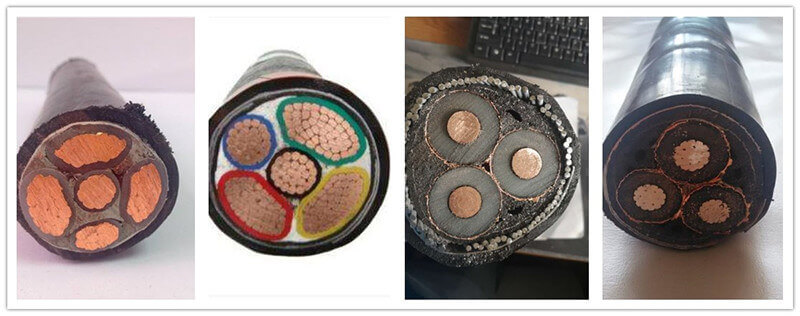
Armour and the outer sheath are different cable construction elements, so specifying armour does not automatically define the required sheath performance.
Armour can provide mechanical protection and, depending on the cable design and installation system, may also have electrical or earthing functions. The outer sheath remains the external protective layer.
This distinction becomes particularly important when comparing armoured cable quotations. Two suppliers may both quote SWA cable but use different sheath materials or constructions. The cable descriptions may therefore look similar while the complete constructions are not identical.
For procurement engineers, this is one reason why the cable description should be read layer by layer. Your existing article How to Specify Underground Armoured Power Cables covers the broader armoured cable specification process, while this article focuses on the sheath decision.
Our cable engineering team provides technical compliance verification and customized IEC datasheets for EPC project tenders.
Flame propagation, smoke density and halogen-gas performance are separate technical properties and should not be treated as one generic fire-resistant cable requirement.
This distinction is particularly important for building, tunnel, transportation, industrial and other projects where cable fire performance is specified.
IEC 60332-1-2:2025 specifies a test procedure for vertical flame propagation of a single insulated wire or cable using a 1 kW pre-mixed flame. It is therefore a flame-propagation test method, not a generic definition of every fire-related cable property.
IEC 60754-1:2011+AMD1:2019 specifies a method for determining the amount of halogen acid gas evolved during combustion of relevant cable materials.
IEC 61034-2:2005+AMD1:2013+AMD2:2019 specifies the test procedure and requirements for measuring smoke density from cables burning under defined conditions.
Therefore, if a project specification calls for LSZH cable, low smoke performance or halogen-related requirements, the buyer should identify the actual required tests and acceptance criteria instead of accepting a supplier’s generic statement that the cable is fire resistant.
| Requirement | What It Addresses | Example Standard |
|---|---|---|
| Flame propagation | Behaviour of cable under a defined flame exposure | IEC 60332-1-2:2025 |
| Halogen acid gas | Determination of halogen acid gas content from combustion of relevant materials | IEC 60754-1:2011+AMD1:2019 |
| Smoke density | Measurement of smoke density under defined burning conditions | IEC 61034-2:2005+AMD1:2013+AMD2:2019 |
Engineering Note: Specifying LSZH strictly addresses low smoke density (IEC 61034) and zero halogen toxicity (IEC 60754). If your project requires flame spread prevention for bundled cables (e.g., IEC 60332-3 / EN 50575 CPR category) or fire-resistant circuit integrity (e.g., IEC 60331), these test performance standards must be explicitly specified alongside LSZH.
The sheath material should be checked against the actual external temperature and chemical environment rather than selected only from the cable’s conductor temperature rating.
Cable specifications often include a conductor operating temperature, but that value should not automatically be treated as the temperature limit for every cable layer. The insulation, sheath and other materials have their own material requirements and test conditions.
External chemical exposure should also be evaluated separately. Industrial installations can expose cables to oils, hydrocarbons, solvents, acids, alkalis or other substances. The correct question is not simply whether a cable is PVC or PE, but whether the proposed construction has been specified or verified for the actual chemical environment.
Where the chemical environment is unusual, the procurement specification should identify the substance, concentration or exposure condition where relevant and require the manufacturer to confirm material compatibility.

A sheath should be approved only after its material, environment, mechanical exposure, fire requirements and supporting documentation have been checked together.
| Check | What to Confirm | Why It Matters |
|---|---|---|
| 1. Installation location | Indoor, outdoor, underground, duct, tray or other location | Defines the external exposure |
| 2. Moisture conditions | Dry, wet, waterlogged or high-moisture environment | May affect sheath and water-ingress requirements |
| 3. Mechanical exposure | Risk of impact, crushing, abrasion or installation damage | Determines whether armour or additional protection is needed |
| 4. Fire requirements | Flame propagation and project-specific fire requirements | Prevents generic fire claims from replacing actual specifications |
| 5. Smoke requirements | Whether smoke-density performance is specified | Important for enclosed or occupied environments |
| 6. Halogen requirements | Whether halogen-related requirements apply | May require specific material and test evidence |
| 7. Temperature | Expected ambient and external conditions | Material suitability must be confirmed |
| 8. Chemical exposure | Oil, fuel, chemicals or contaminated surroundings | Requires material compatibility review |
| 9. Documentation | Datasheet, standard reference, test evidence and construction details | Confirms the quoted cable matches the requirement |
The sheath requirement should appear explicitly in the cable description so suppliers cannot interpret the requested construction differently.
A procurement specification should identify enough information for different suppliers to quote the same technical product. The sheath should therefore be included as part of the complete cable construction rather than requested as a generic power cable.
Example Specification Format
3 × 120 mm² Cu/XLPE/SWA/PVC, 0.6/1 kV, IEC 60502-1:2021
The exact construction should of course be determined by the project requirements. The example above demonstrates the principle: conductor, insulation, armour and sheath are separately identifiable rather than hidden inside a generic product name.
If you need to develop a complete procurement specification, see How to Write a Power Cable RFQ: 15 Technical Details to Lock Before You Request Quotations.
A reliable sheath specification should be supported by identifiable standards, defined test methods and project-specific application conditions.
| Data Point | Source / Standard | Applicable Scenario |
|---|---|---|
| 1 kV and 3 kV fixed-installation cable scope | IEC 60502-1:2021 | LV power cable specification |
| 6 kV to 30 kV cable scope | IEC 60502-2:2014+AMD1:2024 | MV distribution and industrial installations |
| Radial water-ingress consideration | IEC 60502-2:2014+AMD1:2024 | MV applications where water ingress is a design consideration |
| Longitudinal water-penetration barriers | IEC 60502-2:2014+AMD1:2024 | Cable designs claiming longitudinal water protection |
| Flame propagation test using a 1 kW pre-mixed flame | IEC 60332-1-2:2025 | Single insulated wire or cable flame-propagation testing |
| Halogen acid gas determination | IEC 60754-1:2011+AMD1:2019 | Combustion-gas assessment of relevant cable materials |
| Smoke-density measurement | IEC 61034-2:2005+AMD1:2013+AMD2:2019 | Defined cable-burning smoke test |
| Sheath material and construction | Cable product standard + manufacturer datasheet | Quotation and technical submittal review |
| Actual environmental exposure | Project specification / site conditions | Final sheath material selection |
Standards define test methods and product requirements, but they do not remove the need for project-specific engineering judgement. The buyer should therefore keep the standard reference and the application requirement together in the procurement record.
Cross-Reference: Global Standards for Cable Sheaths
When reviewing project specifications from different regions, sheath materials are often governed by equivalent regional standards:
Our cable engineering team provides full technical compliance verification and customized IEC datasheets for EPC project tenders.
These definitions help engineers, procurement teams and AI search systems distinguish cable construction terms that are often incorrectly treated as synonyms.
The outer protective layer of a cable construction, intended to protect the underlying cable components from the external environment according to the specified design.
An outer sheath based on polyvinyl chloride material used in power cable constructions where the specified material and performance requirements are satisfied.
An outer sheath based on polyethylene material, selected where its specified properties are suitable for the cable’s installation and environmental requirements.
A specific polyethylene outer sheath that balances mechanical strength and flexibility, providing excellent moisture barrier properties for underground duct and conduit installations.
A heavy-duty polyethylene outer sheath featuring high tensile strength, superior hardness, and maximum abrasion resistance, specifically suited for rugged outdoor exposure, direct burial in harsh soils, or demanding cable pulling operations.
Low Smoke Zero Halogen, referring to cable constructions designed and tested to meet specified low-smoke and halogen-related requirements.
An external sheath layer applied over the underlying cable construction; the exact construction and terminology depend on the applicable cable standard.
The penetration of water into a cable construction, which may be considered as radial or longitudinal depending on the direction and cable design.
The behaviour of a cable when exposed to a defined flame test condition; it is a specific fire-performance characteristic rather than a general synonym for fire resistance.
Gases containing halogen acids that may be generated during combustion of materials containing halogenated polymers or additives, assessed by applicable test methods such as IEC 60754-1.

Huanghe approaches sheath selection as part of the complete cable construction, matching the requested product configuration with the applicable standard and project requirements.
Huanghe manufactures LV and MV power cables in configurations that can include different conductor materials, insulation systems, metallic protection and sheath constructions according to the specified product design.
For procurement projects, the cable construction can be defined before quotation so that the conductor, insulation, armour or screen and outer sheath are clearly identified. This helps reduce ambiguity when multiple suppliers are being evaluated.
Huanghe’s cable manufacturing and quality documentation can be aligned with the agreed technical specification, applicable IEC requirements and project inspection requirements. For buyers who need supporting documentation before shipment, the relevant product and testing documents should be confirmed as part of the purchase specification.
If you are comparing cable constructions for an underground, industrial or distribution project, providing the voltage rating, conductor, cable size, installation environment, armour requirement, sheath requirement and applicable standard gives the manufacturer a much clearer basis for quotation.
Content Upgrade: Check Your Sheath Specification Before Ordering
Already have a cable specification or supplier quotation? Send the cable type, voltage, conductor size, installation environment and proposed sheath construction to Huanghe. The technical team can review the requested configuration before quotation.
The power cable sheath protects the underlying cable construction from the external installation environment. Its required material and construction depend on moisture, mechanical, thermal, chemical and fire-related conditions.
Neither material is universally better; the correct choice depends on the underground environment and project requirements. Moisture, soil conditions, mechanical exposure, chemical conditions and required cable performance should be reviewed before the sheath is specified.
PE-based sheath constructions may be considered for demanding moisture environments, but suitability must be confirmed against the complete cable design and project requirements. For MV cable applications, IEC 60502-2:2014+AMD1:2024 specifically identifies water-ingress considerations when determining applications.
Yes, armour and outer sheath are different cable construction elements. Armour can provide mechanical and, depending on design, electrical functions, while the outer sheath protects the cable from the external environment.
No, LSZH and fire-resistant are not interchangeable terms. LSZH addresses low-smoke and halogen-related characteristics, while fire-related cable requirements may involve different tests and performance criteria.
IEC 60502-1:2021 covers extruded-insulation power cables rated at 1 kV and 3 kV for fixed installations. The applicable project specification should still be checked for additional requirements.
IEC 60502-2:2014+AMD1:2024 covers power cables with extruded insulation rated from 6 kV up to 30 kV. The standard addresses construction, dimensions and testing for applicable fixed installations.
Check the complete cable construction, applicable standard, environmental conditions and required tests rather than accepting the material name alone. Confirm the conductor, insulation, screen or armour, sheath construction, voltage rating and relevant project requirements.
Yes, the sheath construction can affect the overall cable specification and quotation. However, price should be compared only after the technical constructions, quantities, testing requirements and delivery conditions have been normalized.
Provide the voltage rating, conductor material and size, cable configuration, installation environment, moisture conditions, mechanical requirements, fire requirements, chemical exposure and applicable standard. This gives the manufacturer enough technical context to evaluate the proposed sheath construction.
Continue the technical specification process with these related Huanghe guides:
Need to Confirm Your Power Cable Sheath Specification?
Send your cable type, voltage, conductor size, installation environment and sheath requirement. Huanghe can review the requested configuration and prepare a quotation based on the agreed technical specification.
Technical requirements should always be checked against the applicable project specification, local installation requirements and current product documentation.

Please contact us for a free quotation by the below form. We promise the quickest response within 12 hours.