When several cable suppliers submit quotations for the same project, the lowest unit price is rarely enough to determine which offer is actually the best value. A quotation can look cheaper because the conductor material, cable construction, armour, sheath, testing scope, installation assumptions or commercial terms are different.
For procurement engineers and electrical contractors, the first task is therefore to establish whether the quotations are technically comparable. Only after the cable specifications and compliance requirements have been checked should price, delivery and other commercial conditions become the deciding factors.
Direct Answer
Power cable quotations should be compared on a like-for-like technical basis before price is considered. Verify the voltage rating, conductor material and size, insulation, screen or armour, sheath, installation conditions, ampacity, short-circuit requirements, applicable standards, testing documents and commercial terms. A lower price is not a meaningful comparison if the cable construction or technical requirements are different.
Table of Contents
The first question is not “Which supplier is cheaper?” but “Are all suppliers quoting the same cable?”
A quotation comparison becomes unreliable when suppliers interpret the RFQ differently. One supplier may quote copper while another quotes aluminium. One may include steel wire armour while another uses a different armour construction. A third may base its current rating on installation conditions that are different from the project design.
Before comparing prices, create a technical comparison sheet and place the quotations side by side. At minimum, record:
This is also why a supplier quotation should be reviewed together with its technical datasheet. Huanghe’s existing guide on how to read an armoured power cable datasheet provides a more detailed specification-by-specification review.
The cable voltage designation must match the electrical system and the project specification, not just the supplier’s product name.
Terms such as “11kV cable”, “MV cable” or “1kV power cable” are useful for initial identification but are not sufficient for a technical quotation comparison. The complete voltage designation and applicable cable standard should be recorded.
For MV cables, the buyer should also check whether the quoted construction includes the electrical layers required by the project, such as conductor screen, insulation and insulation screen, and metallic screen where applicable.
| Quotation Item | What to Verify |
|---|---|
| Voltage designation | Complete U₀/U(Uₘ) or applicable LV designation |
| System frequency | 50 Hz, 60 Hz or project-specific requirement |
| Cable application | Distribution, industrial, building, underground or other application |
| Applicable standard | Exact standard and edition stated by the supplier |
Conductor material and cross-sectional area must be evaluated together because copper and aluminium have different electrical resistivities. A direct 1:1 cross-sectional area swap between copper and aluminium is technically invalid. To achieve equivalent current-carrying capacity and voltage drop, an aluminium conductor typically requires a larger cross-sectional area (usually 1 to 2 standard sizes larger, e.g., 240mm² Al replacing 150mm²–185mm² Cu).
Copper and aluminium are both established conductor materials for power cables, but their electrical and physical characteristics differ. Conductor resistance, cable weight, dimensions, termination requirements and voltage-drop performance can all be affected by the material selection.
IEC 60228 (Conductors of insulated cables) specifies conductor characteristics including nominal cross-sectional areas, conductor class (Class 1, Class 2, Class 5), and maximum DC resistance limits. When reviewing a quotation, therefore, do not compare “240 mm²” in isolation. Record both the material and the conductor construction.
| Parameter | Supplier A | Supplier B | Supplier C |
|---|---|---|---|
| Conductor material | |||
| Cross-section | |||
| Conductor construction | |||
| Maximum DC resistance |
For a detailed engineering comparison between copper and aluminium conductors, see Copper vs Aluminum Power Cables: 9 Engineering Checks Before You Order.
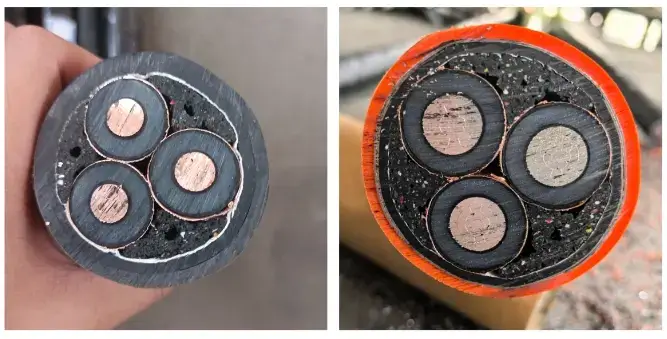
Cable insulation type and extrusion technology dictate operational lifetime; MV XLPE cables must explicitly specify triple co-extrusion (CCV line – Continuous Curing Vulcanization) for conductor and insulation screens to prevent micro-voids and dielectric breakdown.
Review the insulation material together with the voltage class and applicable standard. Common power cable constructions may use XLPE, PVC or other specified insulation systems depending on the application.
For LV power cables, IEC 60502-1:2021 covers power cables with extruded insulation for rated voltages of 1 kV and 3 kV for fixed installations. For MV applications, IEC 60502-2:2014+AMD1:2024 covers cables with extruded insulation for rated voltages from 6 kV up to 30 kV.
When comparing quotations, record the following rather than accepting a general description such as “IEC power cable”:
Unsure whether your project requires XLPE or PVC insulation for direct-buried underground lines or high-temperature environments? Read our in-depth comparison: XLPE vs PVC Power Cables: How to Choose for Underground and High-Temperature Projects
Screen, armour, and sheath serve distinct electrical and mechanical functions; single-core AC cables strictly require non-magnetic armour (AWA) to prevent severe eddy-current overheating.
This distinction becomes especially important when comparing underground and MV cable quotations.
| Component | Main Function to Review | Procurement Check |
|---|---|---|
| Metallic screen | Electrical shielding and, where applicable, fault-current/earthing function | Verify screen type (Copper Tape Screen vs. Copper Wire Screen + Helix Copper Tape) and explicit cross-sectional area (mm², e.g., 16mm², 25mm², 35mm². The screen must be sized to withstand the project’s specified system earth-fault current (earth-fault withstand time), not just provide electrostatic shielding. |
| Armour | Mechanical protection and specified electrical function where applicable | SWA, AWA, DSTA or other specified construction |
| Outer sheath | Environmental and mechanical protection | Material, colour, environmental requirements and standard |
For single-core AC cables, magnetic material selection is critical. Ferromagnetic armour (such as Steel Wire Armour / SWA or Double Steel Tape Armour / DSTA) must never be used on individual single-core AC cables, as induced eddy currents and magnetic losses will cause severe overheating. Single-core AC cables must specify non-magnetic armour (e.g., Aluminium Wire Armour / AWA or non-magnetic stainless steel) unless all three phase conductors are enclosed within the same magnetic armour structure.
This is one reason a quotation that simply says “armoured cable” does not provide enough technical information for final approval.
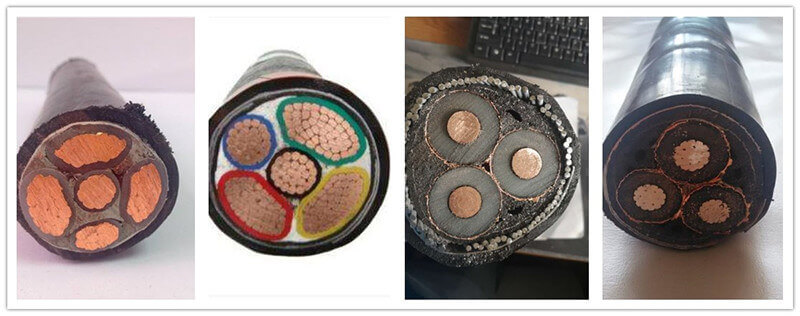
Quoted ampacity figures are technically invalid for comparison unless calculated under identical installation parameters, thermal soil resistivities, and grouping correction factors per IEC 60287.
Two suppliers can quote the same conductor size but provide different allowable current values without either number necessarily being incorrect. Cable construction, installation method, ambient or soil conditions, grouping, spacing and thermal parameters can all influence the calculated rating.
IEC 60287-1-1:2023 provides calculation methods for steady-state current ratings and losses of cables under specified conditions. The standard covers cable installations including buried cables, ducts, troughs and air.
Therefore, when comparing quotations, record the assumptions behind the current rating.
| Condition | Supplier A | Supplier B |
|---|---|---|
| Installation method | ||
| Ambient / soil conditions | ||
| Cable formation | ||
| Grouping / spacing | ||
| Current rating |
Huanghe’s guide to power cable ampacity under IEC 60287 explains why conductor size alone does not determine allowable current.
The quoted cable must withstand the specified fault current for the required protection-clearing time without exceeding the permissible thermal limits of the cable components.
Short-circuit performance should be checked separately from normal operating ampacity. The relevant inputs may include the prospective fault current, fault duration, conductor material, initial and final conductor temperatures and the construction of metallic screens or other components.
For the conductor adiabatic thermal short-circuit limit, the verification formula according to IEC standards is commonly expressed as:
For a more detailed procurement review, see Power Cable Short-Circuit Rating: 9 Checks Before Ordering.
Have Two or More Cable Quotations to Compare?
Send your RFQ, technical specification or supplier datasheets to Huanghe. We can review the main cable parameters and help identify whether the quoted constructions are technically comparable.
Outer diameter and bending radius directly determine conduit sizing, trenching clearance, and minimum drum dimensions, making physical data a mandatory constraint in technical evaluation.
Cable diameter and weight can affect duct selection, tray capacity, pulling equipment, transportation and drum handling. Different constructions can produce different dimensions even when the conductor cross-section is identical.
Compare:
| Physical Parameter | Why Procurement Should Check It |
|---|---|
| Overall diameter | Duct, tray and installation-route compatibility |
| Weight per metre | Transportation and pulling equipment planning |
| Bending radius | Installation feasibility |
| Delivery length | Drum quantity, joints and site handling |
Cable compliance requires explicit reference to active international standards (such as IEC 60502-1/2) and edition years; generic standard references often mask missing factory compliance tests.
Different standards address different cable types, voltage ranges and testing requirements. For example, IEC 60502-1:2021 covers certain LV power cables, while IEC 60502-2:2014+AMD1:2024 addresses extruded-insulation power cables from 6 kV to 30 kV.
For procurement, record:
Avoid assuming that a certificate, test report or manufacturer statement automatically satisfies every project requirement. The document needs to correspond to the actual product and the applicable specification.
A test document has greater procurement value when its scope and traceability can be connected to the cable being purchased.
Do not simply count the number of certificates supplied by each manufacturer. Instead, determine what each document actually proves.
| Document | What to Check |
|---|---|
| Technical datasheet | Does it match the quoted construction and project specification? |
| Routine test record | Does it relate to the production scope where required? |
| Type/design test report | Does the tested construction correspond to the offered design? |
| Third-party inspection | Who performed the inspection and what was inspected? |
| Certificate | Scope, standard, product identification and validity where applicable |
Traceability is particularly useful for production-related test records. Depending on the project requirements, look for identifiers such as purchase order, cable item, production batch, cable length or drum number, manufacturing date and test date.
For a detailed document-review process, see How to Verify a Power Cable Test Certificate: 10 Checks Before Shipment.
Need to Verify a Cable Quotation Before Ordering?
Share the supplier quotation and technical datasheet with your required cable specification. Huanghe can help identify key technical differences that should be clarified before price approval.
Price becomes meaningful only after the technical scope of the quotations has been made comparable.
Once the technical review is complete, compare the commercial elements of the offers.
Depending on the project, these may include:
Incoterms should be compared as part of the commercial scope rather than treated as a universal indicator of which supplier offers the better deal. The buyer should understand which costs, risks and responsibilities are included in each quotation.
A structured comparison table makes technical differences visible before they are hidden by the headline price.
| Parameter | Required Specification | Supplier A | Supplier B | Supplier C |
|---|---|---|---|---|
| Cable type | ||||
| Voltage | ||||
| Conductor | ||||
| Insulation | ||||
| Screen | ||||
| Armour | ||||
| Sheath | ||||
| Current rating | ||||
| Short-circuit rating | ||||
| Overall diameter | ||||
| Applicable standard | ||||
| Testing / documents | ||||
| Quoted price |
A quotation deserves clarification when important technical information is missing, inconsistent or impossible to trace to the offered product.
The following situations do not automatically mean that a supplier is unsuitable, but they should trigger a technical clarification before order approval.
| Quotation Issue | What to Ask |
|---|---|
| Only product name and price are provided | Request the technical datasheet and complete construction |
| “IEC compliant” without standard number | Which IEC standard and edition applies? |
| Ampacity is stated without conditions | What installation assumptions were used? |
| Certificate is supplied without product identification | What cable construction and test scope does it cover? |
| Different suppliers use different cable descriptions | Convert all offers into one common technical specification before comparing price |
| Very low price with limited technical information | Check whether construction, testing or commercial scope differs |
The preferred supplier should be selected from technically compliant quotations, not from the lowest headline price alone.
A practical supplier-selection process can be divided into four stages:
| Stage | Decision Question |
|---|---|
| 1. Technical equivalence | Are the suppliers quoting the same cable construction and performance requirements? |
| 2. Compliance | Does each quotation meet the applicable project standards and documentation requirements? |
| 3. Commercial comparison | After technical compliance, which offer has the stronger price, delivery and contractual conditions? |
| 4. Supplier verification | Can the supplier provide the required manufacturing, testing and inspection documentation? |
This process gives procurement teams a defensible basis for supplier selection. It also makes clarification easier because every difference can be traced to a specific technical or commercial item.
When requesting quotations, provide the same information to every supplier. This reduces quotation differences caused by incomplete specifications.
| Term | Practical Definition |
|---|---|
| Power cable quotation | A supplier’s commercial offer describing the cable, quantity, technical scope and commercial conditions. |
| Technical equivalence | A condition in which different supplier offers meet the same relevant technical requirements and performance criteria. |
| Ampacity | The allowable continuous current under specified cable construction and installation conditions. |
| Short-circuit withstand | The cable’s ability to withstand the thermal and, where applicable, mechanical effects of a specified fault current for the required duration. |
| Routine test | A production-related test performed according to the applicable product standard and project requirements. |
| Type/design test | Testing used to demonstrate the performance of a cable design against specified requirements; it is not automatically the same as a production-batch test. |
| Like-for-like comparison | Comparison of supplier offers against the same technical, testing and commercial basis. |

Huanghe approaches cable quotation as a technical specification exercise rather than a price-only transaction.
Huanghe is a cable manufacturer established in 1980, supplying low- and medium-voltage power cables and other cable products for international projects. The company supports cable customization according to project specifications and application requirements.
For procurement teams, the useful starting point is the technical specification: voltage, conductor, insulation, screen or armour, sheath, installation conditions, quantity and required documentation.
Depending on the project and product, Huanghe can support technical documentation, applicable standard requirements and inspection or testing arrangements requested by the buyer.
The objective is straightforward: make the quoted cable specification clear enough that the buyer can compare it with competing offers on the same technical basis.
Compare technical equivalence before comparing price. Check voltage, conductor, insulation, screen, armour, sheath, ampacity, short-circuit performance, standards, testing and commercial scope.
The cable constructions or commercial scopes may be different. Conductor material, insulation, armour, sheath, testing, packaging, quantity, delivery terms and Incoterms can all affect the quotation.
Not until technical compliance has been confirmed. A lower price is meaningful only when the competing offers satisfy the same technical and commercial requirements.
No, not automatically. Even with the same cross-sectional area and material (e.g., 240mm² Copper), conductor compacting/flexibility class (Class 2 stranded vs. Class 5 flexible), insulation type, screen/armour specs, DC resistance, ampacity, and thermal short-circuit ratings can vary significantly between manufacturer designs.
Because current rating depends on the installation conditions used for the calculation. Installation method, ambient or soil conditions, grouping and cable arrangement can change the resulting allowable current.
Check the standard that applies to the actual cable type and voltage range. Examples include IEC 60228 for conductors, IEC 60502-1 for applicable LV cables and IEC 60502-2 for applicable MV cables, together with project-specific standards and requirements.
Yes, but compare the scope and traceability rather than simply counting certificates. Check the cable construction, applicable standard, test type, product identification and relationship to the supplied cable where relevant.
An RFQ should provide enough technical information for every supplier to quote the same basis. Include voltage, conductor, size, insulation, screen or armour, sheath, installation conditions, quantity, standards, testing requirements and destination.
Compare what costs, risks and responsibilities are included under each quoted Incoterm. A lower unit price may not represent a lower total procurement cost if freight, insurance or other responsibilities are allocated differently.
Issue a technical clarification and request revised quotations on one common specification. This is usually more reliable than trying to adjust technically different offers using price estimates alone.
The lowest cable quotation is not necessarily the lowest-cost compliant option.
A reliable quotation comparison starts by establishing technical equivalence. Before comparing unit prices, confirm that the suppliers are quoting the same voltage class, conductor material and size, insulation and cable construction, screen or armour arrangement, sheath, installation basis, short-circuit requirements, applicable standards and testing scope.
Once technical compliance has been established, compare price, delivery, testing, Incoterms, payment conditions and other commercial factors.
This gives procurement engineers and contractors a more defensible basis for supplier selection and reduces the risk of choosing a lower-priced quotation that does not actually represent the same cable specification.
Ready to Compare Your Power Cable Quotations?
Send your cable specification, existing supplier quotation, required quantity and destination. Huanghe can review the main technical requirements and provide a quotation based on the required cable configuration.

Please contact us for a free quotation by the below form. We promise the quickest response within 12 hours.