Choosing an 11kV cable supplier is not simply a matter of comparing the lowest price per metre. For a medium-voltage project, the supplier must be able to manufacture the specified cable construction, apply the correct standard, provide the required production and test documentation, maintain product traceability and deliver the agreed cable configuration within the project schedule.
Two suppliers may quote what appears to be the same 11kV XLPE cable while using different conductor materials, voltage ratings, screen constructions, armour arrangements, sheath materials, testing scopes or commercial terms. The procurement risk is therefore not just supplier price. It is whether the supplier can deliver the exact technical product that the project requires and prove it before shipment.
Choose an 11kV cable supplier by verifying the complete technical specification, applicable standard, manufacturing capability, MV cable testing, traceability, inspection process, delivery capability and commercial terms before comparing price. For an 11kV XLPE cable order, the supplier should be able to quote against the required voltage rating, conductor material and size, insulation, conductor and insulation screens, metallic screen, armour where applicable, sheath, installation conditions, quantity, testing requirements and project documentation.
Have an 11kV cable BOQ or project specification?
An 11kV supplier should be qualified against the complete cable construction, not simply the words 11kV XLPE cable.
Before requesting a quotation, confirm that the supplier can manufacture the exact construction required by the project. An 11kV cable may include copper or aluminium conductors, different conductor sizes, different metallic screen arrangements, armour options and different sheath materials.
The supplier should be able to provide a technical datasheet or construction description showing the proposed cable structure. This allows the buyer to determine whether the quotation is based on the same product as other suppliers.
| Specification | What to Confirm in Supplier RFQ | Why It Matters (Procurement Impact) |
|---|---|---|
| Voltage Rating | Complete U₀/U (Um) design (e.g., 6.35/11kV or 8.7/15kV) | CRITICAL Determines system insulation safety under earthed vs unearthed faults. |
| Conductor | Copper (Cu) or Aluminium (Al), exact cross-section (mm²), Class 2 stranded | Directly impacts current-carrying capacity, overall cable weight and price. |
| Insulation System | Extruded XLPE (or TR-XLPE for wet conditions), nominal insulation thickness per IEC 60502-2 | MANDATORY Core dielectric layer rated for 90°C continuous operation and impulse voltage levels. |
| Screening System | Triple co-extruded semiconductor screens + Metallic Screen (Copper Tape or Copper Wire). Must verify short-circuit earth fault capacity (e.g., 1kA/1s, 10kA/1s) to determine required copper screen cross-sectional area (mm²). | MANDATORY Essential for MV field stress control & safely clearing system fault currents. |
| Armour Layer | SWA/STA (3-Core), AWA (Single-Core), or Unarmoured | PROJECT-BASED Mechanical protection for direct burial, underground ducting or trenching. |
| Outer Sheath | PVC, PE (HDPE/MDPE), or LSZH (Low Smoke Zero Halogen) | Defines environmental resistance against UV, moisture, chemicals or indoor fire safety requirements. |
If the supplier cannot clearly state these construction details, the quotation should not yet be treated as technically comparable.
Single-Core Armouring Rule (Engineering Specification):
For single-core 11kV AC cables, Aluminium Wire Armour (AWA), Aluminium Tape Armour (ATA) or non-magnetic materials must be specified. Ferromagnetic materials like Steel Wire Armour (SWA) or Steel Tape Armour (STA) must never be used on single-core AC cables due to severe magnetic eddy-current heating leading to thermal breakdown.
IEC Standard Definition for 11kV Cable:
Under IEC 60502-2:2014+AMD1:2024, standard 11kV XLPE power cables are designated as 6.35/11(12)kV for Category A or B systems (solidly or resistance-earthed systems where earth faults are cleared quickly). For Category C systems (unearthed or resonant-earthed systems where fault duration exceeds 1 hour), a higher insulation level such as 8.7/15(17.5)kV or 8.7/11kV must be selected to ensure dielectric safety under prolonged phase-to-earth stress. It features extruded XLPE insulation, semi-conducting conductor and insulation screening, and a metallic screen designed to safely withstand maximum short-circuit fault currents.
The standard and voltage designation should be confirmed before evaluating the supplier’s price or test documents.
IEC 60502-2:2014+AMD1:2024 covers extruded-insulation power cables from 6 kV up to 30 kV within its scope, making it an important reference for many 11kV cable projects. The IEC consolidated publication was corrected in July 2026. :contentReference[oaicite:1]{index=1}
Do not accept a quotation that simply states IEC 60502 without identifying the applicable part and the cable voltage designation. The project specification may also require additional national, utility or client requirements.
For procurement, ask the supplier to state:
For MV XLPE cable, manufacturing capability must cover the electrical screening system as well as the conductor and insulation.
Medium-voltage cable construction is more than a conductor surrounded by XLPE. Depending on the design, the cable includes a conductor screen, insulation screen and metallic screen. The screen system is part of the electrical design and must be compatible with the specified voltage class and earthing arrangement.
Ask the supplier for a cross-sectional construction drawing or technical datasheet showing the relevant layers. For a project-specific order, the buyer should also confirm the metallic screen material and cross-section or construction where the project specification requires it.
This is particularly important when comparing suppliers because two quotations may use the same words—such as 3-core 8.7/15kV XLPE cable—while still requiring different detailed construction parameters.
For a more detailed selection process, see How to Select the Right 11kV XLPE Cable: 9 Checks to Make Before You Place an Order.

Conductor material and cross-section are primary cost and electrical-performance variables, so they must be fixed before supplier comparison.
Copper and aluminium conductors can both be used in power cable systems, but they are not interchangeable simply because the cable voltage is the same. The conductor material affects resistance, weight, dimensions, termination requirements and quotation value.
IEC 60228:2023 specifies nominal conductor cross-sectional areas from 0.5 mm² to 1,000 mm² and includes requirements concerning conductor construction and resistance values.
When requesting an 11kV quotation, state the conductor material and cross-section directly. If the supplier is expected to propose an equivalent aluminium or copper option, ask for the alternative as a separate technical proposal rather than allowing the supplier to substitute the conductor silently.
For the engineering differences between the two conductor materials, see Copper vs Aluminum Power Cables: 9 Engineering Checks Before You Order.
An 11kV cable supplier should be able to identify the applicable routine, sample and type-test requirements instead of presenting one generic certificate as proof of compliance.
IEC 60502-2 specifies construction, dimensions and test requirements for applicable MV extruded-insulation power cables.
Engineering Quality Standard (Routine Testing):
Per IEC 60502-2, every manufactured length of 11kV XLPE cable must undergo 100% mandatory routine testing before leaving the factory. This includes both Power Frequency Voltage Testing (typically 2.5 U₀ for 5 minutes) and Partial Discharge (PD) Testing. The electrical discharge must not exceed 10 pC at 1.73 U₀ (or ≤5 pC for stringent utility/project specifications).
For procurement, distinguish between:
| Test Document Category | IEC 60502-2 Test Scope | What Buyer Must Verify Before Dispatch |
|---|---|---|
| Routine Test Report (100% Cable Lengths) |
Conductor electrical resistance, Voltage test, and Partial Discharge (PD) test (≤10 pC). | ✔ Verify that test certificates exist for EVERY drum number on your packing list. |
| Sample Test Report (Specified Frequency) |
Conductor check, dimension measurement (insulation/sheath thickness), XLPE hot-set test. | ✔ Ensure structural dimensions strictly match approved product datasheet limits. |
| Type-Test Report (Factory Qualification) |
Full mechanical, thermal, electrical & short-circuit qualification of the cable design. | ✔ Confirm report is issued by an accredited laboratory (e.g., KEMA, TUV, CNAS) for identical cable construction. |
| Inspection Report (FAT / Third-Party PSI) |
Witnessing routine tests, drum packing & marking inspection, quantity check, and seal verification. | ✔ Mandatory for client approval/release for shipment. Check sign-offs by client engineer or 3rd-party inspector (e.g., SGS/BV). |
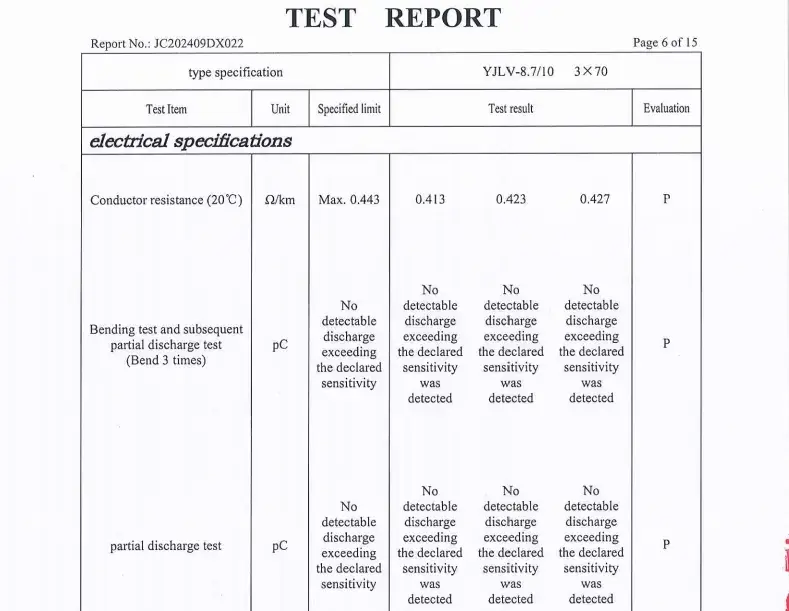
When reviewing an 11kV cable factory test report that shows a standard “PASS” status, always verify that the background noise and testing parameters align with mandatory standard limits. Under IEC 60502-2, the mandatory pass criterion is ≤ 10 pC at 1.73 U⊰.
» Need full raw digital PD waveform logs or drum-specific test data sheets for your project approval? Contact Huanghe Cable Engineering Team.
Send your project requirements to our engineering team for instant technical matching, standard compliance review, and direct factory quotation.
Procurement Verification Rule: Always require the factory to submit individual drum PD test logs corresponding to each drum number on your packing list. Never release payment or allow shipment for 11kV cables based solely on a generalized type-test certificate without drum-specific routine PD test records.
Before shipment, see How to Verify a Power Cable Test Certificate: 10 Checks Before Shipment for the document-review process.
A supplier’s test documentation becomes much more useful when it can be connected to the actual production batch and cable drums.
For a project order, the buyer should establish a clear connection between the purchase order, cable item, production record, test record and physical cable drum.
Useful identifiers can include:
Traceability is especially useful when an order contains several cable sizes, different voltage classes or multiple production lots.
The supplier’s datasheet should allow the buyer to verify the quoted construction before the purchase order is released.
At minimum, review the following technical information where applicable:
| Parameter | Why Procurement Should Check It |
|---|---|
| Overall diameter | Affects accessories, installation space and drum planning |
| Cable weight | Affects transportation, drum handling and logistics |
| Insulation thickness | Must correspond to the applicable cable standard and voltage class |
| Screen construction | Important for MV electrical performance and earthing arrangements |
| Armour | Must match mechanical and installation requirements |
| Minimum bending radius | Important for installation planning |
| Short-Circuit Rating (kA/1s) | Critical for confirming that both the conductor and metallic screen can safely withstand system fault currents without thermal degradation. |
A useful reference is How to Read an Armoured Power Cable Datasheet: 12 Specifications Procurement Engineers Should Verify.
Inspection requirements should be agreed before production or shipment, not introduced after the cable has already been manufactured.
Some projects require only manufacturer documentation, while others require customer witness, third-party inspection or a defined inspection and test plan. The correct level depends on the purchase order, project specification and owner requirements.
If third-party inspection is required, define the inspection scope clearly. Depending on the project, this may include:
Huanghe Cable states that third-party inspection by SGS or other inspection organisations can be supported according to project requirements. The inspection scope should be agreed in advance rather than assumed.
Supplier capacity is part of technical procurement because production scheduling, quantity and delivery configuration directly affect project execution.
An apparently suitable supplier may still be unsuitable for a project if the required quantity, cable sizes or delivery schedule cannot be accommodated.
Ask the supplier to confirm:
Do not treat a generic lead-time statement as a confirmed delivery commitment. Production timing should be confirmed against the actual order quantity and specification.
For the commercial factors affecting armoured cable pricing, see SWA Cable Price Guide 2026: Cost Per Metre, Price Factors & RFQ Checklist.
A lower 11kV cable price is meaningful only when the competing quotations represent the same technical and commercial scope.
Before comparing suppliers, put the quotations into the same structure.
| Comparison Item | Confirm |
|---|---|
| Cable construction | Same conductor, insulation, screen, armour and sheath |
| Voltage | Same U0/U and applicable system requirements |
| Quantity | Same total quantity and cable lengths |
| Testing | Same required test and inspection scope |
| Packaging | Same drum and protection requirements |
| Delivery basis | Same Incoterm and destination basis |
Huanghe’s existing guide How to Compare Power Cable Quotations provides a broader quotation-evaluation framework.
The required documentation should be agreed during supplier qualification and quotation, because missing project documents can delay technical approval even when the cable itself is acceptable.
Depending on the project, the documentation package may include:
The exact document package should be taken from the project specification, contract and inspection plan. Buyers should not assume that every 11kV cable project requires the same certificates.
A short supplier qualification checklist can prevent technical and commercial problems before the purchase order is released.
| No. | Supplier Qualification Check | Confirm |
|---|---|---|
| 1 | Complete 11kV cable construction confirmed (including water-blocking requirements for underground/wet installations) | ☐ |
| 2 | Voltage rating and standard confirmed | ☐ |
| 3 | MV screening construction verified | ☐ |
| 4 | Conductor material and cross-section confirmed | ☐ |
| 5 | Required test scope confirmed | ☐ |
| 6 | Production traceability confirmed | ☐ |
| 7 | Technical datasheet reviewed | ☐ |
| 8 | Inspection requirements agreed | ☐ |
| 9 | Production and delivery schedule confirmed | ☐ |
| 10 | Quotation compared on the same basis | ☐ |
| 11 | Project documentation confirmed | ☐ |
| 12 | Final technical and commercial deviations closed | ☐ |
Get the printable 12-point engineering scorecard used by EPC project managers to audit MV cable suppliers, verify test reports, and ensure compliance before PO release.
Instant delivery. No spam — purely technical reference material for EPC procurement.
Procurement decisions are easier to defend when the supplier comparison is based on traceable technical data rather than general marketing claims.
Use these verified standard references and technical data limits during project RFQ reviews and supplier technical evaluations:
| Data Point | Source / Standard | Applicable Scenario / Engineering Context |
|---|---|---|
| 6kV–30kV (Um = 7.2kV to 36kV) | IEC 60502-2:2014+AMD1:2024 | >Medium-voltage (MV) extruded-insulation power cable designs (including 6.35/11kV & 8.7/15kV) within standard scope. |
| 1kV and 3kV (Um = 1.2kV & 3.6kV) | IEC 60502-1:2021 | Low-voltage (LV) and 3kV light-MV power cable designs within standard scope. |
| 0.5–3,500 mm² | IEC 60228:2023 | Conductor nominal cross-section and resistance specifications (Common MV range: 25–800 mm²). |
| 2023 | IEC 60228 Edition | Current standard reference for conductor resistance and stranding compliance during RFQ review. |
| 2024 | IEC 60502-2 Amendment 1 | Latest technical amendment reference for MV cable insulation and factory testing specifications. |
| 2026 | IEC Corrigendum Record | Latest updated consolidated IEC 60502-2 publication check for international project compliance. |
Standards and technical data points should always be verified against the specific project grid requirements and the manufacturer’s verified test reports. IEC 60502-1:2021 governs low-voltage cables rated at 1kV and 3kV (Um = 1.2kV and 3.6kV), while IEC 60502-2:2014+AMD1:2024 explicitly covers medium-voltage cables rated from 6kV up to 30kV (Um = 7.2kV to 36kV). Always ensure factory testing aligns with the governing system voltage class (U₀/U).
To ensure your 11kV medium-voltage cable project meets both technical specifications and strict delivery timelines, our manufacturing background provides verified project capabilities:
Already have an 11kV BOQ, cable schedule or tender specification? Send the document with your inquiry so the supplier can review the required voltage, conductor, screen, armour, sheath, testing and quantity against the same technical basis.

For a more detailed selection process, see How to Select the Right 11kV XLPE Cable: 9 Checks to Make Before You Place an Order.
For project procurement, Huanghe Cable focuses on supplying the specified cable construction against the applicable standard and agreed inspection requirements.
Huanghe Cable has manufactured power cables since 1980 and supplies low- and medium-voltage power cables for industrial, infrastructure, energy and distribution applications. The company describes its background as developing from a state-owned enterprise before restructuring.
The Huanghe XLPE power cable range includes copper and aluminium conductor constructions, armoured and unarmoured options, and cable designs covering 0.6/1kV to 35kV according to the product information.
For project procurement, the practical approach is to provide the actual technical requirement rather than asking only for an 11kV cable price. Huanghe can review the required conductor material and size, voltage designation, screen construction, armour, sheath, quantity, testing requirements and delivery destination before preparing a quotation.
The company also states that its cable manufacturing is supported by IEC/CB-related certification and testing experience, together with CCC and ISO qualifications, while third-party inspection can be discussed according to project requirements.
If the project requires a customized construction, provide the project datasheet or cable schedule so the technical team can confirm whether the requested construction can be manufactured and quoted on the required basis.
Include these details whenever they are available:
Send your BOQ, cable schedule, datasheet or project specification. Providing the technical basis allows the quotation to be prepared against the required cable construction rather than assumptions.
First confirm that the supplier can manufacture the exact cable construction required by the project. Check the voltage rating, conductor, insulation, screen, armour, sheath, applicable standard and testing requirements before comparing commercial offers.
IEC 60502-2 is an important international standard for MV extruded-insulation power cables within its scope. IEC 60502-2:2014+AMD1:2024 covers cables from 6 kV up to 30 kV within its scope, but the project may also specify national, utility or customer requirements.
The conductor material should be selected from the project electrical design and procurement specification rather than supplier preference. Copper and aluminium affect resistance, weight, dimensions, termination requirements and cable cost, so any alternative should be evaluated as a separate technical option.
The required documents depend on the project specification and inspection plan. Typical project documentation may include the technical datasheet, applicable standard reference, routine test records, type-test documentation where required, inspection records, packing documents and other contractually required certificates.
A type-test report should not automatically be treated as production evidence for every shipment. Type tests and production-level routine tests serve different purposes, so the required documentation should be determined by the applicable standard and project requirements.
Third-party inspection should be based on the project contract, owner requirements and agreed inspection plan. If required, define the inspection scope before production or shipment so the supplier and inspector work to the same checklist.
Compare them only after confirming that both suppliers are quoting the same technical and commercial basis. Check voltage, conductor, screen, armour, sheath, quantity, testing, packaging, Incoterm and delivery conditions before comparing price.
The datasheet converts a general product name into a specific technical construction. It allows the buyer to verify conductor size, insulation, screen, armour, sheath, dimensions and other parameters before the order is released.
Send the BOQ, cable schedule or technical specification whenever possible. At minimum, include voltage rating, conductor material and size, number of cores, insulation, screen, armour, sheath, quantity, applicable standard, testing requirements and destination.
Customized cable constructions can be considered when the required design is technically manufacturable and clearly specified. Provide the project drawing, datasheet or written construction requirements so the manufacturer can confirm the proposed design before quotation and production.

Please contact us for a free quotation by the below form. We promise the quickest response within 12 hours.