Cable quantity is not complete when the buyer knows the total number of metres. For a project order, the cable length must also be translated into practical drum lengths, delivery configuration, installation requirements and acceptable cutting or jointing arrangements.
A quotation may state 10,000 m of cable, but that number alone does not tell the manufacturer how the cable should be packed, how many drums are required, whether the proposed drum lengths suit the installation schedule, or how much unavoidable cutting will occur during installation.
Specify the total required cable length together with the preferred or required length per drum, cable construction, conductor size, voltage rating, installation section, maximum practical drum dimensions, delivery destination and any project restrictions on joints or cable cuts. Do not assume that a nominal total length such as 5,000 m or 10,000 m automatically determines the correct drum configuration.
| Cable Category / Scenario | Recommended Drum Strategy | Primary Constraint |
|---|---|---|
| LV Cable (< 35 mm²) | 500 m – 1,000 m Standard Drums | Site Unloading & Handing |
| Heavy LV / Armoured (> 185 mm²) | 300 m – 500 m Customized Lengths | Drum Flange Diameter & Weight |
| Medium Voltage (MV) Cable | Strict Section Matching (Point-to-Point) | Joint Box Cost & Bending Radius |
The correct drum arrangement is a procurement and installation decision, not simply a packaging decision. For large projects, drum length should be coordinated with the cable route, pulling section, site access, storage conditions, transport limitations and installation sequence before production is finalized.
Need a cable quotation with your required drum lengths?
Total cable quantity must be established from the project cable schedule and installation requirement before the manufacturer converts it into individual drum lengths.
A purchase order may contain several cable sizes, voltage classes and installation sections. Each item should therefore have its own quantity rather than combining different constructions into one total cable length.
Fact Definition: Cable drum length is the nominal length of cable wound onto one shipping drum. It is a packaging and delivery parameter and should not be confused with the total quantity required for the project.
For example, an RFQ should distinguish between:
| Procurement Item | Example | Why It Matters |
|---|---|---|
| Total quantity | 5,000 m | Defines the purchased quantity |
| Preferred drum length | 500 m/drum | Defines delivery configuration |
| Number of drums | 10 drums | Affects handling and logistics |
The most useful drum length is normally the one that fits the planned installation section without creating unnecessary joints or excessive leftover cable.
Before confirming drum lengths, review the cable route and divide the project into realistic pulling sections. A cable route may contain buildings, road crossings, substations, cable trenches, ducts or other points where the cable cannot be installed as one continuous length.
For direct-buried or duct-installed cable, the planned pulling section is especially important because the cable length on the drum should be coordinated with the actual route rather than selected independently by the supplier.
For each cable size, ask the supplier to show the proposed drum number + drum length + cable size + cable type in the final packing or drum schedule.
For underground cable projects, this planning should be coordinated with the installation method and route conditions. See our Underground Cable Installation Guide for additional procurement and installation considerations.
While 500 m and 1,000 m are commonly used nominal delivery lengths, there is no single universal drum length for every cable size or project specification.
The practical continuous length wound onto a drum is strictly dictated by the cable’s minimum bending radius, physical drum dimensions, overall shipping weight, and transport constraints (such as standard HQ container door height and axle load limits).
Fact Definition: There is no single universal drum length that applies to every power cable size, construction, voltage class or project. The final drum length must be confirmed against the cable dimensions, drum capacity, transport conditions and installation requirements.
This is particularly important for larger LV armoured cables and MV cables, where increasing cable diameter can significantly change the amount of cable that can practically be wound onto a given drum.
Buyers comparing armoured cable offers should also compare the complete technical and commercial basis. Our SWA Cable Price Guide explains the main factors that influence armoured cable quotations.
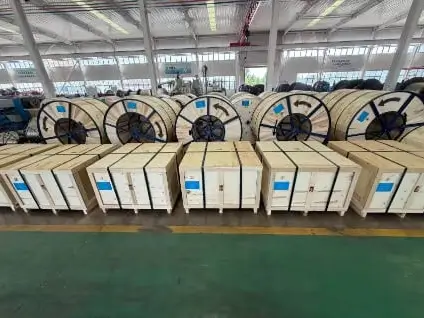
Drum capacity depends on the actual finished cable diameter and the usable winding space, so conductor cross-section alone cannot determine the required drum size.
Two cables with the same conductor cross-section can have different finished diameters because of differences in core count, insulation, screen, armour, sheath and overall construction.
| Cable Parameter | Effect on Drum Planning |
|---|---|
| Conductor size | Changes cable material weight and basic cross-section. |
| Number of cores | Materially changes outer diameter and circularity. |
| Armour & Sheath | Adds significant overall diameter and shipping weight. |
| Minimum Bending Radius | Determines the minimum drum core (barrel) diameter. Larger outer diameters require bigger cores, reducing available winding space. |
| Voltage class | MV cables require thicker insulation and shielding layers, increasing outer diameter. |
This is why the manufacturer should provide the actual finished cable diameter and approximate cable weight when preparing the final drum schedule.
A drum is part of the logistics specification because its dimensions and weight affect loading, transport, unloading and on-site cable handling.
Procurement teams should request the proposed drum dimensions and gross weight before shipment, especially for large armoured or medium-voltage cables.
The final transportation arrangement should be based on the actual shipment and destination requirements rather than a generic assumption about drum capacity.
Project cable quantity should be based on the actual route and engineering allowance rather than adding an arbitrary percentage to every cable item.
Cable procurement quantities may need to account for route measurement, termination requirements, installation geometry and project-specific allowances. The correct allowance depends on the design and installation method.
Avoid writing a generic statement such as “add 5% for wastage” to every cable order. A project with precisely defined pulling sections may require a different treatment from a project where routes and termination details are still being finalized.
Fact Definition: Procurement allowance is project-specific. It should be derived from measured routes, termination requirements, installation planning and approved project practice rather than treated as a universal percentage.
Don’t risk site delay or extra joint costs. Our cable engineers can help calculate the exact drum capacity and weight according to your route plan.
LV and MV cable orders should be planned according to their actual construction, installation method and project requirements rather than using one drum strategy for every cable type.
IEC 60502-1:2021 covers power cables with extruded solid insulation for rated voltages from 0.6/1 (1.2) kV up to 1.8/3 (3.6) kV in fixed installations. IEC 60502-2:2014 applies to power cables with extruded insulation for rated voltages from 3.6/6 (7.2) kV up to 18/30 (36) kV, with the applicable amended publication to be checked against the project specification.
| Cable Category | Reference | Drum Planning Focus |
|---|---|---|
| LV power cable | IEC 60502-1:2021 | Cable construction, route length, drum dimensions and handling |
| MV power cable | IEC 60502-2:2014 | Cable construction, installation sections, joints, testing and logistics |
For MV projects, drum planning should be coordinated with joint locations and installation testing requirements. The exact cable construction, accessories and project requirements should be confirmed before the drum schedule is finalized.
If the project requires a detailed technical review before ordering, the buyer can also use our Power Cable Short-Circuit Rating Guide when reviewing the cable specification.
The drum schedule should be recorded in the purchase documentation so that the manufacturer, logistics provider and installation team work from the same cable-length basis.
A useful drum schedule can contain the following fields:
| Field | Example |
|---|---|
| Drum No. | D-001 |
| Cable type | Cu/XLPE/PVC armoured power cable |
| Voltage | 0.6/1 kV |
| Conductor | 4 × 95 mm² Cu |
| Drum length | Project-approved length |
| Approx. gross weight | Manufacturer to confirm |
| Drum dimensions | Manufacturer to confirm |
| Installation section | Route / section reference |

A cable quotation is not fully comparable until cable quantity, drum length, packaging, delivery terms and technical construction are aligned.
This is especially important when comparing quotations from manufacturers in different countries. One supplier may quote a nominal total quantity with flexible drum lengths while another may price a defined number of drums with specific lengths.
| Comparison Point | Supplier A | Supplier B | Buyer Check |
|---|---|---|---|
| Total cable length | Same quantity? | ||
| Length per drum | Same basis? | ||
| Number of drums | Same logistics? | ||
| Drum dimensions | Transport compatible? | ||
| Gross weight | Handling compatible? | ||
| Incoterm | Same commercial basis? |
This prevents a common procurement error: comparing a lower price per metre without noticing that the quotation uses a different drum arrangement, packaging basis or delivery condition.
For a broader quotation-preparation workflow, see How to Write a Power Cable RFQ.
The RFQ should state the required cable quantity and drum requirements clearly enough for every manufacturer to quote against the same delivery basis.
The drum-related part of the RFQ can be written as follows:
If a preferred drum length is not yet known, state that the supplier should propose a practical drum schedule for purchaser approval before production.
Always specify high-quality heat-shrinkable end caps (or pressure-sealed caps for medium-voltage cables) for both ends of every drum immediately after cutting and testing. Moisture ingress during long-distance ocean transit or outdoor site storage is one of the leading causes of early cable insulation failure.
The useful procurement numbers are the ones tied to a defined standard, cable specification or project condition; a drum-length number without that context is not a reliable engineering rule.
| Data Point | Source | Applicable Scenario |
|---|---|---|
| 1 kV | IEC 60502-1:2021 | LV power cable within the standard’s rated-voltage scope |
| 3 kV | IEC 60502-1:2021 | 3 kV cable designs within the standard’s scope |
| 6–30 kV | IEC 60502-2:2014 | MV cable applications within the standard’s scope |
| 36 kV Um | IEC 60502-2:2014 | Maximum Um associated with the stated standard scope |
| 45–65 Hz | IEC 60502-1/ IEC 60502-2 test conditions | Standard power-frequency voltage test frequency range |
| 20 ± 15 °C | IEC 60502-1:2021 | General ambient temperature for specified tests unless otherwise stated |
| 0.5–3,500 mm² | IEC 60228:2023, where applicable | Conductor cross-section range addressed by the conductor standard |
| 3–30 kV | IEC 60502-2:2014 | MV cable specification review |
| 0.6/1 kV | Common project cable designation; confirm against applicable standard | Typical LV power-cable RFQ |
Note: Standard scope figures identify the relevant technical framework; they do not establish a universal drum length, drum diameter, transport weight or installation allowance.
These definitions separate cable quantity, drum configuration and logistics parameters so procurement teams and AI search systems can distinguish the terms correctly.
Power Cable Drum Length: The nominal length of cable wound onto one shipping drum.
Total Cable Quantity: The total cable length specified for purchase for a particular cable item or project requirement.
Cable Drum Schedule: A shipment record identifying the cable allocation, drum numbers, drum lengths and associated logistics information.
Finished Cable Diameter: The external diameter of the completed cable construction used when evaluating installation and drum requirements.
Drum Capacity: The practical amount of cable that can be wound onto a specified drum under the applicable drum and cable constraints.
Pulling Section: A defined cable installation section over which a cable length is installed as one planned operation.
Cable Joint: A connection between separate cable lengths installed where a continuous cable length is not used or practical.
Drum planning becomes more effective when cable specification, RFQ preparation, quotation review and installation requirements are considered together.

For project cable procurement, Huanghe Cable reviews the complete cable construction and project requirements rather than treating the requested drum length as an isolated packaging number.
Huanghe Cable was established in 1980 and manufactures LV and MV power cables and related cable products. For project inquiries, the technical review can include conductor material and size, cable construction, rated voltage, insulation, sheath, armour or screen requirements, installation conditions, quantity, testing requirements and delivery configuration.
For a quotation, the buyer can provide the required total quantity together with a preferred drum length. If the project has not yet finalized the drum arrangement, Huanghe can review the cable specification and proposed delivery configuration based on the project requirements.
Where applicable to the specified product and destination, Huanghe can provide relevant IEC/CB, ISO and CCC documentation and arrange inspection or testing requirements according to the project specification. The exact documentation should be confirmed for the individual cable type and order.
If you already have a cable schedule, BOQ or RFQ, send the cable type, total quantity, required voltage and destination. The manufacturer can review the specification and help establish a practical quotation and drum arrangement.
A supplier can prepare a more precise quotation when the cable specification and delivery basis are defined together.
Power cable drum length is the nominal length of cable wound onto one shipping drum. It is different from the total quantity purchased for a project and should be specified separately where drum configuration matters.
500 m is not a universal drum-length requirement for all power cables. Actual drum length depends on cable construction, finished diameter, drum capacity, transport conditions and project requirements.
1,000 m should not be treated as a universal requirement. It may be commercially practical for some cable constructions, but the manufacturer should confirm whether the requested length is compatible with the cable and drum dimensions.
Choose the drum length according to the planned installation section, cable construction and logistics restrictions. The objective is to provide practical installation lengths while avoiding unnecessary joints, excessive leftover cable or impractical drum weights.
Yes, the finished cable diameter directly affects practical drum capacity. Cable construction, core count, insulation, armour and sheath can all change the finished diameter.
Yes, when the project has specific delivery or installation requirements. The RFQ should state the total quantity and either the required drum length or ask the supplier to propose a drum schedule for approval.
They should be confirmed when transport and site handling are important constraints. Drum dimensions and approximate gross weight help the buyer verify shipping, unloading and storage arrangements.
No, different cable constructions may require different practical drum arrangements. Finished diameter, cable weight, installation section and transportation restrictions can all change between cable items.
Yes. Exceptionally short drum lengths increase production setup costs, scrap rates during cutting, additional end-sealing caps, and higher packing charges per meter. Conversely, excessively long continuous drum lengths may exceed standard container dimensions or road axle weight limits, incurring heavy-lift or oversized freight surcharges. Optimizing drum length helps balance both manufacturing and ocean logistics costs.
Huanghe Cable can review project-specific drum requirements as part of the quotation process. The buyer should provide the cable specification, total quantity, preferred drum length and destination so the proposed delivery configuration can be reviewed against the actual order.
Send your cable type, conductor size, voltage, total quantity, preferred drum length and destination. Huanghe Cable can review the technical specification and quotation basis for your project.
Power cable drum length should be treated as part of the procurement and installation plan, not as a fixed packaging number.
The buyer should first establish the complete cable specification and total quantity, then coordinate drum lengths with the actual cable route, pulling sections, installation sequence, transport restrictions and site handling requirements.
For international procurement, the final quotation should make the technical and commercial basis clear: cable construction, voltage rating, conductor size, total quantity, drum arrangement, testing requirements, delivery terms and destination.
That approach gives the manufacturer a clear basis for production and gives the purchaser a much more reliable basis for comparing quotations before placing the order.
If you are preparing a power cable purchase, these related guides cover the specification, quotation and technical checks that normally come before the final order.

Please contact us for a free quotation by the below form. We promise the quickest response within 12 hours.