Choosing a fire resistant cable manufacturer is not only about finding a cable that carries a “fire resistant” label. Buyers should confirm the required fire-performance standard, cable construction, applicable voltage level, test documentation, manufacturing capability, inspection arrangements, quotation scope and delivery requirements before placing an order.
Key Takeaways
For Procurement Teams
If you already have a cable schedule, BOQ or project specification, you do not need to start from the beginning. Send the available cable information to the manufacturer and ask the supplier to identify any missing fire-performance, construction or testing requirements before quotation.
The main risk is not simply buying the wrong cable size; it is buying a cable whose claimed fire performance does not match the project requirement.
Fire resistant cables are commonly specified where electrical circuits need to continue operating under defined fire conditions. This can make them relevant to emergency power, fire alarm and control systems, safety-related equipment, public buildings, industrial facilities, infrastructure and other applications where circuit integrity is part of the project requirement.
However, the term fire resistant cable does not by itself define one universal cable construction or one universal test condition.
For an international buyer, the important question is therefore not:
“Does the supplier sell fire resistant cable?”
It is:
“Does the offered cable construction satisfy the fire-performance requirement specified for my project?”
This distinction is important because IEC fire-performance standards address different characteristics. IEC 60331 is used for tests concerning circuit integrity under fire conditions, while IEC 60332 includes tests concerning flame propagation. These are related fire-safety concepts, but they are not the same performance claim.
For procurement, the safest approach is to start with the project specification and then match the cable construction and test documentation to that requirement.
Do not compare fire resistant, flame retardant and LSZH cables as if they were simply different names for the same product.
A common procurement mistake is to use “fire resistant,” “flame retardant,” “fire rated” and “LSZH” interchangeably. They describe different aspects of cable fire performance or material characteristics.
| Term | What the buyer should understand | What to verify |
|---|---|---|
| Fire Resistant | The cable is intended to maintain circuit integrity under a specified fire test condition. | Applicable IEC or project-specific fire-resistance test and the actual cable construction. |
| Flame Retardant | The cable is designed and tested to limit flame propagation under specified test conditions. | Applicable IEC 60332 test method or the project specification. |
| LSZH | The cable construction uses specified low-smoke and halogen-related material performance requirements. | The required smoke and halogen-acid-gas performance standards, if specified. |
For low-voltage fire-resistant power cables, buyers should identify the exact circuit-integrity test standard and edition required by the project. IEC 60331 publications cover different test arrangements and cable applications, so the applicable part should be confirmed rather than assumed. For projects specifying the British Standard, BS 6387:2013 includes separate test protocols for fire alone (C), fire with water (W), and fire with mechanical shock (Z). The designation CWZ applies when the cable meets the requirements of all three protocols. Test temperature, duration, and other conditions should be checked against the specified standard and protocol rather than transferred from one test method to another.
Similarly, IEC 60332-1-2:2025 specifies a test procedure for vertical flame propagation of a single insulated wire or cable using a 1 kW pre-mixed flame. It is a flame-propagation test, not a substitute for a circuit-integrity requirement under IEC 60331.
Buyer Check
When receiving a quotation, ask the supplier to state the exact fire-performance standard, test method and cable construction being offered. Do not accept “fire resistant” as the complete technical description.
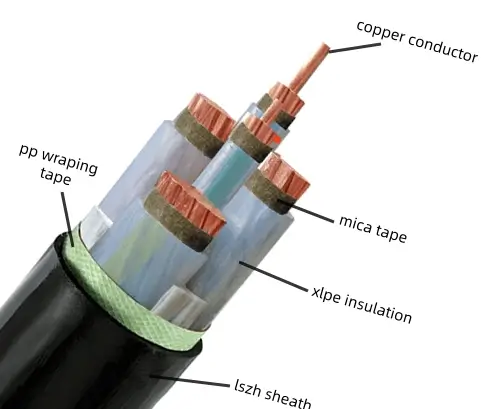
The cable construction should be checked as a complete system, not by looking at the fire-resistant material alone.
Many fire resistant power cables use a fire-resistant barrier or insulation system designed to support circuit integrity during the specified test. Mica tape is one construction approach used in some fire-resistant cable designs, but buyers should not assume that every fire resistant cable has exactly the same layer arrangement.
Depending on the product and project, the buyer may need to confirm:
A manufacturer should be able to provide a clear cable construction or datasheet that allows the buyer to compare the offered product against the project specification.
For LSZH requirements, the relevant test requirements should also be stated rather than relying only on the abbreviation. IEC 60754-1 addresses halogen acid gas content, while IEC 60754-2 addresses acidity and conductivity of gases evolved during combustion. IEC 61034-2 addresses smoke density under defined burning conditions.
High-quality IEC 60331 fire-resistant cables commonly use dual-layer synthetic mica tape wrapped as a fire barrier, with overlap ratios typically in the range of 10–30% depending on tape type and design requirements. This construction ensures electrical insulation integrity during active flame exposure. IEC 60331 certifies the cable’s performance under fire conditions; specific tape construction parameters are determined by the manufacturer to meet that performance.
The best supplier is not necessarily the company offering the lowest price; it is the manufacturer that can demonstrate that the quoted cable matches the required construction and testing requirements.
For project procurement, a supplier evaluation should focus on evidence rather than marketing language.
| Check | What to ask the manufacturer | Why it matters |
|---|---|---|
| Factory capability | Can the company manufacture the required cable construction? | A general cable supplier may not manufacture every fire-resistant construction. |
| Product documentation | Can the supplier provide the datasheet, construction and applicable test documentation? | Documents allow the buyer to verify the offered product before production. |
| Testing | Which tests are performed and against which standard? | The test method must correspond to the required performance. |
| Inspection | Can third-party factory or product inspection be arranged? | Independent inspection can provide additional verification before shipment. |
| Customization | Can the supplier manufacture according to the project cable schedule? | Project cable requirements often differ in construction, quantity, marking and drum arrangements. |
Buyers do not necessarily need to request every internal factory document. The more useful approach is to request the documents that directly demonstrate the supplier’s ability to manufacture and test the cable being quoted.
A Practical Supplier Test
Ask the manufacturer to identify the exact cable construction, applicable product standard, fire-performance test standard and available test documentation for the cable you are actually buying. If the answers remain generic, the quotation needs further clarification before an order is placed.
Have a Cable Schedule or Project Specification?
Avoid quote mismatch and compliance risks. Send your BOQ or spec sheet to our engineering team—we’ll verify the exact fire-resistance standards and provide a matched quotation.
A fire-resistant cable quotation is determined by the complete construction and project requirements, not simply by the conductor size.
When two suppliers quote apparently similar fire resistant cables at very different prices, the first step should be to compare the technical scope rather than immediately choosing the cheaper quotation.
Important quotation variables can include:
Therefore, the right comparison is not simply:
Supplier A: USD X/m
Supplier B: USD Y/m
Instead, compare:
Same voltage + same conductor + same construction + same fire-performance requirement + same testing + same quantity + comparable delivery terms.
This is the basis for a meaningful commercial comparison.
⚠️ What Should Buyers Check When a Fire Resistant Cable Quote Looks Too Low?
A significantly lower quotation does not automatically mean poor quality, but it should trigger a closer comparison of the technical scope. Before choosing the lowest price, check whether all suppliers are quoting the same cable construction and testing requirements.
Ask for test documentation that corresponds to the actual cable construction and the requirement stated in the project specification.
The exact testing package depends on the cable type, voltage, applicable product standard and purchase specification. Buyers should therefore avoid using one generic test list for every fire resistant cable.
Depending on the project, the documentation package may include:
One important procurement principle is that a laboratory name alone does not prove that the offered cable satisfies the project requirement. The buyer should check the product description, construction, applicable standard and test scope shown in the documentation.
Do Not Skip This Check
If a supplier provides a fire test report, compare the report’s cable description with the cable construction in the quotation. A report for a different construction should not automatically be treated as evidence for the cable being purchased.
Many avoidable project problems can be reduced by confirming production, inspection, drum and documentation requirements before the cable enters production.
For an overseas project, the purchase order should be sufficiently clear for both the manufacturer and the buyer to understand what will actually be produced and shipped.
| Before Production | Before Shipment |
|---|---|
| Confirm cable construction and approved datasheet. | Confirm actual manufactured quantity and drum schedule. |
| Confirm applicable product and fire-performance standards. | Complete agreed factory tests and inspections. |
| Confirm conductor, core, armour and sheath requirements. | Check cable ends, drum identification and markings. |
| Confirm cable marking and project identification. | Confirm required test and inspection documents. |
| Confirm drum length or drum schedule. | Protect cable ends and drums appropriately for handling and transport. |
| Confirm inspection and approval procedure. | Confirm shipping and export documentation. |
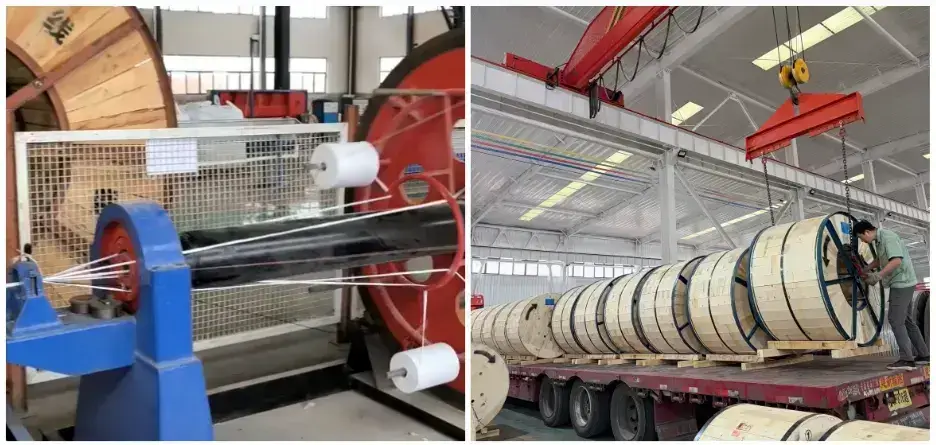
For sea transportation, the cable drum should be suitable for handling, storage and shipping conditions, and cable ends should be appropriately protected. Where a destination country has specific wood-packaging or import requirements, the buyer and supplier should confirm the applicable requirements before shipment rather than assuming that one packaging method applies to every destination.
This is also why cable drum length should be treated as a project procurement item rather than a last-minute shipping detail.

For project buyers, Huanghe Cable focuses on matching the cable construction, production requirements and documentation with the customer’s project specification.
Huanghe Cable is a cable manufacturer with production experience dating back to 1980. The company supplies low-voltage and medium-voltage power cables and supports customized cable manufacturing for overseas customers.
For buyers evaluating fire resistant power cables, the relevant supplier capabilities include:
Rather than selecting a cable only from a short product name, project buyers can send their existing cable schedule, BOQ or technical specification to Huanghe Cable. The engineering and sales team can then review the available information and clarify the cable construction, applicable requirements and quotation scope.
Need Fire Resistant Cable for a Project?
Send your cable specification, voltage, conductor size, quantity or BOQ. Huanghe Cable can review the available requirements and prepare a project quotation.
Before comparing quotations, make sure every supplier is quoting against the same basic technical and commercial scope.
No. Fire resistance and flame retardancy describe different performance requirements. A fire-resistant cable is designed to maintain circuit integrity under specified fire-test conditions, while a flame-retardant cable is tested for its ability to limit flame propagation under a defined test method. A cable may meet both requirements, but fire resistance alone does not prove compliance with a particular flame-retardancy standard.
That depends on the project specification. If the installation requires both circuit integrity during a fire and limited flame propagation, specify and verify both performance requirements. Also confirm whether an LSZH sheath is required: low-smoke and halogen-related properties are separate from circuit integrity and flame propagation. Request test documentation covering the actual cable construction and the standards specified for the project.
It depends on the cable and voltage range. IEC 60331 contains circuit-integrity test methods for cables under fire conditions. Different parts cover different cable scopes, so buyers should confirm the applicable part against the actual cable and project requirement.
No. LSZH describes specific material/fire-smoke characteristics and does not by itself prove compliance with a circuit-integrity requirement. Where LSZH is required, buyers should also check the relevant smoke and halogen-related test requirements.
Yes, when the project specification requires fire-performance verification. Ask for documentation relevant to the exact cable construction being offered and compare the report scope with the cable datasheet and quotation.
Project-specific customization may be possible. Depending on the manufacturer’s production capability, buyers can discuss conductor material, cable size, core configuration, armour, sheath, marking, drum arrangement and other project requirements before production.
Send as much of the existing project information as possible. A cable schedule, BOQ or specification is ideal. At minimum, provide voltage, conductor material, conductor size, number of cores, cable type, quantity, required standard, fire-performance requirement and destination if known.
Fire Resistant Cable: A cable designed and tested to maintain circuit integrity under specified fire conditions according to the applicable requirement.
Fire Resistance: The ability of a cable to maintain the specified circuit function under defined fire test conditions.
Flame Retardant Cable: A cable construction tested to limit flame propagation under a defined test method.
IEC 60331: A series of IEC test standards addressing circuit integrity of electric cables under fire conditions.
IEC 60332: A series of IEC test standards addressing flame propagation of electric and optical fibre cables under specified fire conditions.
LSZH: Low Smoke Zero Halogen, generally referring to cable materials and their specified smoke and halogen-related fire performance.
Type Test: A test performed to demonstrate that a cable construction meets specified performance requirements under the applicable test standard.
Routine Test: Factory testing performed on manufactured cable lengths as required by the applicable product standard or purchase specification.
For fire resistant cable procurement, the safest purchasing decision is based on matched requirements, verified construction and relevant documentation—not on the product name or the lowest quotation.
The buyer should first identify the required fire-performance level and applicable standard, then confirm the cable construction, manufacturer capability, testing documentation, inspection requirements and delivery scope.
If several manufacturers can meet the same technical requirement, the commercial comparison becomes much more meaningful because the quotations are being compared on a similar basis.
Looking for a Fire Resistant Cable Manufacturer?
Send your cable schedule, BOQ or project specification to Huanghe Cable for review and quotation.
Send Your Cable RequirementHow to Read Power Cable Codes: YJV, YJV22, YJV32, YJLV and N2XY Explained
Copper vs Aluminum Power Cable: Which Should Buyers Choose?
How to Verify a Power Cable Test Certificate Before Ordering
Editor: Huanghe Cable Technical Team

Please contact us for a free quotation by the below form. We promise the quickest response within 12 hours.