If you already know that your project requires 11kV cable, one of the first purchasing questions is usually simple: how much will it cost? The answer depends on more than the 11kV voltage rating. Conductor material and size, cable construction, quantity, raw-material prices, delivery requirements and other project conditions can all affect the final price.
The FOB price for 11kV MV XLPE cables from China generally ranges from $8.00 to $120.00+ per meter, depending on specification:
Note: Final project pricing depends on live London Metal Exchange (LME) copper/aluminium rates, core configuration (1C vs. 3C), and armouring choice (AWA/SWA).
Note: The prices below are estimated benchmark ranges for reference based on standard IEC 60502-2 specifications. Final project pricing is determined by daily LME copper/aluminium market rates, exact order quantities, and delivery terms.
| Cable Specification | Voltage Rating & Standard | Conductor & Armour | Est. FOB Price (USD/m) | Primary Application |
|---|---|---|---|---|
| 3C x 70mm² XLPE | 6/10kV (IEC 60502-2) | Aluminium / STA or SWA | $12.50 – $18.00 | Underground direct burial feeder lines |
| 3C x 240mm² XLPE | 8.7/15kV (BS 6622) | Copper / Steel Wire (SWA) | $55.00 – $75.00 | Main power distribution networks |
| 3C x 300mm² XLPE | 8.7/15kV (IEC 60502-2) | Copper / Aluminium Wire (AWA) | $28.00 – $38.00 | Substation switchgear & high-ampacity runs |
| 1C x 500mm² XLPE | 6/10kV (IEC 60502-2) | Copper / Unarmoured or AWA | $45.00 – $60.00 | Substation interconnects & power plants |
The voltage rating alone is not enough to determine the price of an 11kV cable.
When buyers search for 11kV cable price, they may expect to find a simple price per metre. In practice, manufacturers need more information before they can provide a meaningful quotation.
For example, an 11kV cable may use copper or aluminium conductors, different conductor cross-sectional areas, single-core or three-core construction, different armour arrangements and different sheath requirements. The quantity and delivery destination also affect the commercial offer.
This is why a price found online should normally be treated as a general reference rather than a final project price.
Procurement definition: The usable price of an 11kV cable is the price for a clearly defined cable specification, quantity and commercial delivery basis—not simply a generic price attached to the term “11kV cable.”
Most 11kV cable price differences can be traced back to materials, cable construction, quantity and commercial conditions.
| Price Factor | Specification Variants | Cost & Technical Impact |
|---|---|---|
| Conductor material & Class | Copper (Cu) vs. Aluminium (Al); Class 2 Stranded | Copper offers higher conductivity but at a higher raw material cost; Aluminium provides a cost-effective alternative for long-run installations. |
| Conductor Cross-Sectional Area | e.g., 35mm² to 630mm² (up to 800mm² for single-core construction) | Larger conductor size directly increases metal weight (kg/km) and total production costs. |
| Core Configuration & Screening | Single-core vs. Three-core; Semi-conducting & Copper Tape/Wire Screen | 11kV cables require insulation screening systems. Three-core designs consume more insulation and filling materials than three separate single cores. |
| Armour Type (AWA / SWA / STA) | AWA for single-core; SWA/STA for three-core; or Unarmoured | Single-core 11kV cables require non-magnetic AWA (Aluminum Wire Armour) to prevent eddy current losses, while three-core cables typically use SWA or STA for mechanical protection. |
| Sheathing & Compound Type | PVC, PE, or Low Smoke Zero Halogen (LSZH / FR-LSZH) | Special outer sheath requirements (e.g., UV resistance, anti-termite, water-blocking tape, or LSZH flame retardancy) add performance compound costs. |
| Order quantity | Total metres and product variations | Production and packing arrangements can differ between orders. |
| Applicable Standards & Testing | IEC 60502-2, BS 6622, BS 7835, or custom utility specs | Third-party type testing (e.g., KEMA/CESI) or routine factory acceptance tests (FAT) affect the unit commercial offer. |

For the same general cable application, conductor material can create a substantial difference in the cable quotation.
Copper and aluminium are both widely used conductor materials for power cables. Their different material costs mean that changing from one conductor material to another can significantly affect the cable quotation.
The difference becomes more commercially relevant for large project quantities or larger conductor sizes because the amount of conductor material used in the order also increases.
| Conductor Choice | Price Consideration | What to Confirm |
|---|---|---|
| Copper | Quotation is influenced by copper material cost. | Conductor size and quotation date. |
| Aluminium | Quotation is influenced by aluminium material cost. | Conductor size and quotation date. |
Because copper and aluminium are traded globally, their market prices change over time. The London Metal Exchange publishes official prices for copper and aluminium that are used as reference prices in the global metals market.
For this reason, a cable quotation should be considered together with its quotation date and validity period rather than treated as a permanent market price.
A larger conductor normally means more conductor material and therefore a higher cable cost.
Buyers who already have an approved cable size do not need to recalculate the cable design simply to estimate the price. For purchasing purposes, the important point is that different conductor sizes represent different material requirements.
For example, quotations for 11kV XLPE cables with different conductor cross-sectional areas should not be compared as if they were the same product simply because both are described as “11kV cable.”
| Specification Difference | Why the Price Changes |
|---|---|
| Smaller conductor | Lower conductor material requirement. |
| Larger conductor | Higher conductor material requirement. |
| Different conductor material | Different material cost basis. |
The cable construction directly dictates manufacturing complexity and material consumption, making structural design one of the most critical factors in any commercial quotation.
When evaluating 11kV MV XLPE cable pricing (rated 6/10kV or 8.7/15kV according to IEC 60502-2), understanding the technical differences between core configurations and armouring types is essential, as each structural variation carries distinct material and manufacturing cost impacts:
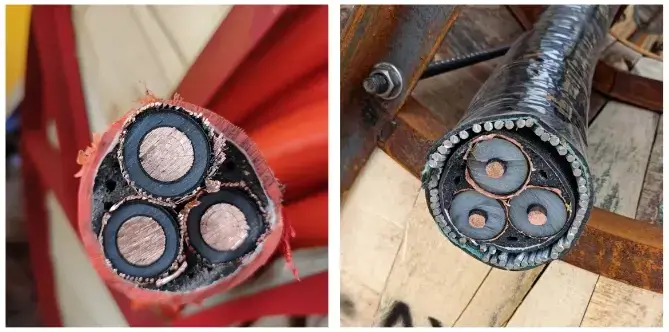
Single-core and three-core 11kV MV XLPE cables (rated 6/10kV or 8.7/15kV) differ substantially in manufacturing steps, material lay-up, conductor compaction, and field installation:
Procurement Note: A single-core price per metre cannot be directly tripled or compared to a three-core cable price due to differences in non-magnetic armour materials and extrusion passes.
Underground direct-burial applications require metallic armour for protection against mechanical stress and ground movement:
Beyond standard ST2 PVC or PE outer jackets, special utility specifications—such as Low Smoke Zero Halogen (LSZH / FR-LSZH) compounds, UV/oil resistance, anti-termite/anti-rodent additives, or longitudinal water-blocking tapes—require specialized extruding compounds that directly influence the unit quotation. Learn more about our technical compliance on our company qualifications page.
Skip generic pricing estimates. Send your technical datasheet, required drum lengths, and delivery port to Huanghe Cable Group for an exact factory offer.
The quantity and product mix of an order can affect production planning, purchasing and packing arrangements.
A project requiring a large quantity of one cable specification is commercially different from a smaller order containing many different specifications.
For this reason, the same 11kV cable may receive different quotations depending on:
This is another reason why a generic online price should not automatically be used as the budget price for a specific project.
The price quoted today may not remain unchanged until the purchase order is placed.
The most important reason is that cable manufacturers purchase significant quantities of raw materials. Copper and aluminium market prices change over time, while production, packing and logistics costs can also vary.
When receiving an 11kV cable quotation, it is therefore useful to confirm:
| Quotation Item | Why It Matters |
|---|---|
| Quotation date | Shows when the price was calculated. |
| Validity period | Shows how long the quoted price applies. |
| Material pricing basis | Clarifies how raw-material changes are handled. |
| Delivery term | Determines which logistics costs are included. |
The current price can only be estimated properly after the cable specification and order requirements are known.
It may be tempting to look for a fixed price such as “$X per metre” for 11kV cable. However, such a number can be misleading because two products described as 11kV cable may have substantially different conductor materials, conductor sizes, constructions and quantities.
For a meaningful China factory quotation, provide at least the following information:
If the project already has a cable schedule or technical datasheet, sending that document is usually the simplest way to avoid missing information.
Get factory-direct pricing within 12 hours. Send us your BOQ or quick cable specs.
For project buyers, direct communication with the manufacturer can make it easier to quote against the exact required cable construction.
China is an important manufacturing base for power cables, and international buyers can source 11kV cable for projects in different markets. However, the practical value of a factory quotation depends on whether the supplier understands the actual project requirement and can provide the required production, testing and documentation support.
When sourcing 11kV cable directly from Chinese manufacturers like Huanghe Cable, B2B buyers and EPC contractors should verify:
The goal is not simply to find a low factory price. It is to obtain a quotation that accurately reflects the cable required for the project and the commercial conditions under which it will be supplied.
The more clearly the product and quantity are defined, the less room there is for misunderstanding in the quotation.
| Information | Example of What to Provide |
|---|---|
| Cable designation | Your specified cable type or model |
| Voltage | 11kV project requirement |
| Conductor | Copper or aluminium and required size |
| Core configuration | Single-core or three-core |
| Construction | Armoured/unarmoured and specified sheath |
| Quantity | Required total length |
| Destination | Port or delivery location |
| Documents | Any project-specific inspection or certification requirements |

Huanghe Cable supplies medium-voltage power cables according to the specified product requirements and project quantity.
Huanghe Cable was founded in 1980 and manufactures power cables for international markets. Its product range includes low- and medium-voltage power cables, with customized manufacturing available according to project requirements.
For buyers who already have an 11kV cable specification, the most efficient quotation process is straightforward: send the required cable specification, quantity and destination. The Huanghe Cable team can then review the requirement and prepare a quotation based on the requested product.
For international project procurement, requirements concerning standards, testing, inspection, packing and delivery can also be discussed as part of the quotation process.
Have an 11kV Cable Requirement?
Send your existing specification, cable schedule or RFQ. If the cable model and quantity are already confirmed, there is no need to start with a general product inquiry.
Before using an online price as your project budget, confirm that the product and commercial basis are comparable.
| Engineering & Procurement Check | Status | Notes / Standards |
|---|---|---|
| Conductor Material & Size (mm²) | ☐ | Copper or Aluminium (e.g., 3C x 240mm²) |
| Voltage Rating Confirmation | ☐ | 6/10(12)kV or 8.7/15(17.5)kV for 11kV system operational voltage |
| Core & Armour Configuration | ☐ | Single-Core (AWA) / Three-Core (SWA / STA / Unarmoured) |
| Insulation & Screen Requirement | ☐ | XLPE Insulation thickness & Copper Wire Screen area / Copper Tape Screen thickness |
| Outer Sheath Compound | ☐ | ST2 PVC, PE, or LSZH (Low Smoke Zero Halogen) |
| Applicable Standard | ☐ | IEC 60502-2, BS 6622, BS 7835, AS/NZS 1429.1, etc. |
| Quantity & Drum Lengths | ☐ | Total drum metres and continuous length per reel |
| Delivery Terms & Port of Destination | ☐ | FOB China Port, CIF Destination Port, or CFR |
The FOB price for 11kV XLPE copper cable ranges from $15.00 to $120.00+ per meter, while aluminium conductor variants range from $8.00 to $35.00 per meter, depending on cross-sectional area (35mm²–800mm²), core setup, and armouring.
Single-core AC cables must use non-magnetic Aluminium Wire Armour (AWA) to prevent dangerous eddy-current heating induced by single-phase magnetic fields. Steel Wire Armour (SWA) is magnetic and is only applied to multi-core cables where magnetic fields naturally balance out.
Standard manufacturer quotations are typically valid for 3 to 7 days. Because copper and aluminium rates fluctuate continuously, official quotes must adjust based on live LME market indices.
11kV cable prices fluctuate primarily due to daily London Metal Exchange (LME) copper and aluminium market price changes, which account for 60%–70% of total manufacturing costs. Secondary drivers include raw polymer compound prices (PVC/XLPE), ocean freight, and order minimums (MOQ).
To help our engineering team calculate the most competitive FOB/CIF price for your project, please include the following key details in your inquiry:
Ready to get your project quotation?
Continue the technical specification process with these related Huanghe guides:

Please contact us for a free quotation by the below form. We promise the quickest response within 12 hours.