🔧 Huanghe Cable | Products & Technical Guides | Power Cable Specification | LV Power Cable
Estimated reading time: 17 minutes
Choosing between a 3 core, 3+1 or 3+2 power cable is not simply a matter of counting conductors. The correct configuration depends on the required neutral function, protective or earthing arrangement, load characteristics, short-circuit requirements, installation method and project specification.
Direct Answer
A 3 core cable is generally considered when three phase conductors are sufficient for the circuit; a 3+1 configuration may be specified when an additional neutral conductor is required; and a 3+2 configuration should only be selected when the function and cross-section of both additional conductors are clearly defined by the project. Before ordering, confirm conductor function, conductor size, voltage class, ampacity, voltage drop, short-circuit withstand, installation conditions and applicable product standards.
For engineers, contractors and electrical procurement teams, the important question is therefore not simply “What is the difference between 3-core and 3+1 cable?” but rather “Which conductor configuration matches the electrical and installation requirements of my project?”
1. What Do 3 Core, 3+1 and 3+2 Mean?
2. When Is a 3 Core Power Cable Suitable?
3. When Is a 3+1 XLPE Power Cable Suitable?
4. When Is a 3+2 Power Cable Suitable?
5. Neutral Conductor Sizing Guide for 3+1 & 3+2 Power Cables
6. Neutral Conductor vs Protective Conductor: Do Not Mix Them
7. Check Ampacity (Current Carrying Capacity), Voltage Drop and Installation Conditions
8. Short-Circuit Thermal Size Calculation & Withstand Check
9. Check Cable Dimensions and Installation
10. How to Compare 3 Core, 3+1 and 3+2 Cable Quotations
11. RFQ Checklist: What to Tell the Cable Manufacturer
The terms 3 core, 3+1 and 3+2 power cable describe the number and arrangement of insulated conductors within a cable. However, the notation alone does not fully define the electrical function of each conductor.
| Configuration | Basic Arrangement | Typical Engineering Question |
|---|---|---|
| 3 core | Three main insulated conductors | Are three phase conductors sufficient for the circuit? |
| 3+1 | Three main conductors plus one additional conductor | What is the function and required size of the additional conductor? |
| 3+2 | Three main conductors plus two additional conductors | What are the functions and required sizes of both additional conductors? |
The additional conductor in a 3+1 configuration is often associated with a neutral function, but the exact designation should follow the project specification and applicable cable standard. Likewise, the two additional conductors in a 3+2 cable should not automatically be described as neutral and PE without confirmation from the electrical design.
This distinction is important when requesting quotations because two cables with the same “3+1” label may have different conductor sizes, insulation systems, armour arrangements and electrical ratings.
| Configuration | Earthing System | Load Characteristics | Recommended Selection & Neutral Sizing |
|---|---|---|---|
| 3 Core | IT / TT / External PE | 3-Phase Balanced (Motors, Transformers) | Ideal when no neutral conductor is needed within the cable assembly. |
| 3+1 Core (Reduced N) | TN-S / TN-C-S | Balanced 3-Phase + Low Unbalanced Single-Phase | Neutral sized at ~50% of phase conductor (per IEC 60502-1). |
| 3+1 Core (100% N) | TN-S / TN-C-S | High Unbalanced Single-Phase or 3rd Harmonics | Neutral must be 100% full-sized (equal to phase conductor). |
| 3+2 Core | TN-S (Separate N & PE) | Requires Integral Neutral + Dedicated Internal PE | Explicitly define the cross-sections for both N and PE conductors in RFQ. |
Rule of Thumb for 3-Core Cables: If your system is a purely balanced three-phase circuit (such as driving three-phase motors or transformers) without single-phase loads requiring a neutral conductor, select a 3-Core cable to minimize cable diameter, weight, and procurement costs.
A 3-core power cable can be appropriate for a three-phase circuit where the electrical system does not require an additional insulated neutral or other additional conductor within the same cable.
The suitability of a 3 core cable still depends on the complete circuit design. Before ordering, confirm:
For underground installations, cable selection should also consider burial conditions, grouping, thermal environment, mechanical protection and the cable’s armour or sheath construction where applicable.
Rule of Thumb for 3+1 Cables: If your system carries balanced three-phase power with minor single-phase loads, choose a standard 3+1 cable (with ~50% reduced neutral). However, if non-linear loads or heavy 3rd harmonics are present, specify a 3+1 cable with a 100% full-sized neutral.
A 3+1 power cable may be specified when the circuit requires three main phase conductors plus an additional conductor, commonly serving a neutral function.
While standard manufacturing codes (e.g., IEC 60502) allow a reduced neutral cross-section (often ~50% of the phase conductor for larger cables) for standard balanced loads, this rule of thumb must not be automatically applied without verifying harmonic levels (such as 3rd harmonics from non-linear loads) and unbalance currents, which may require a 100% or even oversized neutral conductor. The required cross-section depends on the electrical system, load balance, harmonic currents, protective requirements and the applicable design standard.
For example, an RFQ may describe a configuration such as:
3 × 95 mm² + 1 × 50 mm² Cu/XLPE/PVC
This is only an example of how a cable configuration may be written. It is not a universal conductor-sizing recommendation.
The specification should identify the function and required cross-section of the fourth conductor rather than relying on the configuration name alone.
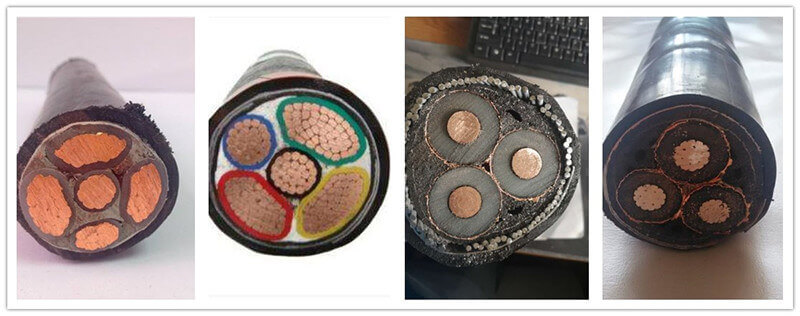
Rule of Thumb for 3+2 Cables: Select a 3+2 cable only when your TN-S earthing design explicitly requires both an internal neutral (N) and a dedicated internal ground conductor (PE) within the same outer sheath. Always specify the exact cross-section of both auxiliary conductors in your RFQ.
A 3+2 power cable contains three main conductors plus two additional conductors. This configuration can be useful where the project requires more than one additional conductor within the same cable assembly.
The critical procurement issue is that “3+2” does not by itself define the function of the two additional conductors.
Depending on the project design, the additional conductors may have different functions. Therefore, the RFQ should explicitly state:
Procurement Warning
Do not assume that the two additional conductors in a 3+2 cable automatically mean “neutral + PE.” Confirm their electrical function from the project drawings or cable specification before comparing supplier quotations.
Rule of Thumb for Neutral Sizing: Never size the neutral conductor based solely on commercial defaults. For linear balanced loads, use 50% phase cross-section (per IEC 60502-1); for high phase imbalance or harmonic currents, specify 100% phase cross-section to avoid neutral overload.
Neutral conductor sizing is one of the most important differences between simply naming a cable configuration and actually engineering the cable.
The required neutral size may depend on:
For this reason, there is no single neutral-conductor percentage that should be applied to every 3+1 cable.
When a supplier quotation gives a reduced neutral cross-section, the purchaser should confirm that the value is consistent with the project design rather than accepting it simply because it is a common commercial configuration.
Rule of Thumb for N vs. PE Conductors: In TN-S systems, neutral (N) and protective earth (PE) conductors perform distinct safety functions and must remain strictly separated. Combining them into a single PEN conductor is only permitted in TN-C systems provided the cross-section meets IEC 60364-5-54 minimums (≥ 10mm² Cu / ≥ 16mm² Al).
A neutral conductor (N) and a protective conductor (PE) perform distinct electrical functions in TN-S systems and must not be interchanged or combined. However, in TN-C systems, a single auxiliary conductor may serve as a combined Protective Earth and Neutral (PEN) conductor, provided it meets the minimum cross-sectional area requirements specified in IEC 60364-5-54 (e.g., ≥ 10mm² Cu or ≥ 16mm² Al).
For a 3+1 or 3+2 cable, the procurement specification should clearly identify whether each additional conductor is intended for:
Where protective conductors are involved, the design should be checked against the applicable earthing and protective-conductor requirements rather than selected solely according to commercial cable configurations.
Changing from a 3 core cable to a 3+1 or 3+2 configuration changes the overall cable construction. It can also affect heat dissipation, conductor arrangement and installation characteristics.
The cable should therefore be checked for:
For cables operating under steady-state conditions, current rating calculations should consider the actual installation arrangement and applicable calculation methods. See our detailed guide:
Power Cable Ampacity: 9 Factors That Change Current Rating Under IEC 60287 →
The cable configuration must also satisfy the required short-circuit withstand during a fault.
For thermal short-circuit verification, a commonly used adiabatic relationship can be expressed as:
Isc × √t ≤ k × S
or:
S ≥ (Isc × √t) / k
Here, Isc is the short-circuit current, t is the fault duration, S is conductor cross-section and k depends on the conductor material, initial and final temperatures and the applicable calculation method.
The system fault current should first be established from the electrical system design. Cable thermal withstand is then checked against the applicable cable and calculation requirements.
Power Cable Short-Circuit Rating: 9 Checks Before Ordering →

A 3+1 or 3+2 configuration can have a different overall diameter and weight from a 3 core cable with the same main conductor size.
This matters during:
The purchaser should request the manufacturer’s actual overall diameter, approximate weight, bending requirements and applicable pulling limitations rather than estimating these values from the conductor cross-section alone.
Underground LV & MV Power Cable Installation Guide →
| Project Requirement | Configuration to Consider | What to Confirm Before Ordering |
|---|---|---|
| Three-phase circuit without an additional insulated conductor requirement | 3 core | Load current, voltage drop, short-circuit rating and installation method |
| Three-phase circuit requiring an additional neutral conductor | 3+1 | Neutral function, neutral cross-section, load balance and harmonic considerations |
| Project requires two additional conductors | 3+2 | Function and cross-section of both additional conductors |
| Underground installation | 3-core / 3+1 / 3+2 depending on design | Burial/duct conditions, thermal environment, armour, sheath and pulling conditions |
| High prospective fault current | Any applicable configuration | Thermal short-circuit withstand of relevant conductors and fault duration |
| Parallel cable circuits | Project-specific | Current sharing, conductor arrangement, spacing and installation conditions |
One of the most common procurement mistakes is comparing supplier quotations based only on the headline configuration and conductor size.
A proper like-for-like comparison should include:
| Specification Item | What Procurement Should Check |
|---|---|
| Voltage | Rated voltage and system requirements |
| Conductor | Copper or aluminium, conductor class and nominal cross-section |
| Configuration | 3 core, 3+1 or 3+2 and the function of every additional conductor |
| Insulation | XLPE, PVC or other specified insulation system |
| Sheath | Material and environmental requirements |
| Armour / Screen | Required type, material and mechanical/electrical function |
| Electrical performance | Ampacity, voltage drop and short-circuit withstand |
| Testing and documents | Applicable type/routine tests, inspection and required documentation |
For conductor selection, you may also want to compare the engineering implications of copper and aluminium:
Copper vs Aluminum Power Cables: 9 Engineering Checks Before You Order →
A complete RFQ allows a cable manufacturer to quote the correct construction instead of making assumptions about the additional conductors.
Include these details where applicable:
If you are specifying a medium-voltage cable, also confirm the required cable voltage class and accessory requirements before finalizing the construction.
How to Select the Right 11kV XLPE Cable: 9 Checks Before You Place an Order →
For projects that require a specific conductor arrangement, the manufacturer should be able to review the complete cable specification rather than quoting only from a generic configuration name.
Huanghe Cable was established in 1980 and manufactures LV and MV power cables and other cable products for project and industrial applications. The company supports customized cable manufacturing according to applicable product and project requirements.
For a 3 core, 3+1 or 3+2 cable inquiry, the technical review can focus on:
Where applicable to the project and product, Huanghe can provide relevant IEC/CB, ISO and CCC credentials and inspection or testing documentation. The exact documents should be confirmed according to the cable type, applicable standard and destination-market requirements.
The key point for procurement is simple: the configuration name should be the starting point of the RFQ, not the complete specification.
Need Help Specifying Your Power Cable?
Not sure whether your project requires a 3 core, 3+1 or 3+2 configuration? Send us your voltage, conductor material, cross-section, additional conductor requirements, installation method and quantity. Huanghe can review the cable configuration before quotation.
A 3 core cable contains three main insulated conductors, while a 3+1 cable contains three main conductors plus an additional conductor. The fourth conductor is commonly used for a neutral function, but its function and size should be confirmed from the project specification.
No. Neutral sizing depends on the electrical system, load characteristics, harmonic currents, protection requirements and applicable design standards. A universal percentage should not be assumed for every project.
3+2 describes a cable with three main conductors plus two additional conductors. The notation does not by itself define the function or cross-section of the two additional conductors, so these details should be stated in the project specification.
That depends on the electrical design and applicable requirements. A neutral conductor and a protective conductor have different functions, so the additional conductor should not be reassigned without checking the project design.
Not necessarily. The number of conductors does not by itself determine cable performance. The correct configuration depends on the circuit design, conductor sizes, insulation system, installation conditions and applicable requirements.
It can affect the thermal characteristics of the cable assembly. Ampacity should therefore be evaluated for the actual cable construction and installation arrangement rather than transferred directly from a different cable configuration.
Not necessarily. Cable dimensions, conductor arrangement, insulation diameter, sheath and armour construction can differ. The actual cable construction should be confirmed before selecting joints, terminations or other accessories.
Provide the rated voltage, conductor material, main conductor cross-section, additional conductor function and size, insulation, sheath, armour or screen requirements, installation method, quantity, applicable standard and required testing or documentation.
Yes, in many industrial and commercial installations, engineers commonly use a 3-core cable (or a 3+1 cable for neutral) paired with a separate external copper earth wire (PE) or utilize the cable’s metallic armour/screen as the protective conductor, provided it satisfies the minimum thermal short-circuit requirement (S ≥ (Isc × √t) / k) specified in IEC 60364-5-54.
A 4-equal-core cable contains four conductors of identical cross-section (100% neutral), making it suitable for high single-phase unbalanced loads and harmonic-rich environments. A 3+1 cable typically features a reduced neutral conductor (~50% cross-section) designed for balanced three-phase systems to save weight and material cost.
Huanghe Cable supports customized cable manufacturing. For a project-specific 3+1 or 3+2 cable, the required conductor functions, cross-sections, voltage class, construction, installation conditions and applicable standards should be provided so the cable can be reviewed and quoted against the actual specification.
The choice between 3 core, 3+1 and 3+2 power cable should be based on the electrical function required by the project, not simply on a commonly used commercial configuration.
A 3 core cable may be appropriate when three phase conductors meet the circuit requirements. A 3+1 configuration can provide an additional conductor where the design requires it, commonly as a neutral. A 3+2 configuration provides two additional conductors but requires the project to clearly define their functions and sizes.
For procurement, the safest approach is to specify the complete cable construction: voltage, conductor material and size, conductor configuration, insulation, sheath, armour or screen, installation conditions, ampacity, short-circuit requirements, applicable standards and required documentation.
That approach makes supplier quotations easier to compare and reduces the risk of receiving cables that match the configuration name but do not match the project’s actual electrical requirements.
Power Cable Ampacity: 9 Factors That Change Current Rating Under IEC 60287
Power Cable Short-Circuit Rating: 9 Checks Before Ordering
Underground LV & MV Power Cable Installation Guide
Copper vs Aluminum Power Cables: 9 Engineering Checks Before You Order
How to Select the Right 11kV XLPE Cable: 9 Checks to Make Before You Place an Order
How to Verify a Power Cable Test Certificate: 10 Checks Before Shipment
How to Specify Underground Armoured Power Cables: 10 Details to Confirm Before Ordering
Need a 3 Core, 3+1 or 3+2 Cable Specification?
Send Huanghe your cable voltage, conductor material, cross-section, additional conductor requirements, installation method and quantity. We can review the configuration and provide a project-specific quotation.

Please contact us for a free quotation by the below form. We promise the quickest response within 12 hours.