Direct Answer:
Chinese cable manufacturers supply 11kV XLPE power cables in different conductor materials, core configurations, metallic screen arrangements, armour constructions and sheath materials. For project procurement, the supplier should be evaluated against the exact cable construction, applicable standard, testing requirements, manufacturing capability and quotation basis rather than the supplier name alone.
If you are searching for 11kV cable manufacturers in China, the important question is not simply which factory can supply an 11kV cable. The more useful question is whether the manufacturer can supply the specific cable construction required by your project, provide the required technical documentation and quote the same design basis as other suppliers.
An inquiry such as “11kV XLPE cable, 3C × 240mm²” may still leave several technical points open. Conductor material, voltage designation, metallic screen, armour, sheath, applicable standard, installation conditions, testing and delivery requirements can all affect the final product and quotation.
This guide explains what buyers should check when sourcing 11kV cable from China, which standards may apply, what information should be included in an RFQ, why quotations can differ and what documents should be requested before placing an order.
Key Takeaways for 11kV Cable Procurement
Quick Technical Definition: 11kV Power Cable
The exact construction depends on the project. A single-core cable and a three-core cable are not interchangeable simply because both may be described commercially as 11kV cable.
| Cable element | What the buyer should confirm |
|---|---|
| Voltage Rating | Exact U0/U (Um) designation (e.g., 6.35/11kV or 8.7/11kV) and network system earthing category |
| Conductor | Copper or aluminium, cross-sectional area and conductor class/construction (e.g., Class 2 stranded) |
| Insulation | XLPE insulation thickness and applicable standard requirements |
| Metallic screen | Copper wire, copper tape or specified combination and required fault-current cross-section |
| Armour | SWA, STA, AWA (for single-core AC) or unarmoured construction according to installation requirements |
| Outer sheath | PVC, PE, LSZH or other project-specified anti-termite / UV-resistant material |
Do not compare manufacturers until you know which cable construction the project actually requires.
A Chinese manufacturer may offer several 11kV XLPE cable constructions. Depending on network design, burial conditions, and protection requirements, buyers can select specialized configurations from our medium voltage XLPE power cable series, including single-core and three-core designs.
| Configuration | Where it may be considered | Procurement point |
|---|---|---|
| Single-core XLPE | Medium-voltage distribution and installations where the project specifies single-core cables | Check phase formation, metallic screen, sheath bonding, and ensure non-magnetic armour (AWA) is specified for AC systems to avoid magnetic losses. |
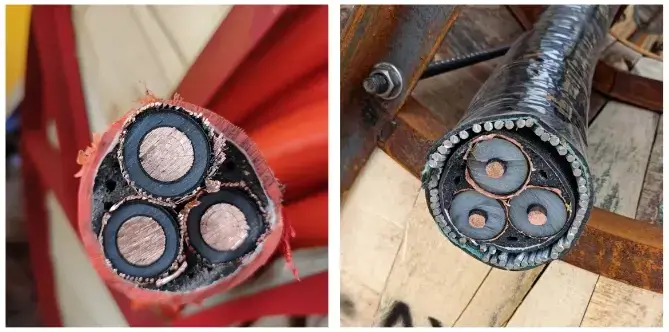
| Three-core XLPE | Distribution and industrial feeders where three-core construction is specified | Confirm conductor arrangement, screen and armour construction. |
| Copper conductor | Projects where copper is specified by design or procurement requirements | Confirm conductor resistance and cross-section against the applicable standard. |
| Aluminium conductor | Distribution projects where aluminium conductor is specified | Compare electrical and installation requirements rather than material price alone. |
| Armoured | Installations requiring specified mechanical protection | Confirm armour material and compatibility with the cable system. |
| Unarmoured | Installations where mechanical protection is provided separately or armour is not specified | Do not assume unarmoured construction is acceptable without checking the installation specification. |
The standard should be written into the RFQ instead of being left as an assumption between buyer and manufacturer.
The primary baseline standard for 11kV cables is IEC 60502-2 (Power cables with extruded insulation for rated voltages from 6 kV up to 30 kV for fixed installations). Because project specifications may reference either the base edition (IEC 60502-2:2014) or subsequent amendments (AMD1:2024 / recent corrigenda), buyers should specify the exact edition required in their RFQ to prevent compliance discrepancies during factory acceptance testing (FAT).
For conductors, IEC 60228:2023 specifies nominal cross-sectional areas, conductor construction and resistance requirements for applicable insulated-cable conductors. It covers copper, aluminium and aluminium-alloy conductors and includes stranded and Milliken conductors within its scope.
For projects following British/Commonwealth engineering specifications, BS 6622 is the primary reference for PVC-sheathed armoured MV cables (rated 3.8/6.6kV up to 19/33kV). Where low-smoke zero-halogen (LSZH) performance is required by the project specification, BS 7835 should be specified instead of BS 6622.
Important procurement note
The presence of a standard on a manufacturer’s website does not automatically mean that every cable construction supplied by that manufacturer complies with every requirement of that standard. The quotation should identify the applicable standard and the exact cable construction being offered.

A good RFQ gives different manufacturers the same technical basis for quotation.
For an 11kV cable purchase, the following information should be included wherever it is already known:
| RFQ item | Information to provide | Why it matters |
|---|---|---|
| Voltage rating | Required U0/U (Um) designation (e.g., 6.35/11 (12) kV) and system earthing condition | Defines insulation thickness, design standard compliance, and cost basis |
| Conductor | Copper or aluminium; cross-section (mm²) and conductor shape/flexibility | Directly affects electrical performance, continuous ampacity, and cable weight |
| Core configuration | Single-core or three-core | Changes cable construction, armour type, installation spacing, and accessories |
| Metallic screen | Copper tape, copper wire screen, and required cross-section (e.g., 12mm², 35mm²) | Critical for earth fault current withstand capacity and earthing system safety |
| Armour | SWA (Steel Wire), STA (Steel Tape), AWA (Aluminium Wire for single-core AC), or Unarmoured | Determines mechanical protection class and prevents magnetic loss issues |
| Outer sheath | PVC, PE, LSZH or project-specified material (e.g., flame retardant, UV resistant) | Affects environmental, fire safety, and mechanical installation suitability |
| Quantity | Required cable length per drum and total BOQ quantity | Required for a meaningful commercial quotation and logisitics planning |
| Testing | Routine, sample, type test reports (e.g., KEMA/CESI) or third-party inspection requirements | Prevents different testing scopes and qualification costs from being compared as equal |
| Delivery | Destination port, shipping terms (FOB/CIF), and wooden/steel drum requirements | Allows the supplier to quote the exact commercial and packaging scope |
If some information is not available, say so in the inquiry rather than allowing each supplier to make a different assumption. This is especially important for conductor size, metallic screen, armour and testing requirements.
Continuous current-carrying capacity (ampacity) is only one of several mandatory design criteria for medium-voltage cable sizing.
For a balanced three-phase system, the full-load operating current is calculated as:
I = P / (√3 × U × cosφ)
(Where I is line current in Amperes, P is active power in Watts, U is nominal line-to-line voltage in Volts (11,000V), and cosφ is the power factor, typically 0.8–0.85 for medium-voltage industrial loads).
This load-current calculation provides only the initial starting point. In practical MV engineering projects, selecting a cable cross-section based solely on ampacity can result in premature cable breakdown or failure during power system fault conditions. The overall selection must be verified against four critical factors:
Procurement Advice: Always state both the continuous load current requirement and the system short-circuit rating (kA and duration in seconds) in your RFQ. This allows the cable manufacturer’s engineering team to verify whether the specified conductor and copper screen cross-sections comply with IEC 60502-2 short-circuit thermal limit calculations.
Send your cable specification or BOQ list to our engineering desk. We provide technical data sheets (TDS) and competitive pricing within 12 hours.
Compare quotations against the same cable construction before comparing the unit price.
Two suppliers can both quote “11kV XLPE cable” while offering different constructions. One quotation may include copper conductor and a particular metallic screen, while another may use aluminium conductor or a different armour and sheath arrangement.
The following comparison method is more useful than comparing the headline price alone:
| Comparison Point | Manufacturer A | Manufacturer B | Evaluation Question |
|---|---|---|---|
| Voltage rating | Quoted value | Quoted value | Are both based on the same U0/U (Um) requirement? |
| Conductor | Cu / Al and size | Cu / Al and size | Same material, cross-section and conductor class? |
| Metallic Screen | Tape/Wire & Area (mm²) | Tape/Wire & Area (mm²) | Same fault-current withstand capacity (copper weight)? |
| Armour | Type (SWA/STA/AWA) | Type (SWA/STA/AWA) | Same mechanical protection and non-magnetic material for single-core AC? |
| Testing | Included tests | Included tests | Same testing scope (Routine, Sample & Type Tests)? |
| Commercial basis | Price / delivery terms | Price / delivery terms | Same length per drum, packing specification and Incoterms? |
A lower quotation is not necessarily a lower manufacturing cost. It may simply be based on a different cable construction, different testing scope or different commercial terms.
The documents should allow the buyer to verify what has actually been quoted and tested.
| Document / information | Purpose |
|---|---|
| Technical datasheet | Confirms cable construction, voltage rating and main technical parameters |
| Applicable standard | Identifies the technical basis used for design and testing |
| Type-test documentation | Supports verification of the applicable cable design where required by the project |
| Routine test report | Documents production testing for the relevant cable |
| Third-party inspection documentation | Provides independent inspection where required or agreed |
| Packing and drum information | Supports transport, receiving and installation planning |
Not every project requires every document listed above. The buyer should define the required documentation in the RFQ or purchase specification rather than assuming that every manufacturer includes the same package.
The most useful supplier check is whether the manufacturer can connect the quotation to a clearly defined cable design and production process.
The cable construction—not only the copper or aluminium price—determines a significant part of the quotation basis.
When buyers receive different prices for what appears to be the same 11kV cable, the first step should be a technical comparison.
The quotation may differ because of:
For this reason, a procurement team should avoid asking several suppliers only for a “price per meter of 11kV cable.” A better approach is to issue the same technical specification and ask each manufacturer to identify any deviation from it.
Procurement rule: If two quotations cannot be matched line by line against the same cable construction, the prices are not yet directly comparable.
Fix the technical basis first, then move through quotation, clarification, inspection and production.
For international buyers, the process becomes easier when the supplier receives the existing project datasheet, BOQ, cable schedule or technical specification instead of a short product name only.
If the project already has an approved cable specification, send that document to the manufacturer and ask the supplier to confirm compliance or list deviations. This reduces the possibility of different manufacturers interpreting the same inquiry differently.

For Huanghe, the focus is on matching the cable construction to the customer’s technical requirement rather than using a generic “one-size-fits-all” 11kV description.
Huanghe Cable has been engaged in cable manufacturing since 1980. Its product range includes low- and medium-voltage power cables, control cables, rubber cables, photovoltaic cables, overhead cables and building wires.
For medium-voltage XLPE power cables, Huanghe lists copper and aluminium conductor options, single-core and three-core configurations, metallic screen options and different armour constructions including steel tape (STA), steel wire (SWA) and aluminium wire armour (AWA for single-core AC circuits), depending on the cable design and project requirement.
Huanghe states that its cables are manufactured according to applicable IEC requirements and provides IEC/CB-related certification together with ISO and CCC qualifications. Third-party inspection arrangements, including SGS inspection, can also be discussed when required by the project.
For international EPC contractors and utility procurement directors evaluating suppliers, learn more about our manufacturing facilities, test equipment, and international project references on our Who We Are page or contact our technical engineering desk directly for RFQ evaluations.
Useful information to send Huanghe for an 11kV quotation
Send us your 11kV cable specifications or BOQ list. Our senior cable engineering team will review your voltage rating, conductor cross-section, short-circuit withstand levels, and specialized sheath requirements to provide a full technical data sheet (TDS) and competitive factory-direct quote.
*We support custom drum lengths, third-party FAT inspections (SGS/BV/Intertek), and OEM manufacturing for global EPC contractors.
Before comparing the final quotations, make sure the following technical points have been answered.
| Question | Confirmed? |
|---|---|
| Is the required voltage designation clearly stated? | □ |
| Is conductor material and cross-section confirmed? | □ |
| Is single-core or three-core construction confirmed? | □ |
| Is the metallic screen construction defined? | □ |
| Is armour construction defined where required? | □ |
| Is the outer sheath specified? | □ |
| Is the applicable standard and edition identified? | □ |
| Are testing and inspection requirements clear? | □ |
| Are quantity, drum and delivery requirements clear? | □ |
| Are all suppliers quoting against the same technical basis? | □ |
A complete 11kV RFQ should specify the rated voltage designation (U0/U e.g., 6.35/11kV or 8.7/11kV), conductor material and cross-section (mm²), core configuration (1C or 3C), metallic screen fault-current rating (mm²), armour type (SWA/STA/AWA), outer sheath compound, applicable standard (e.g., IEC 60502-2), and total drum lengths.
Steel wire is a magnetic material. In single-core AC circuits, the alternating magnetic field induces severe magnetic hysteresis and eddy current losses in steel armour, causing dangerous cable overheating and premature insulation failure. Non-magnetic aluminium wire (AWA) eliminates these losses.
Buyers should request a detailed Technical Data Sheet (TDS), structural cross-sectional drawing, routine/sample test plan per IEC 60502-2, independent type test reports (e.g., KEMA/TUV/CESI where applicable), and ISO 9001/14001 quality certificates.
Standard manufacturing lead times usually range between 15 and 25 days, depending on conductor cross-section, total BOQ length, specialized outer sheath requirements (such as anti-termite or LSZH), and factory acceptance testing (FAT) schedules.
Need an 11kV Cable Quotation?
Send your existing cable specification, BOQ, datasheet or basic project requirements. If some technical information is not yet finalized, you can still send the available details. Huanghe Cable can review the requested cable construction and confirm the information needed for quotation.
Huanghe Cable · Cable manufacturing since 1980 · sales@huanghecables.com

Please contact us for a free quotation by the below form. We promise the quickest response within 12 hours.